Last Updated: October 9, 2026
- Top Biological Filter Media
- The Nitrogen Cycle: Why Biological Media Exists
- Surface Area: The Only Metric That Matters
- Biological Media Types Compared
- Flow Rate Through Biological Media
- Biological Media in Planted Tanks and Reef Systems
- How to Clean Biological Media Without Crashing Your Cycle
- Frequently Asked Questions
- Related Articles
- Related Guides
- Top Pick: LLTGMV 10 Pcs Aquarium Filter Media Bags – Reusable Mesh Bags (6" x 4") for Fish Tank Filters
- Best Value: AQUANEAT Aquarium Filter Media Bags 6pcs Fish Tank Extra Fine 100 Micron Mesh Bags with Plastic Zipper for Activated Carbon (3” x 4”)
- Premium Choice: Sukh Ceramic Rings for Aquarium Filter – 15oz Bio Filter Media with 3 Bags

TL;DR: Aquarium biological media is the physical substrate where nitrifying and denitrifying bacteria colonize to process ammonia and nitrite. Surface area per liter, flow-through design, and media longevity determine filter performance far more than brand marketing. This guide explains the chemistry, compares media types, and identifies the best options for freshwater, planted, and marine setups.
Best Aquarium Biological Media for Filters: Surface Area, Bacteria, and Water Chemistry
Everything that comes out of your fish — ammonia, CO₂, dissolved organics — passes through a biological filter before it has any chance of being harmless. The filter housing and pump matter less than the material inside: aquarium biological media is the substrate on which nitrifying bacteria establish colonies, and its surface area, porosity, and flow characteristics determine how much biological load your filtration can actually process.
As an Amazon Associate we earn from qualifying purchases at no extra cost to you.



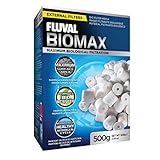

This guide covers the nitrogen cycle chemistry that biological media enables, how to evaluate media by surface area and design, and which products perform reliably in freshwater, planted, and marine systems.
🛒 Best Price Today on Amazon
Prime members get fast, free shipping on everything above, plus member-only deals. New members get a 30-day free trial — cancel anytime.
Start 30-Day Prime Free Trial →See Today’s Amazon DealsTop Biological Filter Media



As an Amazon Associate we earn from qualifying purchases. Product prices and availability are accurate as of the date/time indicated.


As an Amazon Associate we earn from qualifying purchases. Product prices and availability are accurate as of the date/time indicated.



As an Amazon Associate we earn from qualifying purchases. Product prices and availability are accurate as of the date/time indicated.
The Nitrogen Cycle: Why Biological Media Exists
Fish excrete ammonia (NH₃/NH₄⁺) continuously through gill diffusion and urine. At pH 7.5 and 25 °C, the toxic NH₃ fraction is roughly 5–8% of total ammonia nitrogen (TAN) — still lethal at concentrations above 0.05 mg/L NH₃. The biological filter converts this through two sequential oxidation steps:
Step 1 — Ammonia oxidation: Nitrosomonas and related genera convert NH₃ → NO₂⁻ (nitrite). Nitrite is also toxic, with an LC50 for most freshwater fish around 5–10 mg/L, and marine fish are considerably more sensitive. Step 2 — Nitrite oxidation: Nitrospira and Nitrobacter convert NO₂⁻ → NO₃⁻ (nitrate). Nitrate is relatively inert below 40 mg/L for most species and is removed through water changes or plant uptake.
Both bacterial genera are obligate aerobes — they require dissolved oxygen to function. Biological media must allow aerobic water flow through its entire volume. Porous media that develops anaerobic cores (from clogging) can shift to denitrification chemistry, producing N₂ gas and occasionally hydrogen sulfide in low-DO zones. For the full cycle sequence, see our tank cycling and nitrogen cycle guide.
Surface Area: The Only Metric That Matters
Bacterial colonization is a surface phenomenon — bacteria attach to media surfaces, not the water column. More surface area per unit volume means more bacteria, which means higher processing capacity. Media manufacturers measure this in m² per liter (surface area density).
Ceramic rings (sintered ceramic, bioceramic) typically provide 200–400 m²/L. Plastic biological media (Kaldnes K1, K3 moving bed variants) achieves 500–800 m²/L in moving bed reactor (MBBR) applications. Sintered glass media (Seachem Matrix, similar products) claims up to 700 m²/L with macro and micro porous structure — though independent measurement often yields 300–500 m²/L effective colonized area under real flow conditions.
The practical implication: a liter of high-surface-area sintered glass outperforms three liters of basic ceramic rings. For tanks with heavy bioload — heavily stocked community tanks, goldfish systems, or active carnivore marine setups — premium biological media pays for itself in reduced crash risk. For a baseline comparison, check how biological media integrates into a complete filtration system in our Fluval 207 canister filter review.
Biological Media Types Compared
| Media Type | Surface Area | Flow Behavior | Lifespan | Best Use Case |
|---|---|---|---|---|
| Ceramic Rings | 200–400 m²/L | Static; channeling risk | 3–5 years | Budget freshwater setups |
| Sintered Glass (Matrix) | 300–700 m²/L | Static; high porosity | Indefinite | High bioload, canister filters |
| Plastic Bio-Balls | 100–200 m²/L | Static; excellent gas exchange | Indefinite | Sump wet-dry; not submerged |
| K1/K3 Moving Bed | 500–800 m²/L (active) | Suspended; self-cleaning | Indefinite | MBBR sumps, high-volume systems |
| Sponge Media | 150–250 m²/L | Static; traps detritus | 1–2 years | Breeding tanks, nano systems |
| Lava Rock | 400–600 m²/L (variable) | Static; inconsistent | Indefinite | Budget DIY sumps |
Flow Rate Through Biological Media
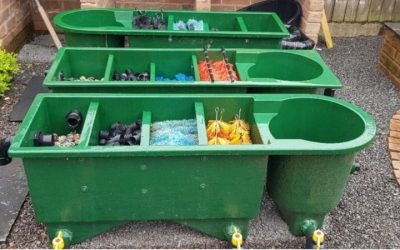
Surface area only delivers its potential when water actually contacts colonized surfaces at an appropriate velocity. Too fast — water channels through the path of least resistance, bypassing 60–80% of the media. Too slow — DO is depleted before reaching inner media surfaces, creating the anaerobic conditions that kill aerobic bacteria.
For static biological media in a canister filter, the target flow rate through the bio chamber is typically 100–200 L/hour per liter of media. Check manufacturer specs — this is rarely listed but matters significantly for multi-stage canister configurations. If you’re running biological media in a sump, ensure the return pump provides adequate turnover without short-circuiting the bio chamber. See our powerhead and flow guide for pump sizing methodology.
Biological Media in Planted Tanks and Reef Systems
In high-tech planted tanks, healthy plant mass directly competes with Nitrosomonas for ammonia — plants assimilate NH₄⁺ preferentially over NO₃⁻ when both are available. This means biological filtration capacity requirements are lower in a well-planted system, but not zero: during low-light periods, nighttime, or high-fish-density phases, bacterial processing provides the safety margin. Do not reduce biological media volume in planted tanks — the redundancy is valuable. Review the planted tank substrate guide for how substrate layer depth affects benthic bacterial colonies, which supplement in-filter biological media significantly.
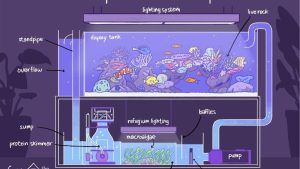
In marine and reef systems, biological filtration interacts with protein skimming and live rock in ways that demand careful balancing. Live rock in a mature reef provides substantial biological surface area — a 50 kg rock structure in a 200-gallon system may provide equivalent or greater biological filtration than 2–3 liters of premium synthetic media. Adding excessive biological media to an established reef can create competing bacterial populations and disrupt denitrification pathways in anaerobic rock cores. Use supplemental biological media in reef sumps rather than display-side, and ensure your protein skimmer handles dissolved organic removal before it reaches the bio chamber. For saltwater system baseline parameters, see our saltwater vs. freshwater comparison guide.
How to Clean Biological Media Without Crashing Your Cycle
The single most common cause of a post-maintenance ammonia spike is cleaning biological media in tap water. Chloramine and chlorine in municipal water kill bacterial colonies within minutes. Always rinse biological media in old tank water removed during a water change — never tap water, even dechlorinated tap water that may still contain chloramine residues.
Stagger media cleaning: never clean all biological media at the same time. In a multi-stage canister, clean one chamber per month, rotating through. This preserves 66–75% of bacterial mass at any point, allowing rapid recolonization of cleaned media from the intact sections. After any biological media disturbance, test ammonia and nitrite daily for one week to catch any cycle disruption early. Use a reliable water test kit — liquid reagent tests are significantly more accurate than strip tests for detecting sub-0.25 mg/L ammonia readings that early-cycle issues produce.
Frequently Asked Questions
How much biological media do I need per gallon of water?
As a baseline: 1 liter of high-quality sintered glass or ceramic biological media per 50–75 gallons of water for a moderately stocked freshwater system. Heavily stocked tanks (cichlids, goldfish, predatory fish) need 1 liter per 25–40 gallons. Marine systems with live rock can reduce synthetic media volume by 40–50%. The correct benchmark is ammonia consistently at zero with NO₂⁻ below 0.1 mg/L under full bioload — not a volume formula. Scale up if you cannot achieve this baseline.
Can I add new biological media to an existing filter without cycling?
Yes — new media added alongside established media seeds quickly from the existing bacterial population, typically colonizing to functional capacity within 7–14 days under active bioload. The existing media maintains ammonia processing during colonization. This is also the correct method for upgrading biological media: add new media alongside old for 2–3 weeks, then remove old media in stages. Never do a complete swap of all biological media at once in an established tank.
Does biological media need to be replaced, or does it last forever?
High-quality sintered glass and plastic biological media (K1, K3, bio-balls) last indefinitely — the substrate itself does not degrade. Basic ceramic rings, however, have micro-pores that collapse over 3–5 years as calcium deposits fill internal channels, reducing effective surface area. Check ceramic media by visual inspection: whitening and opacity suggest calcium fouling. Soak in dilute white vinegar (1:10) overnight to partially restore porosity, or replace on a 3-year rotation. Sintered glass media should last the lifetime of the aquarium if cleaned correctly.
What is the difference between biological, mechanical, and chemical filtration?
The three stages have distinct functions: mechanical filtration physically removes suspended particles (detritus, uneaten food, algae fragments) through foam, filter floss, or mesh. Biological filtration converts dissolved toxic compounds (ammonia, nitrite) through bacterial metabolism. Chemical filtration adsorbs dissolved compounds (tannins, medications, trace organic molecules) through activated carbon, zeolite, or GFO (granular ferric oxide for phosphate in reef tanks). Biological filtration is the most critical of the three — mechanical failure means cloudy water, biological failure means dead fish. A complete canister setup sequences all three stages in order: mechanical first (protects biological media from clogging), biological second, chemical last.
Why is my biological filtration failing even with adequate media volume?
Five common causes: (1) Oxygen depletion — biological media packed too tightly or flow too slow, creating anaerobic conditions. Check filter flow rate against media volume. (2) Temperature shock — bacterial populations crash below 10 °C or above 35 °C; check heater calibration with a secondary thermometer. See our aquarium heater guide for reliable heater models. (3) pH extremes — nitrification slows dramatically below pH 6.5 and above 8.5; planted tanks with CO₂ injection can push pH below 6.5 at peak injection. Check our CO₂ system guide for pH buffering during CO₂ injection. (4) Medication residue — many antibiotics and antifungals are bactericidal; run activated carbon for 48–72 hours after any medication course to remove residues before the biological filter recovers. (5) Chloramine exposure — water changes with insufficiently dechlorinated tap water. Use a dechlorinator that specifically neutralizes chloramine (sodium thiosulfate alone does not).
Ready to decide? Our #1 pick for 2026 is the Ceramic Rings.
Live price & availability on Amazon.
Related Reviews & Guides
What Size Dosing Pump Do You Need: Top Expert Sizing Guide
Best Probes and Calibration Kit for an Aquarium Controller