Last Updated: October 4, 2026
- Top Pick: Inkbird Aquarium Heater with Probe Thermostat Fish Ornamental Shrimp Reef Tanks 24 Hours Double Time with Day Night Automatic Temperature Controller
- Best Value: Inkbird ITC308S Temperature Controller for Aquarium with Submersible Probe, Heating Cooling Outlets Thermostat for Heater and Cooling Fans
- Premium Choice: Inkbird ITC-308S Aquarium Heating and Cooling Dual Stage Temperature Controller Freshwater Saltwater Aquarium Tropical Fish Ornamental Shrimp
 Aquarium Heater Temperature Controller” style=”max-width:100%;height:auto;margin-bottom:1rem” loading=”lazy”>
TL;DR: The Inkbird ITC-306A turns any basic aquarium heater into a precision temperature controller — it cuts power to the heater the moment your target temperature is reached, preventing the thermal overshoot that kills fish and corals. A must-have for discus, reef, and sensitive tropical setups where ±0.5°F stability matters. Best pick: ASIN B07WGS5JV1.
Inkbird Aquarium Heater & Temperature Controller Review 2026
Every aquarium heater has an internal thermostat — and every internal thermostat has a tolerance range. Budget heaters can swing ±3–5°F above the set point before cutting off; even quality heaters drift ±1–2°F over time as bimetallic thermostat strips fatigue. For most tropical fish, this variability is manageable. For discus (requiring a tight 82–86°F window), reef tanks (where a spike past 84°F bleaches coral), or shrimp breeding setups (where temperature swings stress molting), that margin is unacceptable. The Inkbird ITC-306A solves this with an external probe-based controller that takes over heater power management from the heater’s own internal thermostat — delivering ±0.5°F accuracy regardless of which heater you pair it with.
As an Amazon Associate we earn from qualifying purchases at no extra cost to you.




🛒 Best Price Today on Amazon
Prime members get fast, free shipping on everything above, plus member-only deals. New members get a 30-day free trial — cancel anytime.
Start 30-Day Prime Free Trial →See Today’s Amazon DealsHow the Inkbird Temperature Controller Works
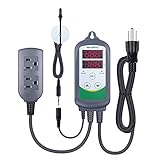
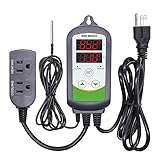
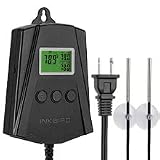
The ITC-306A is a pass-through power controller. Your heater plugs into the Inkbird’s outlet socket; the Inkbird’s probe hangs in the tank water. When the probe reads below your target temperature, Inkbird supplies power to the heater. When the probe reaches target, Inkbird cuts power — bypassing the heater’s internal thermostat entirely. This external control loop is dramatically more accurate because the probe sits in the water column where it matters, not inside the heater body where thermal lag and heating element proximity skew readings.
- Heating and cooling outlets: The ITC-306A has two controlled outlets — one for heating (your aquarium heater), one for cooling (a fan, chiller, or pump). Both activate based on the same probe reading, making it a full temperature management hub.
- High/low temperature alarms: Audible and visual alerts trigger if temperature exceeds your set safety range — critical early warning for heater stuck-on failures, which are the most common heater failure mode and can cook a tank within hours.
- Calibration offset: If your probe reads slightly off a reference thermometer, you can input a calibration offset of ±9.9°F to correct it — useful for verifying accuracy in breeding and reef applications.
Top Pick: Inkbird Temperature Controller
BEST OVERALL
Inkbird ITC-306A Digital Aquarium Temperature Controller
BEST DUAL-PROBE
Inkbird ITC-308 WiFi Temperature Controller
BEST BUDGET HEATER TO PAIR
Eheim Jager Adjustable Submersible Aquarium Heater
Inkbird ITC-306A vs ITC-308 WiFi: Spec Comparison
| Spec | ITC-306A | ITC-308 WiFi |
|---|---|---|
| Temperature accuracy | ±0.5°F (±0.3°C) | ±0.5°F (±0.3°C) |
| Display | LCD digital | LCD digital |
| WiFi / app control | No | Yes (Inkbird Pro app) |
| Heating outlet load | Up to 1200W | Up to 1200W |
| Cooling outlet load | Up to 1200W | Up to 1200W |
| Temperature alarm | Yes (audible + visual) | Yes + push notification |
| Calibration offset | ±9.9°F | ±9.9°F |
| Probe type | Waterproof NTC | Waterproof NTC |
| Best for | Single-tank precision control | Remote monitoring + control |
Setting Up the Inkbird with Your Aquarium Heater
Setup takes under 10 minutes. Plug your aquarium heater into the Inkbird’s heating outlet. Set the heater’s internal dial to maximum (or 2–3°F above your target temperature) — this ensures the heater’s internal thermostat never cuts power before the Inkbird does; the Inkbird becomes the sole arbiter. Hang or suction-cup the probe mid-water-column, away from the heater body and filter outlet (avoid measuring the temperature of the heater itself or the cold filter return — you want representative tank temperature). Set your target temperature and differential (±0.5°F is appropriate for sensitive livestock; ±1°F reduces heater cycling frequency for hardy species).
For reef tanks or discus setups, pair the Inkbird with a quality heater that has a reliable stuck-off failure mode rather than stuck-on — a heater that fails by turning off is survivable; one that fails stuck-on cooks the tank. The Eheim Jager has a well-documented record of failing safely. For complete heater selection across tank sizes, see our betta heater guide and our top 5 heaters comparison for accuracy benchmarks across brands.
Frequently Asked Questions
Does the Inkbird ITC-306A work with any aquarium heater?
Yes — it is heater-agnostic. Any heater that plugs into a standard US outlet and draws under 1200W (virtually all aquarium heaters up to 500W) works with the ITC-306A. Set the heater’s dial to maximum after plugging in; the Inkbird handles all on/off cycling from that point. The controller does not communicate with the heater electronically — it simply controls power delivery, making it universally compatible.
Is the Inkbird temperature controller accurate enough for discus or reef tanks?
±0.5°F (±0.3°C) accuracy is sufficient for discus (82–86°F target window = 4°F tolerance) and for most reef applications (target 76–78°F, critical threshold around 84°F). The Inkbird’s probe-based control eliminates the thermal overshoot that is the primary risk in both setups. For ultra-sensitive SPS coral reef tanks where ±0.2°C matters, dedicated aquarium controllers (Neptune Apex, GHL) offer tighter integration with additional sensor inputs — but at 5–10x the price. The ITC-308 WiFi adds remote monitoring via smartphone, which is valuable for reef tanks where catching a heater failure early can save thousands in coral.
What is the differential setting on the Inkbird and how should I set it?
The differential (also called hysteresis) is the temperature swing allowed before the Inkbird triggers on or off. At a differential of 0.5°F with a 78°F target: heater turns on at 77.5°F, turns off at 78.5°F. Narrower differentials (0.3°F) give tighter temperature but cycle the heater on and off more frequently — this can reduce heater lifespan over years. For most applications, 0.5–1.0°F differential is the sweet spot between accuracy and longevity.
Can I use the Inkbird cooling outlet for an aquarium chiller?
Yes. The cooling outlet activates when temperature exceeds your target by the differential amount. Plug an aquarium chiller, cooling fan, or even a small power head directing surface evaporation into the cooling outlet. For planted tank setups in hot climates where summer temperature spikes above 82°F stress plants and fish, using both outlets — heater for winter, fan/chiller for summer — makes the Inkbird a year-round temperature management solution from a single device. See our aquarium chiller guide for compatible chiller options by tank size.
What happens if the Inkbird probe fails or gives a wrong reading?
The ITC-306A displays an error code (E1 or E2) and cuts power to both outlets if the probe reading falls outside a plausible range or the probe connection fails. This fail-safe behavior is critical — a stuck-on failure without the alarm would cook the tank. Verify probe accuracy weekly with a calibrated reference thermometer (the Zacro digital thermometer is a reliable, inexpensive reference) and recalibrate the offset if needed. Keep a spare probe on hand — they are inexpensive and failure without a spare means several hours of uncontrolled temperature.
Ready to decide? Our #1 pick for 2026 is the Temperature accuracy.
Live price & availability on Amazon.
Related Reviews & Guides


Best Hang on Back Aquarium Filter Quiet: Smart Easy Picks
Best Return Pump for Aquarium Sump: Compared by Numbers