Last Updated: October 4, 2026
- Top Canister Hob Sponge Filter Which Picks for 2026
- Why Filtration Matters
- Canister Filters: Power for Larger Tanks
- Hang-On-Back (HOB) Filters: The Easy All-Rounder
- Sponge Filters: Gentle and Budget-Friendly
- Side-by-Side Comparison
- Which Filter Should You Choose?
- Frequently Asked Questions
- Related Articles
- Related Guides
🛒 Best Price Today on Amazon
Prime members get fast, free shipping on everything above, plus member-only deals. New members get a 30-day free trial — cancel anytime.
Top Canister Hob Sponge Filter Which Picks for 2026
Here are our current top canister hob sponge filter which picks, compared on real Amazon owner reviews, price, and features. Live prices update below.
As an Amazon Associate we earn from qualifying purchases at no extra cost to you.





Choosing a filter is one of the most important decisions you will make for your aquarium, because filtration is what keeps water clean, clear, and safe for fish. Yet beginners are often overwhelmed by the three most common types: canister filters, hang-on-back (HOB) filters, and sponge filters. Each excels in different situations, and the “best” choice depends entirely on your tank size, livestock, and budget. This guide breaks down how each type works, compares them side by side, and gives clear use-case recommendations so you can pick the right filter the first time instead of replacing it later.
Why Filtration Matters
A filter does three jobs. Mechanical filtration traps physical debris like uneaten food and waste. Biological filtration houses the beneficial bacteria that convert toxic ammonia into nitrite and then nitrate, the heart of a healthy tank. Chemical filtration, when used, removes dissolved impurities with media like activated carbon. The right filter provides enough of all three for your stocking level while creating appropriate water flow. If you are setting up a new system, our complete fish tank setup guide explains where filtration fits in the bigger picture.
Canister Filters: Power for Larger Tanks
A canister filter is a sealed external unit that sits below the tank in the cabinet. Water is pumped down through intake tubing, forced through large volumes of media inside the canister, and returned to the tank. Because canisters hold so much media, they offer the highest biological and mechanical capacity of the three types.
Strengths
- High capacity ideal for large and heavily stocked tanks.
- Quiet operation since the motor is enclosed and external.
- Customizable media with multiple baskets for mechanical, biological, and chemical layers.
- Less visible equipment inside the tank, a plus for aquascaping.
Trade-offs
- Higher cost than other types.
- More involved maintenance, requiring disconnection and opening to clean.
- Overkill for small tanks, where flow can be too strong.
Canisters shine on tanks of roughly 40 gallons and up, planted aquascapes, and big-fish setups. If you keep large or messy species like those in our Oscar fish care guide or a 55-gallon community, a canister is usually the right call.
Hang-On-Back (HOB) Filters: The Easy All-Rounder
HOB filters hang on the rim of the tank, drawing water up through an intake tube and returning it over a waterfall-style outflow. They are the most popular choice for beginners and mid-size community tanks because they balance performance, price, and convenience.
Strengths
- Easy to install and maintain, with cartridges or media that swap out quickly.
- Affordable and widely available.
- Good surface agitation from the waterfall return, boosting oxygen exchange.
- Suitable for most community tanks from about 10 to 55 gallons.
Trade-offs
- Less media volume than a canister, so less suited to very heavy stocking.
- Visible on the tank rim, which some aquascapers dislike.
- Cartridge-based models can tempt you to toss biological media; keep some media to preserve bacteria.
For most beginners with a community tank, an HOB is the sweet spot. Our best filters for a 20-gallon tank roundup leans heavily on quality HOB options, and the 20-gallon setup guide shows how one fits a typical community build.
Sponge Filters: Gentle and Budget-Friendly
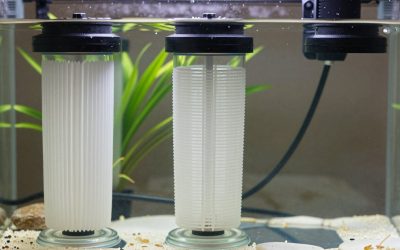
A sponge filter is a simple foam block driven by an air pump. Rising air bubbles pull water through the sponge, which provides both mechanical filtration and a large surface for beneficial bacteria. There is no impeller and no strong intake current.
Strengths
- Very gentle flow, perfect for fry, shrimp, and long-finned fish like bettas.
- No risk of sucking up small creatures, unlike powered intakes.
- Inexpensive and extremely cheap to run.
- Ideal for quarantine and hospital tanks where simplicity matters.
Trade-offs
- Limited mechanical polishing; water may look slightly less crystal-clear.
- Requires an air pump and airline, adding a small amount of hum.
- Lower capacity, not ideal as the sole filter on large, heavily stocked tanks.
Sponge filters are the go-to for shrimp tanks, breeding setups, betta tanks, and quarantine. They also pair well as a secondary biological filter in larger systems.
Side-by-Side Comparison
| Feature | Canister | HOB | Sponge |
|---|---|---|---|
| Filtration capacity | Highest | Medium | Low to medium |
| Best tank size | 40+ gallons | 10-55 gallons | Nano to 40 gallons |
| Relative cost | Highest | Moderate | Lowest |
| Flow strength | Strong (adjustable) | Moderate | Very gentle |
| Noise | Very quiet | Quiet (waterfall) | Air pump hum |
| Maintenance ease | More involved | Easy | Very easy |
| Best for | Large/planted/big-fish tanks | Most community tanks | Fry, shrimp, betta, quarantine |
Which Filter Should You Choose?
Match the filter to your situation rather than chasing the “most powerful” option:
- Beginner with a 10-40 gallon community tank: an HOB is the easiest, most affordable all-rounder.
- Large tank, planted aquascape, or big messy fish: a canister gives the capacity and quiet flow you need.
- Shrimp, fry, bettas, or a quarantine tank: a sponge filter protects delicate livestock with gentle flow.
- Heavily stocked tank: consider running two filters, such as a canister plus a sponge, for redundancy and extra biological media.
Whichever you choose, size the filter for your tank or slightly above, and never let strong flow exhaust your fish. For broader equipment context, see our aquarium brands comparison and pair your filter with a properly sized aquarium heater for a stable, healthy environment.
Frequently Asked Questions
Can I use a sponge filter as my only filter?
On small, lightly stocked tanks, shrimp tanks, and quarantine setups, yes. On larger or heavily stocked community tanks, a sponge filter is best used as a supplement to an HOB or canister rather than the sole filter.
Is a canister filter worth it for a beginner?
For tanks under about 40 gallons, an HOB is usually the better starting point because it is cheaper and simpler to maintain. Canisters become worthwhile on larger tanks, planted aquascapes, or setups with big, messy fish.
How often should I clean my filter?
Rinse mechanical media every few weeks when flow drops, and always rinse it in old tank water, never tap water, to protect the beneficial bacteria. Avoid replacing all media at once, which can crash your biological filtration.
Will a stronger filter hurt my fish?
Excessive flow can exhaust fish, especially bettas and other slow swimmers. Choose a filter sized appropriately for your tank, and use flow controls, spray bars, or baffles to soften the current if fish struggle.
Do I still need water changes if I have a good filter?
Yes. Filters convert ammonia to nitrate but do not remove nitrate, which still builds up. Regular partial water changes remain essential. Our water testing guide helps you track when a change is due.
Related Reviews & Guides
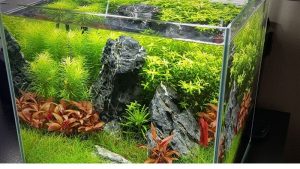
Best Quiet Pond Aerator: Top Smart Shortlist for Beginners
How to Choose an Aquarium Overflow Box: Practical Guide