Last Updated: October 4, 2026
- Top Pick: hygger Small Aquarium Betta Heater, Submersible Fish Tank Heater 10W/25W/50W/100W with LED Digital Display, Suitable for Marine Saltwater and Freshwater up to 5/10/16/26 Gallon
- Best Value: Novique 50W Aquarium Heater Adjustable Temperature Submersible Fish Tank Heater Water Thermostat with Thermometer for Freshwater and Saltwater Tanks
- Premium Choice: Pawfly 12 Pack Aquarium Heater Suction Cups Suckers with 0.95 Inch Clips Black Standard Heating Rod Holders Clamps for Fish Tanks (Not for Airline Tubing), 1.3 Inch
🛒 Best Price Today on Amazon
Prime members get fast, free shipping on everything above, plus member-only deals. New members get a 30-day free trial — cancel anytime.
Why Every Tropical Tank Needs a Quality Heater
Most popular freshwater and saltwater aquarium fish are tropical species requiring water temperatures between 72–82°F. Without a heater, room temperature fluctuations cause stress, disease, and death in tropical fish. Sudden temperature swings of even 2–3 degrees can trigger ich and other stress-related illnesses. A reliable aquarium heater maintains a stable, species-appropriate temperature around the clock — it is non-negotiable equipment for any tropical setup.
As an Amazon Associate we earn from qualifying purchases at no extra cost to you.


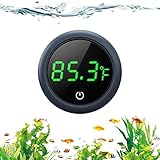


Heaters are rated by wattage. A common rule of thumb is 5 watts per gallon of water. So a 10-gallon tank needs roughly a 50-watt heater, while a 55-gallon tank needs a 200–300 watt unit. In very large tanks or cold rooms, consider using two smaller heaters for redundancy and more even heat distribution.
Eheim Jager Aquarium Thermostat Heater
Eheim Jager heaters are the benchmark for reliability in the hobby. Made from lab-grade shock-resistant glass with a fully submersible design, they can be placed at any angle in the tank. The thermostat is recalibratable — you can match it precisely to an external thermometer for pinpoint accuracy. The dry-run safety shutoff prevents damage if water level drops during maintenance. Jager heaters come in a wide wattage range (25W to 300W), covering tanks from 5 to 100+ gallons. They routinely last 5–10 years.
Fluval E Electronic Heater
The Fluval E series features dual temperature sensors for real-time accuracy and an LCD display that shows the actual water temperature and set temperature simultaneously — no guessing. It includes a fast-temp alert that flashes when the water temperature deviates more than 1.8°F from the set point, warning you immediately of equipment failure. The advanced safety shutoff prevents overheating. This is the heater for aquarists who want maximum control and visibility into their water temperature.
Aqueon Pro Submersible Aquarium Heater
The Aqueon Pro is a shatterproof heater (made with durable, fish-safe plastic casing) — a great choice for tanks with large, boisterous fish that might knock glass heaters around. It is fully submersible, automatically adjusts to maintain the set temperature, and has a fail-safe auto shutoff if it leaves the water. Available in 50W, 100W, 150W, 200W, and 250W versions, it covers the full range of common aquarium sizes. A solid, dependable pick at a competitive price point.
What to Look For in an Aquarium Heater
- Correct wattage: 5W per gallon is a solid baseline; increase in cold rooms or for large tanks.
- Submersible design: Fully submersible heaters are more accurate and versatile than hang-on styles.
- Thermostat accuracy: Look for units that hold within 1°F of the set point.
- Safety shutoff: Auto shutoff prevents catastrophic overheating if water level drops.
- Material: Glass heaters are traditional; shatterproof plastic is safer in high-activity tanks.
- Redundancy for large tanks: Two heaters at 50% each provides backup if one fails.
How to Choose Heater Wattage for Your Tank Size
Matching heater wattage to tank volume is the single most important step in choosing an aquarium heater. A common starting guideline is about 3 to 5 watts per gallon, with the higher end used for larger temperature gaps between the room and the target tank temperature. For example, a 20-gallon tropical tank in a cool room is well served by a 75- to 100-watt heater, while a 55-gallon tank often needs 150 to 200 watts. A heater that is too small runs continuously and cannot recover from cold nights, whereas a properly sized unit cycles on and off and holds a stable temperature.
For larger tanks, many aquarists prefer to split the load between two smaller heaters placed at opposite ends. This improves even heat distribution and provides a built-in safety margin, since a single stuck or failed heater is less likely to cook or chill the whole tank. Whichever approach you choose, always confirm the actual water temperature with a separate thermometer rather than relying on the heater’s dial, which is frequently inaccurate by a degree or two.
Heater Types, Placement, and Reliability
Submersible glass and titanium heaters are the most common choices for home aquariums. Glass models are affordable and effective but can crack if exposed to air while hot, while titanium heaters are nearly unbreakable and often pair with an external controller for precise, reliable temperature control. Inline heaters, which sit in the return plumbing of a canister filter, keep equipment out of view and are popular in aquascaped tanks.
Wherever you place a heater, position it in an area of good water flow, such as near a filter intake or outflow, so warmed water circulates rather than pooling. Keep the unit fully submerged to its marked water line and switch it off during water changes to avoid thermal shock. Reliability matters most with heaters because a stuck-on thermostat can overheat a tank and a stuck-off one lets it chill; for this reason, a separate temperature controller is a worthwhile safeguard on valuable setups. Check your thermometer daily for the first week after installing any new heater.
Frequently Asked Questions
How many watts per gallon does an aquarium heater need?
A common guideline is 3 to 5 watts per gallon, using the higher end when the room is significantly cooler than the target tank temperature. Larger gaps between room and tank temperature call for more wattage.
Should I use two heaters in a large tank?
Yes, splitting the load between two smaller heaters at opposite ends improves even heating and adds safety. If one fails, the other limits how far the temperature can drift.
Are titanium heaters better than glass?
Titanium heaters are far more durable and often pair with precise external controllers, making them a strong choice for larger or high-value tanks. Glass heaters are cheaper and work well but are more fragile.
Where should an aquarium heater be placed?
Place it in an area of good water flow, such as near the filter intake or outflow, so heat circulates evenly. Keep it fully submerged to its water line at all times.
Do I still need a thermometer if my heater has a dial?
Yes. Heater dials are often off by a degree or two, so an independent thermometer is the only reliable way to confirm the real water temperature.
Final Thoughts
An aquarium heater is one of the most critical pieces of equipment in a tropical setup. The Eheim Jager offers unmatched reliability and longevity, the Fluval E provides superior monitoring and alerts, and the Aqueon Pro delivers durable, shatterproof performance. Always pair your heater with a separate thermometer and check it daily. Stable temperature is one of the pillars of a healthy aquarium.
Related Reviews & Guides

Best Pond Liner for a Koi Pond: Top Expert Buying Guide
What Size Pond Pump Do You Need for a Pond: Proven Top Guide