Last Updated: October 4, 2026
As an Amazon Associate we earn from qualifying purchases at no extra cost to you.





🛒 Best Price Today on Amazon
Prime members get fast, free shipping on everything above, plus member-only deals. New members get a 30-day free trial — cancel anytime.
Start 30-Day Prime Free Trial →See Today’s Amazon DealsQuick Picks: Best Aquarium Gravel Vacuums and Siphons at a Glance
Why Trust Our Picks?
Regular gravel vacuuming is one of the most important — and most frequently neglected — aspects of aquarium maintenance. Debris, uneaten food, and fish waste accumulate in substrate and decompose into ammonia and nitrites that threaten fish health. We evaluated these gravel vacuums on ease of starting the siphon, flow rate and suction power, hose length and build quality, usability in planted and decorated tanks, and the practical experience of aquarium hobbyists who perform weekly or biweekly maintenance over years of use.
Buying Guide: What to Look for in an Aquarium Gravel Vacuum
The most important consideration is matching tube diameter to substrate type: wide tubes (2 inches or more) work well for coarse gravel but will suck up fine sand along with waste; narrow tubes (1 to 1.5 inches) provide more controlled suction for finer substrates and planted tanks. Hose length should comfortably reach from the tank to your drain or bucket — measure the distance and add a few feet of margin. Faucet-connected systems like the Python are ideal for tanks over 30 gallons where bucket hauling becomes physically burdensome. For planted tanks, choose models with adjustable flow or a curved nozzle that allows substrate cleaning without uprooting plants. Always check that the faucet adapter included is compatible with your sink’s faucet thread size.
Frequently Asked Questions
How often should I vacuum aquarium gravel?
For most community freshwater tanks, vacuuming during weekly or biweekly water changes is sufficient. Heavily stocked tanks or tanks with messy eaters like goldfish benefit from weekly vacuuming. Lightly planted tanks with low fish loads can often go two to three weeks between thorough gravel cleanings. The goal is to remove accumulated waste before it decomposes into ammonia — if your nitrate levels are climbing faster than expected between water changes, more frequent vacuuming is likely needed.
Will gravel vacuuming disturb my beneficial bacteria?
The majority of beneficial nitrifying bacteria in an aquarium live in the filter media, not in the substrate. Gravel vacuuming removes waste and surface-level organic matter but does not significantly harm the bacterial colonies responsible for the nitrogen cycle. Avoid disturbing deep, anaerobic substrate zones in large gravel beds, and never vacuum more than one-third of the tank’s substrate area in a single session to minimize disruption to any bacteria living in the gravel.
Can I use a gravel vacuum on a sand substrate?
Yes, but technique matters. Hold the vacuum tube just above the sand surface rather than pushing it into the substrate — sand is light enough that the siphon will lift it, so hovering the tube allows waste (which is lighter and rises first) to be drawn up while heavier sand falls back. A narrower tube diameter and lower flow rate help maintain control over fine sand. Regularly stirring sand manually with a finger or stick before vacuuming helps release trapped waste from below the surface.
How do I start a siphon without sucking on the hose?
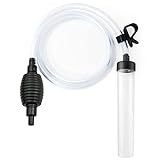
Squeeze-bulb and hand-pump siphon starters — included on the Laifoo and Fluval models — create initial flow without any mouth contact. Alternatively, submerging the entire hose in the tank to fill it with water, then covering one end with your thumb and pointing it into a bucket before releasing produces a working siphon instantly. Faucet-connected systems like the Python use water pressure to create suction and require no manual priming at all.
Do I need to remove fish before vacuuming?
No — fish can remain in the tank during gravel vacuuming and water changes. Most fish will swim away from the vacuum tube naturally. Move the vacuum slowly and deliberately to avoid stressing fish unnecessarily. The exception is very small fish fry or shrimp, which can be accidentally siphoned — using a nylon stocking or fine mesh over the tube end prevents this while still allowing water and waste through.
Final Verdict
The Python No Spill Clean and Fill system is the most impactful upgrade any aquarium keeper can make to their maintenance routine — connecting directly to the faucet eliminates bucket hauling entirely and makes water changes genuinely effortless for tanks of any size. For hobbyists who prefer a traditional bucket-based approach, the Fluval Edge Gravel Cleaner’s curved nozzle and self-starting design make it the best conventional option, especially for planted and decorated tanks. The Laifoo siphon is the ideal starting point for beginners and small-tank owners who need a simple, proven, and affordable gravel vacuum that works reliably from day one.
Related Reviews & Guides
Best Aquarium Siphon: Flow Rate, Reach and Priming Method

What Pond Liner Thickness Do You Need: Best Expert Shortlist