Last Updated: October 9, 2026
- Top Pick: AAwipes 8-in-1 Aquarium Test Kit for Fish Tanks – Quick & Accurate Water Testing Strips for Aquariums & Ponds. Tests pH, Ammonia, Alkalinity, Hardness, Chlorine, etc. (K02-50)
- Best Value: AAwipes Aquarium Ammonia Test Strips 8-in-1 |100 Strips | Quick & Accurate Water Testing for Freshwater & Saltwater Tanks -Test pH, Sodium Chloride, Alkalinity, Hardness, Chlorine etc. (K02-100)
- Premium Choice: AAwipes Aquarium Ammonia Test Strips 8-in-1 |25 Strips | Quick & Accurate Water Testing Test pH, Ammonia, Alkalinity, Hardness, Chlorine, Nitrite, etc. (K02-25)

TL;DR: Aquarium test strips give you water parameter readings in 60 seconds — fast enough to catch problems before fish show symptoms. They’re less precise than liquid test kits but accurate enough for routine monitoring. This guide covers which parameters matter most and how to read results reliably.
Aquarium Test Strips: Quick Water Parameter Testing for Freshwater and Marine Tanks
Water quality is the single biggest factor in fish health, and aquarium test strips make weekly monitoring fast enough that hobbyists actually do it. A 60-second dip-and-read is far more likely to happen consistently than a 15-step liquid test kit process. Consistent testing catches problems early — and early detection is the difference between a quick fix and a tank crash.
As an Amazon Associate we earn from qualifying purchases at no extra cost to you.


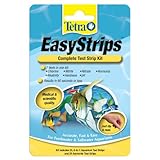


This guide covers how test strips work, which parameters to prioritize, and how to get accurate reads from a product that many hobbyists underuse.
🛒 Best Price Today on Amazon
Prime members get fast, free shipping on everything above, plus member-only deals. New members get a 30-day free trial — cancel anytime.
Start 30-Day Prime Free Trial →See Today’s Amazon DealsWhat Parameters Do Aquarium Test Strips Measure?
| Parameter | Ideal Range (Freshwater) | Ideal Range (Marine) | Why It Matters |
|---|---|---|---|
| Ammonia (NH3/NH4) | 0 ppm | 0 ppm | Fish toxicity at any detectable level |
| Nitrite (NO2) | 0 ppm | 0 ppm | Blocks oxygen uptake in fish blood |
| Nitrate (NO3) | <20 ppm | <10 ppm | Chronic stress and algae fuel |
| pH | 6.5–7.8 (species-dependent) | 8.1–8.4 | Enzyme function, osmotic balance |
| KH (Carbonate Hardness) | 4–8 dKH | 8–12 dKH | pH stability buffer |
| GH (General Hardness) | 4–12 dGH | n/a | Mineral availability for fish/plants |
| Chlorine | 0 ppm | 0 ppm | Toxic to fish and beneficial bacteria |
Top Aquarium Test Strip Products
The following three picks cover multi-parameter freshwater strips, marine-specific strips, and single-parameter ammonia strips for targeted monitoring.




As an Amazon Associate we earn from qualifying purchases. Product prices and availability are accurate as of the date/time indicated.


As an Amazon Associate we earn from qualifying purchases. Product prices and availability are accurate as of the date/time indicated.


As an Amazon Associate we earn from qualifying purchases. Product prices and availability are accurate as of the date/time indicated.
How to Use Aquarium Test Strips Accurately
Test strips get a bad reputation for inaccuracy — often because hobbyists misuse them. Follow this process for reliable results:
- Collect a water sample mid-column (not from the surface or substrate) in a clean, clear container
- Remove one strip without touching the reactive pads
- Dip the strip fully submerged for exactly 1 second — no longer
- Remove and hold horizontally, pad-side up; do not shake off excess water
- Wait the exact time specified on the chart (usually 30–60 seconds per parameter)
- Compare colors in natural light — not under aquarium lighting, which skews perception
- Seal the container immediately after removing the strip to protect remaining strips from humidity
The most common error is leaving the strip in too long or shaking it dry. Both distort color readings. A second common error is reading in artificial light — the warm spectrum of most aquarium lights makes yellows look orange and throws off pH and nitrate readings significantly.
Test Strips vs Liquid Test Kits: When to Use Each
Test strips are ideal for routine weekly monitoring and quick spot-checks when you suspect an issue. Liquid test kits (API Master Test Kit is the standard) are better for:
- Cycling a new tank — you need precise ammonia and nitrite readings daily
- Diagnosing a sick tank — when fish are dying and you need exact numbers
- Confirming a test strip reading that seems off
- Parameters strips don’t cover well (phosphate, copper, calcium for reef)
The practical approach: use strips weekly for fast monitoring, keep a liquid kit for troubleshooting. This gives you consistency and depth when you need it.
How Often to Test Your Aquarium
Established tanks (fully cycled, stable inhabitants): test weekly with strips. New tanks in cycling phase: test ammonia and nitrite daily with liquid kits. After adding new fish or plants: test every 2–3 days for two weeks. After a disease treatment: test every other day until stable, since medications can disrupt biological filtration.
Keep a log. A simple spreadsheet or notebook with date, test results, and any tank events (water changes, new additions, temperature changes) is invaluable for identifying patterns before they become problems.
For related water quality topics, see our guides on understanding the nitrogen cycle, proper water change schedules, and maintaining stable pH in freshwater tanks.
Frequently Asked Questions
Are aquarium test strips accurate enough for a reef tank?
For basic parameters like pH, nitrate, and ammonia, strips provide directional accuracy useful for routine checks. For reef-specific parameters like calcium, alkalinity (dKH), and magnesium, dedicated liquid or electronic tests are necessary. Reef chemistry is tight — a dKH swing of 1–2 points can stress SPS corals, and strips don’t resolve at that precision. Use a quality alkalinity test kit or an ICP water analysis for reef tanks.
Why does my test strip show 0 ammonia but my fish are acting stressed?
Test strips read total ammonia but don’t distinguish between unionized ammonia (NH3 — the toxic form) and ammonium (NH4 — less toxic). At higher pH (above 7.5), a larger proportion of total ammonia is in the toxic NH3 form. You can have a strip reading of 0.5 ppm total ammonia that’s harmless at pH 6.5 but acutely toxic at pH 8.2. Always factor pH into ammonia toxicity assessment.
How long are aquarium test strips good for after opening?
Most test strips are reliable for 12–18 months after opening if stored correctly — sealed container, cool dry location, away from humidity and direct sunlight. The reactive pads degrade when exposed to moisture. If your strip colors look faded or the control color (unused pad) looks off, the strips have degraded and should be replaced. Never store in a bathroom or near your tank where humidity is high.
What should I do if my test strip shows elevated nitrites?
Any detectable nitrite (above 0 ppm) indicates the nitrogen cycle is incomplete or has been disrupted. Do an immediate 25–30% water change to dilute nitrite levels. Stop feeding for 24 hours. Do not add new fish. Check if anything disrupted your biological filtration — recent medication, filter media changes, or a sudden temperature drop. Retest in 24 hours. If nitrite remains elevated, continue daily water changes until it returns to zero.
Can I use freshwater test strips for a saltwater tank?
Most freshwater multi-strip tests will give unreliable readings in saltwater — the ionic composition of saltwater interferes with the chemical reactions on the pads. Some parameters like nitrate and pH may still read approximately correctly, but don’t rely on freshwater strips for marine tanks. Use strips specifically formulated for saltwater, or a liquid test kit designed for marine chemistry.
Ready to decide? Our #1 pick for 2026 is the Ammonia (NH3/NH4).
Live price & availability on Amazon.
Related Reviews & Guides
Best Aquarium Siphon for Water Changes: Top Top Picks
11 Best Aquarium Cave Decorations for Fish Hiding Spots