Last Updated: October 21, 2026
- Top Picks at a Glance
- Liquid Test Kits vs. Test Strips — Why It Matters
- The Core Parameters — What Each One Means
- The Nitrogen Cycle — Reading Tests During Cycling
- Testing Schedule by Tank Stage
- How to Get Accurate Liquid Test Results
- Interpreting Nitrate Test Results (The Tricky One)
- Digital and Electronic Test Options
- What to Do When Tests Show Problems
- Frequently Asked Questions
- Related Guides
- Related Articles
- Related Guides
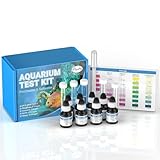
- Top Pick: AAwipes 8-in-1 Aquarium Test Kit for Fish Tanks – Quick & Accurate Water Testing Strips for Aquariums & Ponds. Tests pH, Ammonia, Alkalinity, Hardness, Chlorine, etc. (K02-50)
- Best Value: API Freshwater Master Test Kit 800-Test Freshwater Aquarium Water Kit, White, Single, Multi-Colored
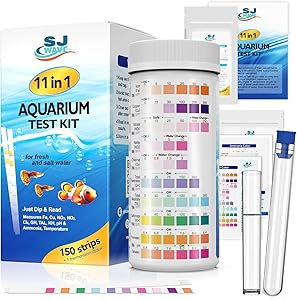
- Premium Choice: 11 in 1 – Aquarium Test Strips | 950 Tests – 150 Strips | Fish Tank Aquariums Water Test Kit & ebook | Aquarium Thermometer | Fish Tank Water Testing Kit Includes 50 Ammonia Strips | Versatile Usage
TL;DR: A fish tank water test kit is the single piece of equipment that prevents most aquarium disasters. Test ammonia, nitrite, nitrate, and pH at minimum. Liquid reagent kits (API Master Test Kit) are more accurate and cost far less per test than strips. Test weekly during cycling, then monthly once the tank is established.
Fish Tank Water Test Kit Guide: What to Test, When, and How to Read Results
Every unexplained fish death has a root cause, and most of the time that cause shows up in the water before it shows up in the fish. Lethargy, clamped fins, loss of appetite — these are lagging indicators. Ammonia at 0.5 ppm is a leading indicator, and a test kit catches it before fish start dying. This guide covers which parameters matter, how to test accurately, and what the numbers mean in practice.
As an Amazon Associate we earn from qualifying purchases at no extra cost to you.




🛒 Best Price Today on Amazon
Prime members get fast, free shipping on everything above, plus member-only deals. New members get a 30-day free trial — cancel anytime.
Start 30-Day Prime Free Trial →See Today’s Amazon DealsTop Picks at a Glance
Best Thermometer


As an Amazon Associate we earn from qualifying purchases. Product prices and availability are accurate as of the date/time indicated.
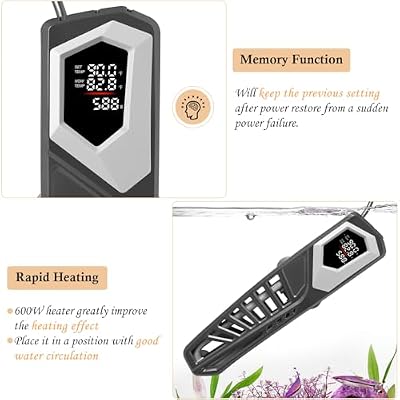
Best Heater




As an Amazon Associate we earn from qualifying purchases. Product prices and availability are accurate as of the date/time indicated.
Best Filter


As an Amazon Associate we earn from qualifying purchases. Product prices and availability are accurate as of the date/time indicated.
Liquid Test Kits vs. Test Strips — Why It Matters
Test strips seem convenient — dip, compare color, done in 60 seconds. The problem is accuracy. Strips are prone to false readings from temperature variation, age, and contamination (humidity in the tube degrades them). In the critical parameters — ammonia especially — a false “safe” reading from a degraded strip can lead you to ignore a dangerous situation.
| Liquid Reagent Kits | Test Strips | |
|---|---|---|
| Accuracy | High — ±0.25 ppm on ammonia | Low — ±1 ppm common |
| Cost per test | $0.10–$0.20 | $0.40–$0.80 |
| Shelf life | 3–5 years if stored correctly | 12–18 months, humidity-sensitive |
| Parameters covered | Individual kits; master kits cover 5–6 | 5–9 on one strip |
| Speed | 5 minutes per test | 60 seconds |
| False “safe” risk | Low | High (old strips especially) |
For cycling, diagnosing problems, and shrimp/sensitive fish tanks: liquid kits only. Strips are acceptable for quick weekly checks in a stable, established community tank where you’re just confirming everything is still normal.
The Core Parameters — What Each One Means
Ammonia (NH3/NH4+)
The first product of fish waste and uneaten food decomposing. Directly toxic to fish — attacks gill tissue and causes hemorrhaging at sustained levels above 0.5 ppm. In a cycled tank it should read 0 at all times. Any detectable ammonia in an established tank means either: cycle crash, overfeeding, dead fish decomposing somewhere, or overstocking.
Important nuance: ammonia exists in two forms — ionized (NH4+, less toxic) and un-ionized (NH3, highly toxic). At higher pH and temperature, a larger fraction is the toxic form. A reading of 1 ppm ammonia at pH 8.0 and 82°F is far more dangerous than 1 ppm at pH 7.0 and 72°F. Most fishkeeping calculators online will convert for you.
Nitrite (NO2)
The intermediate step in the nitrogen cycle — Nitrosomonas bacteria convert ammonia to nitrite. Also directly toxic, causes “brown blood disease” (methemoglobinemia) in fish by binding to hemoglobin and preventing oxygen transport. Should read 0 in a cycled tank. Spikes during cycling are expected; any spike in an established tank is a red flag.
Nitrate (NO3)
The end product of the nitrogen cycle — Nitrobacter/Nitrospira bacteria convert nitrite to nitrate. Much less acutely toxic than ammonia or nitrite. Fish tolerate up to 40 ppm without stress; sensitive species (discus, altum angels, shrimp) prefer below 20 ppm. Managed through water changes and plant uptake. Planted tanks can often run low nitrate without water changes — plants consume it actively.
pH
The acid/base balance of the water. Most community fish prefer pH 6.8–7.8. More important than hitting an exact number is consistency — a fish stable at pH 7.5 handles that better than one swinging between 7.0 and 8.0 daily. CO2 injection causes pH to drop during the light cycle and rise at night — see our Co2 Aquarium System Beginner Setup for managing this safely.
KH (Carbonate Hardness / Alkalinity)
KH is your water’s buffering capacity — its ability to resist pH swings. Low KH (below 3 dKH) means pH can crash rapidly, especially in CO2-injected tanks. For most community tanks, KH above 4 dKH provides adequate buffering. For CO2 systems, KH matters for the CO2/pH relationship (the KH/pH CO2 chart, which estimates dissolved CO2 from these two readings).
GH (General Hardness)
Total dissolved calcium and magnesium. Critical for shrimp (exoskeleton formation), livebearers, and hard water fish. Soft water fish (discus, wild-type tetras) prefer low GH. Plants use calcium and magnesium for growth. GH doesn’t affect toxicity directly but affects what organisms thrive.
The Nitrogen Cycle — Reading Tests During Cycling
Understanding what your tests mean during cycling changes how you interpret the numbers.
| Cycling Phase | Ammonia | Nitrite | Nitrate | Action |
|---|---|---|---|---|
| Days 1–7 | Rising (0 → 2–4 ppm) | 0 | 0 | Normal. Ammonia source active. |
| Days 7–21 | Falling | Rising (0 → 2–5 ppm) | Trace | Nitrosomonas colonizing. Don’t add fish. |
| Days 14–28 | Near 0 | Rising then falling | Rising | Nitrobacter colonizing. Good progress. |
| Cycle complete | 0 | 0 | 5–20 ppm | Add ammonia dose, retest in 24 hrs to confirm. |
A tank using a good canister filter like the see fluval 207 canister filter review cycles faster because the large biological media surface area colonizes quickly. Seeded media from an established tank can compress the cycle to 1–2 weeks.
Testing Schedule by Tank Stage
| Stage | Frequency | Parameters |
|---|---|---|
| Active cycling (no fish) | Every 2–3 days | NH3, NO2, NO3, pH |
| New fish added | Every 2–3 days for 2 weeks | NH3, NO2, pH |
| Established tank (stable) | Weekly | NH3, NO2, NO3, pH |
| After any change (new fish, medication, power outage) | Daily for 5 days | NH3, NO2 |
| Planted tank (stable) | Bi-weekly or monthly | NH3, NO3, pH, possibly KH/GH |
| Shrimp tank | Weekly minimum | NH3, NO2, TDS, GH, KH, pH |
How to Get Accurate Liquid Test Results
- Use clean test tubes — rinse with tank water before the test, not tap (chlorine residue affects results)
- Fill to the exact line — 5 mL is standard for most API tests; overfilling dilutes reagent, underfilling concentrates it
- Shake reagent bottles — especially reagent #2 in the nitrate test, which settles and gives false lows if unshaken
- Wait the full time — ammonia test requires 5 minutes; reading at 3 minutes gives false lows
- Read against white background in natural light — fluorescent light skews color perception. API’s color chart is designed for daylight reading.
- Rinse tubes immediately after testing — dried reagent in the tube affects next test if not cleaned
Interpreting Nitrate Test Results (The Tricky One)
The API nitrate test is the most commonly misread of the standard tests. Reagent #2 must be shaken vigorously — 30 seconds of hard shaking — because potassium periodate settles. Insufficient shaking produces false low readings that make tanks appear safe when they’re accumulating nitrate. If your nitrate has read 0 for weeks in a tank with fish and no heavy planting, your technique may be the issue, not reality.
Planted tanks with light stocking can genuinely read 0–5 ppm nitrate when plants are consuming it faster than fish produce it. Confirm by testing tap water against the tank — if both read zero and your fish are healthy, you likely have active plant nitrate uptake. This is a feature, not a problem.
Digital and Electronic Test Options
For TDS (total dissolved solids), a digital TDS pen is more practical than liquid tests. Essential for shrimp tanks and RO water remineralization — you’re hitting a target TDS range and need precise readings. For pH, a calibrated digital pH meter is more accurate than liquid tests (though liquid tests are adequate for most situations). Electronic ammonia sensors exist but are expensive and require recalibration; liquid kits remain the standard for ammonia testing at the hobby level.
What to Do When Tests Show Problems
| Reading | Immediate Action | Root Cause Investigation |
|---|---|---|
| Ammonia 0.5–2 ppm (established tank) | 25% water change, reduce feeding | Dead fish? Overfeeding? Overcrowding? Cycle disruption? |
| Ammonia 2+ ppm | Emergency 50% water change, stop feeding | Likely cycle crash — check filter media, recent medication use |
| Nitrite detectable | 25–50% water change, add salt (reduces NO2 toxicity in freshwater) | Same as ammonia — cycle disruption |
| Nitrate 40+ ppm | 40% water change | Increase water change frequency, reduce feeding, add fast plants |
| pH crash (below 6.5) | Gradual pH increase with buffer — never drastic | KH depleted, CO2 issue, acid substrate exhausted |
Frequently Asked Questions
How often should I test an established aquarium?
Once weekly for ammonia, nitrite, and nitrate is the baseline. Once the tank is stable over several months with no issues, bi-weekly or monthly is acceptable. Always test immediately after adding new fish, after treating with medication (which can kill beneficial bacteria), or after any equipment failure.
My ammonia test always reads yellow (0 ppm) — is something wrong with the kit?
If your tank is cycled and properly maintained, 0 ppm ammonia is correct and expected — the beneficial bacteria are converting it to nitrite as fast as it’s produced. Verify your kit is working by testing tap water before dechlorinating (chloramines in tap sometimes produce a slight ammonia reading, confirming the test functions).
Can I test too often?
Not in terms of fish health, but excessive testing in a stable tank causes unnecessary anxiety and uses reagents. Weekly is sufficient for established tanks. Testing obsessively in a healthy tank often leads to overreacting to normal minor fluctuations. Set a schedule and stick to it unless something looks wrong with the fish.
Do I need to test phosphate?
For planted tanks: phosphate testing is useful if you’re troubleshooting algae or plant deficiencies. Phosphate deficiency causes purple leaf undersides in some plants; excess contributes to algae. For basic fish-only tanks, phosphate testing isn’t a routine necessity. Reef tanks are a different matter — phosphate management is critical in saltwater.
My test results look fine but fish are still sick — what’s happening?
The basic test kit covers nitrogen cycle parameters and pH, not everything that can harm fish. Disease (ich, bacterial, parasitic), temperature instability, dissolved oxygen, chlorine/chloramine in source water, heavy metals (copper especially, deadly to inverts), and medication overdoses all cause problems that standard test kits won’t detect. If parameters look clean, check temperature stability with a reliable thermometer and look carefully at the fish for physical symptoms of disease.
Related Guides
- our fluval 207 canister filter review
- our pick for betta fish aquarium heater
- aquarium substrate planted tank guide
5 Best Fluval Betta Tanks (2026)
Best Aquarium Lid With Feeding Hole: Top Compared Access Picks