Last Updated: October 9, 2026
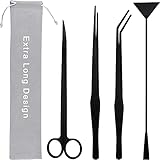
- Top Pick: Liveek Aquarium Aquascape Tools Kit, 4 in 1 Anti-Rust Aquatic Plant Aquascaping Tool Stainless Steel Black Tweezers Scissors Spatula for Aquarium Tank Clean Fish Tank Aquascape Tools Sets (Black)
- Best Value: 4Pcs Aquascaping Tools, Jeimier Aquascape Kit, Long and Strong Aquarium Tweezers, Scissors, Algae Scraper, Aquarium Plant Tools, Fish Tank Plant Trimming Kit
- Premium Choice: Aquarium Aquascape Tools Kit, Long 15 Inch Stainless Steel Aquatic Plants Tools, 4 in 1 Anti-Rust Aquascaping Tweezers Scissors Spatula Scrapers Tool Set for Fish Tank Cleaning Plant Trimming Shears

TL;DR: Aquascaping tweezers and companion tools give you precise plant placement, substrate manipulation, and moss attachment without disturbing the hardscape or clouding water. This guide covers tool types, steel grades, ergonomics, and which tasks each tool handles best.
Aquascaping Tweezers Tools Set: Precision Planting for Planted Tank Perfection
You can design a flawless planted layout on paper and select the best substrate and lighting, but the moment a clumsy hand disturbs the substrate during planting, you get a cloudy tank and uprooted stems for the next 20 minutes. Aquascaping tweezers tools eliminate that problem. Long, angled, or curved blades let you reach the back of a 24-inch tank and press rhizomes, roots, and stem bases precisely into substrate without displacing surrounding plants or hardscape. A proper tool set — tweezers, scissors, and a spatula — transforms planting from a frustrating chore into a satisfying craft.
As an Amazon Associate we earn from qualifying purchases at no extra cost to you.



🛒 Best Price Today on Amazon
Prime members get fast, free shipping on everything above, plus member-only deals. New members get a 30-day free trial — cancel anytime.
Start 30-Day Prime Free Trial →See Today’s Amazon DealsThe Core Four: What Belongs in Every Aquascaping Kit
Straight tweezers handle stem plants in foreground and midground zones where you need direct downward pressure to anchor roots below the substrate surface. A 10–12 inch length covers most standard tanks without submerging your elbow.
Curved tweezers are essential for planting behind rocks and driftwood, attaching moss to hardscape, and working in areas where the straight line of a standard tweezer hits an obstacle. The 45- or 60-degree bend lets you approach from an angle that keeps your hand above water.
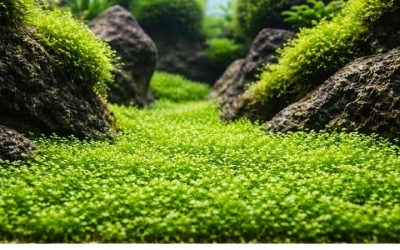
Spring scissors — straight for trimming foreground carpets (HC Cuba, Monte Carlo, dwarf hairgrass) and curved for shaping midground stems and moss balls — keep cuts clean and minimize plant debris. Blunt scissors tear plant tissue and invite melt; sharp stainless blades make clean cuts that heal in 24–48 hours.
Substrate spatula levels Aquasoil or sand, sculpts slopes, and smooths disturbed areas after planting sessions. A good spatula has a thin, flexible blade to work underneath plants without uprooting neighbors.
Top Aquascaping Tool Sets




As an Amazon Associate we earn from qualifying purchases. Product prices and availability are accurate as of the date/time indicated.



As an Amazon Associate we earn from qualifying purchases. Product prices and availability are accurate as of the date/time indicated.


As an Amazon Associate we earn from qualifying purchases. Product prices and availability are accurate as of the date/time indicated.
Tool Specifications Comparison
| Tool | Typical Length | Steel Grade | Best Application | Key Feature |
|---|---|---|---|---|
| Straight tweezers | 10–12 in | SUS304 or 316 | Stem plants, foreground carpet | Serrated tips for grip |
| Curved tweezers | 10–12 in | SUS304 or 316 | Behind hardscape, moss attachment | 45° or 60° bend |
| Straight scissors | 10–11 in | SUS420 | Carpet trimming, stem tops | Micro-serrated blades |
| Curved scissors | 10–11 in | SUS420 | Moss, rounded shapes | Spring-loaded handle |
| Substrate spatula | 11–13 in | SUS304 | Leveling, slope sculpting | Thin flexible blade |
Steel Grade Matters More Than Price
Budget sets often use unspecified stainless alloys that corrode at the weld points and scratch easily. SUS304 (18/8 stainless) resists freshwater corrosion well and is the industry standard for tweezers and spatulas. Scissors need SUS420 or higher — a harder alloy that holds a cutting edge through repeated use. SUS316 (marine grade) costs more but is the right call for saltwater aquascapers or heavily mineralised hard-water tanks where SUS304 can develop surface rust at stress points after a year or two.
Tip geometry matters for tweezers: micro-serrated or cross-hatched tips grip rhizomes and stems without slipping, while smooth polished tips release cleanly but require more hand pressure. Most sets include serrated straight tweezers and smooth curved tweezers, which is a sensible default combination.
Technique: Planting Stems Without Disturbing the Layout
Grasp the stem 0.5–1 inch from the cut base with straight tweezers — gripping too high bends the stem during insertion, too low risks damaging roots. Push straight down until the lowest node is 1–1.5 cm below substrate surface, then release the tweezers slowly while holding the stem with a gentle backward tilt to prevent it pulling out as the tweezers withdraw. For carpet plants like HC Cuba, bunch 3–5 stems and plant groups 1 cm apart for faster coverage. Use a substrate spatula to press disturbed surface area flat after each row.
For moss attachment to rocks and wood, use curved tweezers to hold moss portions flat against the surface while pressing stainless fishing line or black thread over the top. Secure with two half-hitches and trim excess thread after 3–4 weeks when rhizoids have attached. Java moss and Christmas moss establish faster on rough wood surfaces; smooth river rocks benefit from light scoring with a blade before attachment.
Healthy substrate makes planting easier — review our planted tank substrate guide for capping and layering depth recommendations. Good lighting and CO2 support rapid rooting after planting; our CO2 setup guide and LED light comparison cover those variables in depth. For low-tech tanks where tools matter even more due to slower recovery, see our low-tech planted tank setup.
Related Guides
- Live Moss Ball Marimo Aquarium
- Aquarium Gravel Substrate Planted Tank
- Best Aquarium LED Light for Planted Tanks 2026
Frequently Asked Questions
What length aquascaping tweezers do I need for a 4-foot tank?
A standard 48-inch (4-foot) tank is 18 inches deep. Tweezers of 12–14 inches let you reach the back corners while keeping your forearm above the waterline. For 24-inch-deep tanks, 16-inch tweezers are more comfortable. Most sold sets are 10–12 inches, fine for tanks up to 24 inches wide but tight on deep aquariums.
Can aquascaping scissors cut thick stem plants without bending them?
Yes, if the blades are sharp and cross at the full thickness of the stem. Dull scissors compress and bend stems before cutting. Sharpen scissors with a ceramic sharpening rod every 3–6 months. For very thick-stemmed plants (Rotala macrandra, large Ludwigia species), a slightly heavier-duty spring scissor handles the resistance better than lightweight fine-tip models.
Do aquascaping tools need to be rinsed after saltwater use?
Yes — rinse with fresh water and dry immediately after every saltwater session, even with SUS316 tools. Salt water accelerates crevice corrosion at hinge points and weld joints. A light coat of food-grade mineral oil on pivot points every few months prevents seizing and extends tool life significantly.
Is a spatula necessary if I use Aquasoil that clumps?
Yes. Aquasoil’s porous pellets shift easily during planting and create uneven slopes that affect plant root access and aesthetics. A flexible spatula lets you restore gradients, blend transition zones between substrate layers, and level disturbed foreground areas after planting sessions — tasks that tweezers cannot accomplish without knocking over established plants.
Can I use aquascaping tweezers to feed target fish and corals?
Straight tweezers work well for target-feeding anemones, corals, and picky fish like pipefish with mysis or cut silversides. Use smooth-tipped tweezers for this — serrated tips can pierce soft-bodied food items and make delivery messy. Rinse well after contact with meaty foods before reusing for plant work.
Ready to decide? Our #1 pick for 2026 is the Straight tweezers.
Live price & availability on Amazon.
Related Reviews & Guides

Root Tabs vs Liquid Fertilizer: Compared by the Numbers

Aquarium Root Tabs Planted Tank Fertilizer