Last Updated: October 4, 2026
Carpets fail more often at the roots than at the light. The best aquarium soil for carpeting plants gives tiny groundcover roots something fine enough to grip while keeping water chemistry in a range delicate plants tolerate, so the tissue-culture pots you paid for actually take hold.
As an Amazon Associate we earn from qualifying purchases.
By David Nguyen
How to Choose Aquarium Soil for Carpeting Plants
Carpeting soil is judged on how well small roots anchor and how the granules treat your water, not on brand names alone. Grain fineness, root support, active pH behavior, and how you compare bags sold in liters versus pounds are the four things that decide whether a foreground fills in.
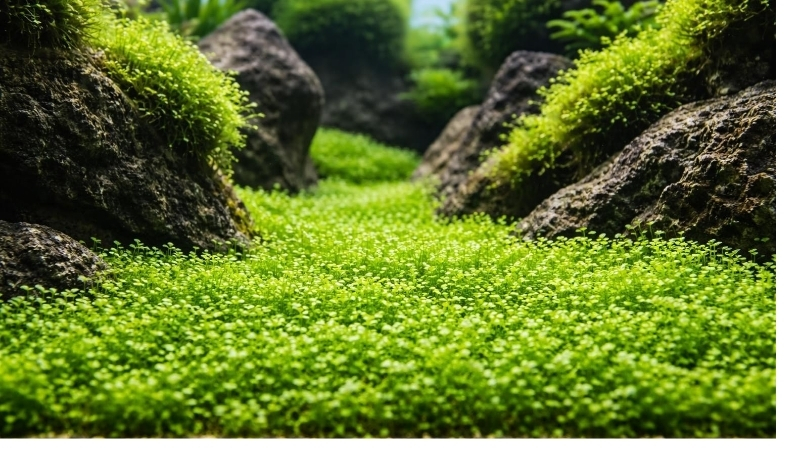
Fine Granules and Anchoring
Finer granules give delicate carpet roots more contact points to grip, which is why powder-type soils exist. ADA sells its Amazonia Ver.2 Powder specifically for fine-root groundcover use, though the exact millimeter figure is not published; UNS Controsoil is offered around 1 mm in its Extra Fine variant, versus roughly 3 mm Fine and 5 mm Normal.
Finer grain helps anchoring, but it is not proof of faster growth; light, CO2, and flow still set the pace. Powder also settles into a shallower, tighter layer, so plan a touch more depth at the back if you want the same slope you would build with standard soil.
Water-Chemistry Behavior
Active soils are not inert; they interact with your water and usually pull it toward slightly acidic. Fluval Bio-Stratum is described as neutral to slightly acidic, while ADA Amazonia leans acidic, which suits soft-water carpets but changes how you dose and how quickly a fresh setup cycles.
Do not assume every aquasoil drops pH to one fixed number, because the shift depends on your source water and the soil’s remaining buffering capacity. Test through the first two weeks of a new carpet build, when active soils move parameters most, and hold off on sensitive livestock until readings settle.
Package Size and Cost
Carpeting soil is sold in mismatched units, so compare by the volume you need, not the sticker. ADA Amazonia Ver.2 Powder comes in 3 L at around $40, Fluval Bio-Stratum in 8.8 lb near under $40, and UNS Controsoil Extra Fine in 10 L around $70, all as of 09/2026.
Because 3 L, 8.8 lb, and 10 L are not interchangeable, a raw price gap can mislead you into overbuying or underbuying for a foreground. Measure the footprint you want to carpet, target a modest depth, and buy the bag that covers it rather than the one that looks cheapest per package.
Root Support vs Growth Promises
A good carpeting soil earns its place by anchoring roots and feeding through the substrate, not by guaranteeing a carpet on its own. No soil, powder or otherwise, promises a CO2-free carpet; demanding groundcover such as dwarf hairgrass or Monte Carlo still leans on injected CO2 and strong light.
Treat the soil as the foundation and match it to your lighting and CO2 plan, since a premium bag under weak light still fills in slowly. If you are low-tech, choose easier carpets and accept a slower fill rather than blaming the substrate for a light-and-CO2 gap.
Top Picks
Three fine soils cover most carpets, plus a coarser ADA base for capping or larger-leaved groundcover. Prices are relative and current as of 09/2026; because bags ship in different units, judge cost by the coverage you actually need rather than by package price.
| Product | Best For | Key Spec | Watch Out For |
|---|---|---|---|
| ADA Amazonia Ver.2 Powder | Best overall for fine carpets | Powder SKU for fine-root groundcover; 3 L | Exact grain mm not published; acidic swing |
| Fluval Bio-Stratum | Best 1 mm bioactive option | 1 mm granules; neutral to slightly acidic | Standard grain is coarser than powder |
| UNS Controsoil Extra Fine | Best large extra-fine bag | ~1 mm Extra Fine variant; 10 L | Must buy the Extra Fine SKU, not Normal/Fine |
| ADA Amazonia Ver.2 (standard) | Best base under a powder cap | 9 L; supports slightly acidic conditions | Grain too coarse alone for the finest carpets |
ADA Amazonia Ver.2 Powder – Best Overall
Amazonia Ver.2 Powder is the top call because ADA markets it directly for fine-root groundcover, giving delicate carpets the fine surface they anchor into. It comes in a 3 L bag at around $40 as of 09/2026, and unlike some ADA lines the Powder SKU is used without the separate Amazonia Supplement.
The honest catch is that ADA does not publish an exact grain diameter, so buy it for its stated groundcover suitability rather than a promised millimeter. Being an active soil, it also swings acidic early, so cycle it and check parameters before adding shrimp or sensitive fish.
Fluval Bio-Stratum – Best 1 mm Bioactive Option
Bio-Stratum is the pick when you want a defined 1 mm granule at a friendlier price, sold as an 8.8 lb bag near under $40 as of 09/2026. It reads neutral to slightly acidic, which makes it forgiving for a first carpet where you are still learning to dose.
Its granules are coarser than a true powder, so the very finest carpets grip a little less securely at first and benefit from planting in small, weighted clumps. For dwarf hairgrass and Monte Carlo it still works well once roots establish and knit the surface together.
UNS Controsoil Extra Fine – Best Large Extra-Fine Bag
Controsoil Extra Fine pairs a roughly 1 mm grain with a large 10 L bag near under $70 as of 09/2026, so it suits bigger foregrounds where a small bag runs out. Buce Plant data lists it as buffering alkaline source water below pH 7, useful for soft-water carpets.
The one thing to get right is the variant: only the Extra Fine SKU is around 1 mm, while Fine is near 3 mm and Normal near 5 mm, so a wrong click gives a coarser bed. Confirm the exact SKU in your cart before ordering the large bag.
ADA Amazonia Ver.2 (standard) – Best Base Under a Powder Cap
The standard-grain Amazonia Ver.2, a 9 L bag around $60 as of 09/2026, is the choice when you want depth and volume beneath a thin powder cap or for larger-leaved groundcover. It supports the same slightly acidic conditions as the powder while filling the bulk of the bed more affordably per liter.
On its own the standard grain is a touch coarse for the finest carpets, so pair it with a powder top layer where you want the tightest surface. Used as a base it stretches an expensive powder bag over a larger footprint without giving up ADA’s active-soil behavior.
Frequently Asked Questions
Carpeting-soil questions cluster around grain size, nano use, whether you truly need CO2, and mixing soil types. Each answer opens with the direct call, then adds the exception or practical detail that changes it in a real planted tank.
What Grain Size Is Best for a Carpet?
A fine grain, roughly 1 mm or the powder grades, anchors small carpet roots best, which is why powder soils and Controsoil Extra Fine exist. Finer grain is easier to plant into and holds tiny roots more securely, but it is not a growth guarantee, since light and CO2 still set how fast a foreground actually fills in.
If you only have a coarser 1 mm granule like Bio-Stratum, plant in small weighted portions and let runners knit the surface together over a few weeks. Avoid going so fine that the bed compacts and turns anaerobic in still corners, and keep gentle flow moving across the foreground to carry away debris.
Can I Use Powder Soil in a Nano Tank?
Yes, and powder soil suits nano tanks well because the fine grain scales to small footprints and short planting distances. A 3 L powder bag covers a typical nano foreground with room to build a modest slope toward the back glass, giving delicate roots a tight surface to grip from day one.
The trade-off is that a shallow powder layer holds less nutrient volume over time, so plan on root tabs or column dosing as the scape matures past its first few months. In a tiny water volume the early acidic swing also concentrates faster, so cycle fully and test before adding shrimp or fish.
Do I Still Need CO2 for a Carpet?
For demanding carpets like dwarf hairgrass and Monte Carlo, injected CO2 and strong light still do most of the work, since no aquasoil promises a CO2-free carpet. Soil anchors the roots and feeds them through the substrate, but it does not replace the carbon and light a dense foreground needs to fill in.
Low-tech carpets are possible with easier species such as some crypts or moss-style groundcovers, as long as you accept a slower, patchier fill. If a premium soil is not carpeting, check your light intensity and CO2 before blaming the substrate, because those are usually the real limiting factors.
Can I Mix Standard and Powder Soil?
Yes, and layering is a common technique: a deeper standard-grain base with a thin powder cap on top for the finest planting surface. It stretches an expensive powder bag over a larger footprint while keeping a tight top layer where roots grip, which is why many aquascapers cap a base soil rather than filling the whole bed with powder.
Keep the powder cap shallow, around half an inch, so it does not compress into a dense skin, and slope the base underneath to build depth. Use the same brand family where possible so the two layers share similar chemistry and buffering behavior as they age together over the following months.
Final Thoughts
The best aquarium soil for carpeting plants is the one whose grain your groundcover can actually grip while its chemistry stays in a soft, stable range, which is why a fine powder like ADA Amazonia Ver.2 Powder leads while a coarser standard soil earns its place as a base. Match the grain to your species, budget CO2 and light honestly, and buy by coverage rather than by the lowest sticker.
As an Amazon Associate we earn from qualifying purchases at no extra cost to you. Prices and availability are accurate as of the date shown and are subject to change.

4 Best Aquarium LED Lights for Planted Tanks 2026
Best Substrate for Shrimp Breeding Tank: Careful Buyer Guide