Last Updated: October 9, 2026
 Aquarium Plants Low Light” style=”max-width:100%;height:auto;margin-bottom:1rem” loading=”lazy”>
TL;DR: Low-light aquarium plants thrive under stock LED fixtures without CO2 or fertilizer dosing. Java fern, anubias, and mosses are nearly bulletproof. The key mistake beginners make is buying high-demand plants labeled “easy” at big-box stores — this list sticks to genuinely low-light species that will survive and spread with minimal intervention.
Best Aquarium Plants for Low Light: 12 Species That Actually Thrive Without CO2
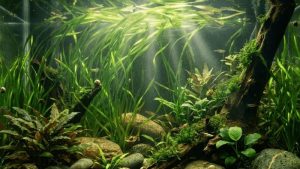
Most planted tank failures aren’t caused by bad water chemistry — they’re caused by the wrong plants for the given light level. “Low light” in aquarium terms means roughly 10–30 PAR (photosynthetically active radiation) at the substrate. That covers most stock LED hoods, desk lamp setups, and older fluorescent fixtures. These 12 species are proven performers at those light levels, sourced from hobbyist experience and scientific data on their natural habitat light conditions.
As an Amazon Associate we earn from qualifying purchases at no extra cost to you.




🛒 Best Price Today on Amazon
Prime members get fast, free shipping on everything above, plus member-only deals. New members get a 30-day free trial — cancel anytime.
Start 30-Day Prime Free Trial →See Today’s Amazon DealsWhat “Low Light” Actually Means in PAR Terms
| Light Category | PAR (µmol/m²/s) | Typical Fixture |
|---|---|---|
| Low | 10–30 | Stock hood LEDs, basic fluorescent |
| Medium | 30–80 | Quality planted LEDs (Fluval 3.0, Chihiros) |
| High | 80–150+ | High-end planted LEDs, T5HO |
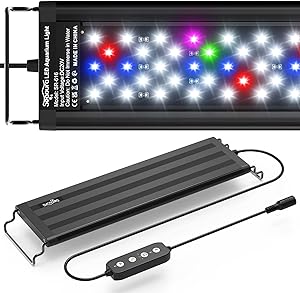
See our aquarium LED light comparison for PAR measurements across popular fixtures. For most low-light builds, a quality budget LED at 50% power will sit in the low-medium range — plenty for this entire list.
Top Low-Light Aquarium Plants
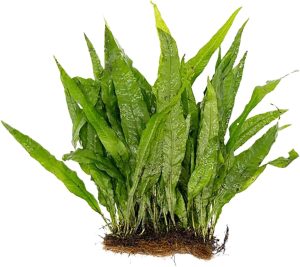
1. Java Fern (Microsorum pteropus)
The single most forgiving aquarium plant. Grows attached to hardscape (rhizome must not be buried — see driftwood and rocks guide), propagates by producing plantlets on old leaves, and tolerates everything from soft acidic to hard alkaline water. Growth is slow (1–2 new leaves/month in low light) but reliable. Black marks on older leaves are reproductive spores, not disease.
2. Anubias (Anubias barteri, A. nana, A. petite)
Thick, waxy leaves that algae finds difficult to colonize, slow but steady growth, and zero CO2 requirement. Like java fern, the rhizome must stay above substrate. Anubias petite stays under 2 inches and suits nano tanks perfectly. Anubias barteri can hit 6+ inches and anchors a midground in larger tanks. Liquid fertilizer accelerates growth slightly but isn’t required.
3. Java Moss (Taxiphyllum barbieri)
Versatile to a fault — grows floating, tied to hardscape, or carpeting (slowly) at low light. Ideal for shrimp tanks (see shrimp tank setup) as a biofilm cultivator and fry refuge. Tolerates temperatures from 59–86°F and virtually any hardness. Tie to mesh for carpet effect; trim with scissors every 4–6 weeks to prevent die-off in the dense interior.
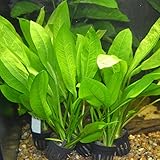
4. Amazon Sword (Echinodorus grisebachii)
A classic background plant for 20+ gallon tanks. Heavy root feeder — plant in active substrate or place root tabs directly under the root zone. Under low light, swords grow slower and stay smaller than their high-light cousins (some species can reach 20+ inches under bright light). Produces runners with daughter plants once established. Read our substrate guide for root tab placement timing.
5. Cryptocoryne (Wendtii, Beckettii, Parva)
Crypts are arguably the best low-light planted tank plant for substrate diversity. Wendtii comes in green, red, and brown color forms; beckettii adds mid-green with ruffled edges; parva stays under 2 inches for foreground use. Warning: “crypt melt” — leaves dissolving after planting — is normal and not death. New growth from the healthy root system typically emerges within 2–3 weeks.
6. Bucephalandra (multiple species)
The “collector’s anubias” — slower growing, more varied leaf shapes and iridescent colors, and equally low light tolerant. More expensive than anubias (often $5–$15/node vs $3–$8 for anubias) but pairs beautifully with hardscape aquascapes. Attach to rock or driftwood. Native to Borneo streams — prefers soft, slightly acidic water but adapts to most aquarium conditions.
7. Hornwort (Ceratophyllum demersum)
Fast-growing stem plant that thrives in low light and competes aggressively with algae for nutrients. Best left floating to maximize light exposure and nutrient uptake. Sheds fine needles during acclimation — expected, not fatal. Excellent for new tanks where algae outbreaks are common; remove once the tank matures and more attractive plants establish.
8. Vallisneria (Vallisneria spiralis, V. americana)
Grass-like background plant that spreads via runners to create a natural wall effect. Tolerates harder water better than most plants — actually prefers slightly alkaline pH (7.0–7.5), making it ideal for African cichlid communities. Grows faster than anubias but still manageable without high light. Do not plant near CO2 diffusers — high CO2 and calcium together can cause calcium carbonate precipitation on leaves.
9. Marimo Moss Ball (Aegagropila linnaei)
Technically an algae colony, not a plant, but functions as a low-maintenance aquarium decoration that absorbs ammonia and nitrates. Grows 5mm/year in natural conditions. Rotate monthly for even spherical growth. Shrimp graze on the surface. Tolerates cold water (59–77°F optimal) — excellent for unheated tanks with white clouds or goldfish.
10. Dwarf Sagittaria (Sagittaria subulata)
One of the few true carpeting plants that works in low-medium light without CO2. Grows 4–6 inches typically (can hit 12 inches in high light) and spreads via runners. Useful as a mid-foreground plant in tanks where true carpeting species like HC Cuba or Glossostigma would fail without CO2 injection.
11. Water Wisteria (Hygrophila difformis)
Fast-growing stem plant with distinctive lacy leaves at high light, more elongated leaves in low light — adapts its morphology to light availability. Strong nutrient competitor. Excellent for cycling new tanks and competing with algae. Can be planted or left floating; trims easily and cuttings replant directly.
12. Pennywort (Hydrocotyle leucocephala)
Round coin-shaped leaves on long stems, grows floating or planted, and adapts well to low light. Provides excellent surface cover for shy fish and fry. Brazilian pennywort is the most common trade species — fast-growing and nearly indestructible once acclimated. Best trimmed regularly to prevent blocking light to lower plants.
Recommended Starter Kits and Fertilizers


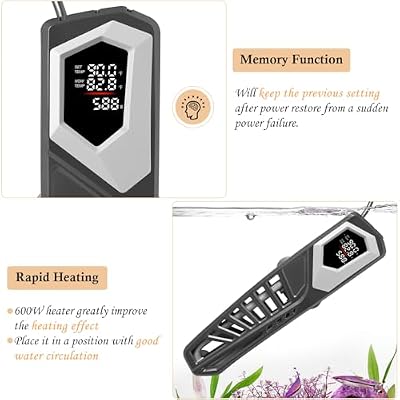


As an Amazon Associate we earn from qualifying purchases. Product prices and availability are accurate as of the date/time indicated.

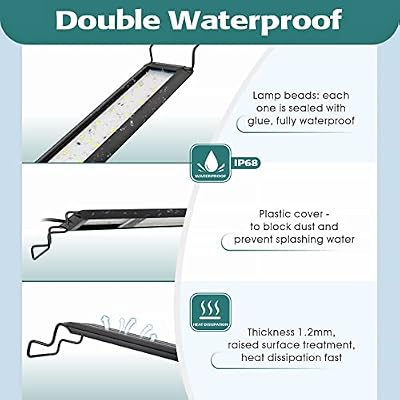


As an Amazon Associate we earn from qualifying purchases. Product prices and availability are accurate as of the date/time indicated.


As an Amazon Associate we earn from qualifying purchases. Product prices and availability are accurate as of the date/time indicated.
Low-Light Plant Care Cheat Sheet
| Plant | Placement | Substrate Needed? | CO2? | Difficulty |
|---|---|---|---|---|
| Java Fern | Hardscape attach | No (rhizome) | No | Beginner |
| Anubias | Hardscape attach | No (rhizome) | No | Beginner |
| Java Moss | Float / attach | No | No | Beginner |
| Amazon Sword | Background | Yes (root tabs) | No | Beginner |
| Cryptocoryne | Mid / foreground | Yes | No | Easy |
| Bucephalandra | Hardscape attach | No (rhizome) | No | Easy |
| Hornwort | Float | No | No | Beginner |
| Vallisneria | Background | Yes | No | Easy |
| Dwarf Sagittaria | Foreground | Yes | Optional | Easy |
For full substrate guidance covering active vs inert options, root tab timing, and layer depth, see our planted tank substrate guide. For a complete low-tech planted tank build using these species, see low-tech planted tank setup guide.
Frequently Asked Questions
Why are my low-light plants melting or yellowing?
Crypts melt as a normal acclimation response — leave them alone and new growth will emerge. Other plants yellowing typically signal nutrient deficiency (nitrogen most commonly), incorrect planting (rhizome plants buried), or insufficient light despite the “low light” label. Check that your light is running 8 hours/day minimum and add a liquid fertilizer like Seachem Flourish Comprehensive.
Can low-light plants grow in gravel?
Rhizome plants (anubias, java fern, bucephalandra) don’t go in substrate at all — attach to hardscape. Root-feeding plants (amazon sword, crypts, vallisneria) can grow in plain gravel but benefit significantly from root tabs placed every 4–6 inches. Active substrates like Fluval Stratum provide nutrients for 12–18 months without any root tabs.
How long does it take low-light plants to establish?
Slow-growing species like anubias and bucephalandra may show only 1–2 new leaves per month. Java moss and hornwort can double in volume within weeks under adequate light. Expect a 2–4 week acclimation period for most plants regardless of species — tissue culture plants especially may melt back before producing aquatic-adapted leaves.
Do low-light plants reduce algae?
Healthy, growing plants compete directly with algae for nutrients (nitrates, phosphates, CO2). Fast-growing species like hornwort and water wisteria are especially effective. However, dying or melting plants release nutrients and feed algae. The goal is establishing a densely planted tank where living plants consume nutrients before algae can — consistency in lighting schedule matters as much as species selection.
What’s the best low-light plant for a betta tank?
Java fern attached to driftwood is ideal — betta rest on the broad leaves, it tolerates the warm temperatures bettas require (78–82°F), and it’s completely unpalatable (bettas may nibble soft-leaved plants). Anubias is equally good. Avoid fine-leaved stem plants with bettas prone to fin nipping. For full betta setup guidance, see our betta heater guide.
Ready to decide? Our #1 pick for 2026 is the Low.
Live price & availability on Amazon.
Related Reviews & Guides

Java Fern Plant: Care Guide and Where to Buy 2026
How Much Substrate for Planted 40 Gallon Tank? Size Guide With Measurements (2026)