Last Updated: October 4, 2026
- Types of Aquarium Quick Disconnect Fittings
- Top Quick Disconnect Plumbing Products
- Where to Install Quick Disconnects in a Reef or Planted System
- Material Selection: PVC vs Polypropylene vs Acrylic
- Spec Reference Table
- Installation Best Practices
- FAQ: Aquarium Quick Disconnect Plumbing
- Preventing Leaks at Quick Disconnect Joints
- Sizing Disconnects to Avoid Flow Restriction
- Frequently Asked Questions
- Related Articles

TL;DR: Aquarium quick disconnect plumbing fittings let you detach sump lines, reactors, and return runs in seconds — no tools, no water spills, no cutting pipes. Essential for any serious reef or planted system that needs regular maintenance access.
Aquarium Quick Disconnect Plumbing: Faster Maintenance, Zero Headaches
Anyone who has wrestled with a glued PVC elbow at midnight during an emergency water change knows the value of easy-break plumbing connections. Aquarium quick disconnect fittings — also called push-to-connect, union fittings, or snap couplings — replace permanent joints with tool-free couplings that open with a quarter-turn or a thumb press.
As an Amazon Associate we earn from qualifying purchases at no extra cost to you.


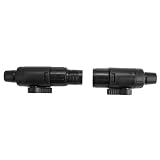


For aquascapers and reef keepers who run external reactors, UV sterilisers, chillers, or dosing pumps on dedicated plumbing runs, quick disconnects transform what used to be a two-hour teardown into a five-minute swap. This guide covers the main fitting types, sizing, material selection, and the best spots to install them in a typical sump-driven system.
🛒 Best Price Today on Amazon
Prime members get fast, free shipping on everything above, plus member-only deals. New members get a 30-day free trial — cancel anytime.
Start 30-Day Prime Free Trial →See Today’s Amazon DealsTypes of Aquarium Quick Disconnect Fittings
The aquarium plumbing market uses three dominant coupling styles, each with different trade-offs for flow rate, leak risk, and cost.
- John Guest / push-to-connect — insert tubing, it locks; press the collar ring, it releases. Fast, compact, rated for both freshwater and saltwater. Most common on small-bore tubing (4–12 mm) for dosing and CO2 lines.
- Union ball valves — a threaded union with a built-in ball valve lets you isolate flow before breaking the connection. Ideal for sump return lines and reactor inlet/outlet pairs.
- Cam-lock couplings — industrial-grade snap fittings originally from irrigation. High flow, bulkier, best for large-diameter sump plumbing (25–50 mm).
Top Quick Disconnect Plumbing Products


As an Amazon Associate we earn from qualifying purchases. Product prices and availability are accurate as of the date/time indicated.



As an Amazon Associate we earn from qualifying purchases. Product prices and availability are accurate as of the date/time indicated.


As an Amazon Associate we earn from qualifying purchases. Product prices and availability are accurate as of the date/time indicated.
Where to Install Quick Disconnects in a Reef or Planted System
Strategic placement makes maintenance faster and reduces the risk of accidental flooding. The highest-value locations are:
- Before and after the return pump — isolate the pump for cleaning without draining the sump.
- Reactor inlet and outlet — remove a calcium reactor, media reactor, or UV steriliser with no tools.
- Chiller feed line — disconnect for seasonal storage without cutting pipe.
- Overflow standpipe unions — emergency access if a standpipe needs clearing during a flood event.
- CO2 reactor loop — in planted tanks, break the loop quickly for a water change without disturbing CO2 settings.
For more on sump planning, see our aquarium sump setup guide which covers pipe sizing and flow rate calculations that inform where quick disconnects add the most value.
Material Selection: PVC vs Polypropylene vs Acrylic
Material choice determines longevity, especially in saltwater environments where chlorides accelerate oxidation of metals and degrade certain plastics.
- Schedule 40 PVC — inexpensive, glue-compatible, widely available. Avoid in ozone-dosed systems as ozone degrades standard PVC.
- Polypropylene (PP) — ozone-resistant, slightly more flexible than PVC, excellent for reef systems with skimmers that use ozone injection.
- Acrylic unions — visually clean, easy to inspect for leaks or deposits. Brittle under torque; hand-tighten only.
- CPVC — rated for higher temperatures; useful if a heater is upstream of the fitting.
Spec Reference Table
| Fitting Type | Typical Sizes | Max Pressure | Saltwater Safe | Best Use |
|---|---|---|---|---|
| Push-to-connect (John Guest) | 4–16 mm tube OD | 10 bar | Yes | Dosing, CO2, small reactors |
| Union ball valve (PVC) | 1/2″–2″ pipe | 10 bar | Yes | Sump return, reactors |
| Cam-lock (PP) | 3/4″–2″ pipe | 8 bar | Yes | Large-diameter sump lines |
| Acrylic union | 3/4″–1.5″ pipe | 6 bar | Yes | Display-area visible plumbing |
Installation Best Practices
Always install union fittings with the socket thread on the downstream side so you can break the connection with flow already isolated by the valve. Use PTFE tape on all threaded connections — two wraps clockwise when viewed from the thread end. Do not over-torque acrylic or polypropylene fittings; finger-tight plus a quarter-turn is sufficient.
Test every new connection at operating pressure for 24 hours before declaring it leak-free. Micro-seeps often only appear after the system reaches thermal equilibrium. Pair quick disconnects with a solid leak prevention strategy including drip trays and water sensors near every union.
If you’re designing a new sump room or cabinet, read our overview of aquarium filtration systems to understand flow rates before specifying pipe diameters and fitting types.
FAQ: Aquarium Quick Disconnect Plumbing
Will quick disconnect fittings reduce flow rate compared to solvent-welded pipe?
A correctly sized union fitting adds negligible head loss — typically under 0.05 m per fitting. Only use fittings rated for your pipe’s nominal diameter; stepping down even one size creates a measurable restriction, especially in high-flow return lines above 3,000 L/h.
Can I use push-to-connect fittings on flexible vinyl tubing?
Push-to-connect fittings are designed for semi-rigid tubing (nylon, polyethylene, HDPE). Soft vinyl tubing collapses slightly under the collet grip and can pull free under pressure. Use barb-and-clamp fittings for flexible vinyl, or insert a short sleeve of rigid tubing at each push-fit end to provide a firm support ring.
How often should I replace quick disconnect O-rings?
In freshwater systems, silicone O-rings last 3–5 years under normal use. Saltwater accelerates ozone and UV degradation — inspect O-rings annually and replace at the first sign of flattening, cracking, or surface tackiness. Keep a spare O-ring kit for every fitting type in your system.
Is it safe to install a quick disconnect on a pressurised return line?
Yes, provided the fitting is pressure-rated above your pump’s maximum head pressure. Most aquarium return pumps operate below 3 bar — well within the range of standard PVC union fittings. Always close the ball valve before opening a union to prevent siphon backflow from the display tank.
What size quick disconnect do I need for a 1-inch return line?
Match the fitting’s nominal pipe size to your schedule 40 or schedule 80 pipe size — a 1″ union fits 1″ pipe OD which is approximately 33 mm. Do not confuse pipe size with tube OD; aquarium plumbing uses nominal pipe sizes while CO2 and dosing lines use actual tube outer diameter measurements.
Preventing Leaks at Quick Disconnect Joints
Quick disconnects earn their keep by making maintenance painless, but every coupling is also a potential leak point, so understanding how they seal is essential. Most union-style and ball-valve disconnects rely on an internal O-ring or gasket that compresses when the fitting is tightened or snapped closed. That O-ring is the part that does the real work, and it needs to be clean, intact, and properly seated to hold back water under the constant pressure of a running pump. Grit, salt creep, or a pinched ring will weep slowly, and a slow weep beneath a stand can go unnoticed until it has done real damage. Inspecting and occasionally lubricating O-rings with a silicone-safe lubricant keeps them supple and sealing reliably.
Push-to-connect fittings seal differently, gripping the tubing with a collet and sealing against an internal O-ring, and they depend on a clean, square-cut, undamaged tube end pushed fully home. A tube cut at an angle or scored by pliers will never seal properly. After assembling any new run, pressure-test it over a towel before trusting it above electronics or a hardwood floor: run the pump, watch each joint for beading water, and tighten or reseat as needed. Catching a weep during a deliberate test is vastly preferable to discovering it as a puddle, and a few minutes of checking saves hours of cleanup.
Sizing Disconnects to Avoid Flow Restriction
A quick disconnect that is too small for the line it sits in quietly chokes your whole system, so sizing the fitting to the plumbing matters as much as the convenience it adds. Every coupling has an internal bore, and if that bore is narrower than the pipe it connects, water is forced through a bottleneck. The result is reduced flow to the display, increased back pressure on the return pump, and sometimes added noise as water accelerates through the pinch point. On a sump return, even a modest restriction can drop turnover noticeably once head pressure is also factored in, leaving the display under-circulated.
The fix is to match the disconnect’s bore to your existing pipe diameter rather than simply buying whatever thread happens to fit. If you run a particular pipe size for the main return, choose a union or valve with a full-bore opening in the same size so flow passes through uninterrupted. Where a fitting must step down, place it on a low-flow line such as a dosing or reactor feed rather than the high-volume return. It is also worth minimizing the number of disconnects on any single run, since each one adds a small amount of resistance; install them only where you genuinely need tool-free access. Thoughtful sizing keeps the time-saving benefit of quick disconnects without sacrificing the circulation your tank depends on.
Frequently Asked Questions
What does a quick disconnect do?
It is a valved coupling that lets you separate a hose or pipe run without draining the system, so a canister filter, reactor or pump can be pulled for cleaning in seconds. Both halves shut off automatically as they part, which is why the disconnection stays dry and mess free.
Will double union ball valves do the same job?
Double union valves on hard PVC serve the same purpose on sumps and return lines, and flow better with less restriction. Quick disconnects suit flexible tubing and equipment you remove often, such as a canister filter serviced monthly. Use unions on plumbing you rarely need to break down.
Do they restrict flow?
Yes, every valve and coupling adds head loss, and a small disconnect on a large return line can cost noticeable flow. Buy the largest size your tubing accepts, keep runs short with gentle sweeps rather than sharp elbows, and factor the loss in when sizing the pump.
How do I stop them leaking?
Most leaks come from a dried, nicked or twisted O-ring, or from cross-threading during reassembly. Lubricate the O-ring with silicone grease rather than petroleum jelly, inspect it at every service and keep spares on hand. Support the tubing so its weight does not hang on the fitting, and hand tighten only.
Are they safe in saltwater?
Yes, provided they are all plastic. Salt creep seizes metal parts and corrodes any brass or steel component. Rinse the fittings in fresh water whenever you disconnect, dry the O-rings and re-grease occasionally. Keep a drip tray underneath, since a slow drip soon becomes a thick salt crust.
Related Reviews & Guides




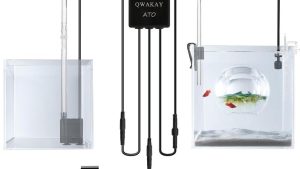
How to Choose an Auto Top Off System: Smart Buying Guide

Best Budget Aquarium Stand Under 100: Essential Perfect