Last Updated: October 9, 2026
- Top Pick: Two Little Fishies ATLKWR300 Kalkwasser Kw ReaCountor, 300 Gallon
- Best Value: Reef Octopus OCTO KS-100 Nilsen Kalk Reactor
- Premium Choice: IceCap Kalk Mixing Reactor KM-120

TL;DR: An aquarium kalkwasser stirrer automates limewater (Ca(OH)₂) dosing to replenish calcium and alkalinity simultaneously, raise pH, and precipitate phosphate — all from a single inexpensive powder. This guide covers the chemistry, stirrer mechanics, dosing rates, and how kalkwasser fits into a reef’s two-part or calcium reactor regimen.
Aquarium Kalkwasser Stirrer: Automate Calcium and Alkalinity for Reef Tanks
Kalkwasser — German for “limewater” — is a saturated solution of calcium hydroxide (Ca(OH)₂) in RO/DI water. At approximately 2.0 teaspoons per gallon, Ca(OH)₂ dissolves to roughly 800 ppm Ca²⁺ and saturates at pH 12.4. When dripped slowly into the sump, this high-pH liquid elevates tank pH, delivers calcium ions, and reacts with dissolved CO₂ and bicarbonate to support alkalinity maintenance. It also precipitates orthophosphate, providing passive phosphate control. An aquarium kalkwasser stirrer keeps the saturated solution in suspension and delivers it at a metered rate — automating a chemistry regimen that formerly required daily manual additions.
As an Amazon Associate we earn from qualifying purchases at no extra cost to you.




🛒 Best Price Today on Amazon
Prime members get fast, free shipping on everything above, plus member-only deals. New members get a 30-day free trial — cancel anytime.
Start 30-Day Prime Free Trial →See Today’s Amazon DealsThe Chemistry Behind Kalkwasser Dosing
When Ca(OH)₂ dissolves in water, it dissociates into Ca²⁺ and two OH⁻ ions. Those hydroxide ions react with dissolved CO₂ to form carbonate (CO₃²⁻), which then equilibrates with bicarbonate (HCO₃⁻) — the primary alkalinity buffer in reef tanks. The net result: every mole of kalkwasser added contributes roughly one mole of calcium and one mole of alkalinity equivalents, maintaining the 2:1 Ca-to-dKH relationship that reef chemistry demands. This is fundamentally different from two-part dosing, which delivers calcium and alkalinity in separate solutions that can drift out of ratio if dosed inconsistently.
The phosphate precipitation effect is a bonus: at pH above 8.3, calcium phosphate salts become insoluble. The high-pH kalkwasser drip creates a local zone in the sump where calcium phosphate precipitates and settles — a passive phosphate export mechanism that complements a refugium’s algae-based export. In a heavily fed tank, kalkwasser dosing alone can maintain undetectable phosphate without additional reactors.
How a Kalkwasser Stirrer Works
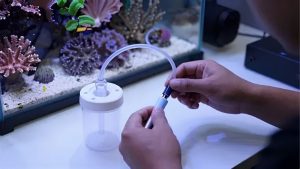
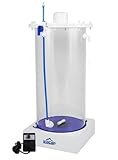
Ca(OH)₂ powder does not stay dissolved — it settles to the bottom of the container as a dense white sludge if left undisturbed. A kalkwasser stirrer is a sealed vessel, typically 1–3 liters, with an internal magnetic stirrer bar and an external motor mount. The stirrer periodically agitates the slurry (usually for a few seconds every few minutes), resuspending Ca(OH)₂ and maintaining maximum saturation concentration. Water enters at the bottom via a float valve or peristaltic pump feed, displacing kalkwasser solution upward through an outlet tube to the sump. The design ensures only clear saturated solution — not undissolved powder — reaches the tank.
Top Kalkwasser Stirrer Products


As an Amazon Associate we earn from qualifying purchases. Product prices and availability are accurate as of the date/time indicated.



As an Amazon Associate we earn from qualifying purchases. Product prices and availability are accurate as of the date/time indicated.


As an Amazon Associate we earn from qualifying purchases. Product prices and availability are accurate as of the date/time indicated.
Kalkwasser Dosing Reference
| Parameter | Value / Range | Notes |
|---|---|---|
| Ca(OH)₂ concentration | ~2 tsp per gallon RO/DI | Saturates at ~850 ppm Ca |
| Solution pH | 12.0–12.4 | Never dose directly into display |
| Max safe daily dose | ~1% of tank volume | Spread over 24 hrs via drip |
| Calcium delivery | ~180 mg Ca per 100 mL | Supplement two-part for high demand |
| Alkalinity effect | ~2 dKH per 100 mL/100 gal | Ratio-matched with calcium |
| pH boost potential | +0.1–0.3 units | Depends on tank buffering capacity |
| Phosphate precipitation | Passive at pH > 8.3 | Most effective in sump drip zone |
Kalkwasser vs. Two-Part vs. Calcium Reactor
Kalkwasser excels for low-to-medium demand systems (soft corals, LPS, mixed reef under 200 gallons) because it delivers calcium and alkalinity in a balanced ratio while raising pH — no other method provides the pH benefit passively. Its limitation is dose ceiling: at more than ~1% tank volume per day, you risk pH spikes. A heavily stocked SPS tank consuming 50+ dKH per week may exhaust what kalkwasser alone can supply without exceeding safe dose volume.
Two-part dosing (calcium chloride + sodium bicarbonate) handles high demand with no dose volume constraints and requires no stirrer hardware, but it adds chloride and sodium ions over time, slowly elevating ionic strength. A calcium reactor dissolves calcium carbonate media with CO₂-acidified water, delivering NSW-balanced ions at the cost of lowering pH slightly — the opposite of kalkwasser’s effect. The practical solution many advanced reefers use: kalkwasser for top-off water plus a calcium reactor for baseline supplementation. The kalkwasser counteracts the calcium reactor’s pH depression; the calcium reactor handles heavy SPS demand. This combination eliminates two-part ionic creep and provides excellent stability.
For a complete picture of reef chemistry management, see our calcium reactor reef guide. Kalkwasser pH benefits integrate directly with the refugium reverse-lighting strategy covered in our refugium reef tank guide. For hobbyists newer to saltwater chemistry who want to understand the full parameter picture before choosing a dosing strategy, our saltwater vs. freshwater beginner guide and marine salt mix comparison build the necessary foundation.
Frequently Asked Questions
Can kalkwasser overdose and crash a reef tank?
Yes — a rapid kalkwasser pulse raises pH above 8.6, precipitating alkalinity as calcium carbonate “snowstorm” and potentially crashing corals within hours. This almost always results from a failed drip valve that allows bulk solution to enter the sump at once, or from hand-dosing concentrated solution directly into the display. Always drip kalkwasser slowly into a high-flow sump area, never directly into the display, and use a float valve with a proven leak record. Dose no more than 1% of tank volume per 24 hours.
How much kalkwasser powder should I add to the stirrer reservoir?
Add Ca(OH)₂ at 2 level teaspoons per gallon of RO/DI water in the reservoir. The powder will not all dissolve — excess settles to the bottom and dissolves progressively as solution is consumed and replaced with fresh RO/DI. Refill the reservoir with fresh RO/DI water and a fresh powder charge when the residue layer is nearly gone, typically every 1–4 weeks depending on tank size and evaporation rate.
Does a kalkwasser stirrer replace top-off ATO systems?
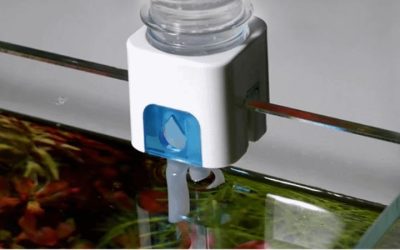
They integrate rather than replace. Most hobbyists feed their kalkwasser stirrer from the ATO reservoir or use the ATO pump to push RO/DI into the stirrer, which then drips dosed water into the sump. The ATO float valve or optical sensor triggers dosing as evaporation occurs — perfectly marrying evaporation replacement with calcium and alkalinity supplementation. Dedicated ATO controllers like those in an auto water change system can manage the kalkwasser feed pump on the same control circuit.
What happens to the white precipitate at the bottom of the kalkwasser stirrer?
The white sludge is a mixture of undissolved Ca(OH)₂ and calcium carbonate (CaCO₃) formed when dissolved CO₂ reacts with the saturated solution. The stirrer’s agitation keeps Ca(OH)₂ available but the carbonate layer is insoluble and builds over time. Clean the stirrer vessel monthly — rinse with RO/DI water, scrub off carbonate crust with a soft brush, and recharge with fresh powder. A heavy carbonate buildup reduces effective dosing concentration without changing the visible powder level, causing subtle calcium drift.
Is kalkwasser safe to use with a protein skimmer running?
Yes, but expect the skimmer to overflow for 15–30 minutes after a kalkwasser dose if the dose is large. The elevated pH temporarily disrupts surface tension in the skimmer neck, causing micro-bubble surge. Slow drip dosing over 24 hours avoids this entirely. If running a calcium reactor simultaneously, the calcium reactor’s CO₂ output and the kalkwasser’s OH⁻ partially neutralize each other in the sump — a feature, not a problem, as it moderates both pH rise from kalkwasser and pH drop from the reactor.
Ready to decide? Our #1 pick for 2026 is the Ca(OH)₂ concentration.
Live price & availability on Amazon.
Related Reviews & Guides


Best Automated Dosing Pumps for Reef Tanks in 2026: Compared and Ranked
Best Wireless Dosing Pump With App Control: Top Compared Guide