Last Updated: October 4, 2026
- The Nitrogen Cycle and Why Macroalgae Outperforms Skimming Alone
- Chaetomorpha vs. Caulerpa: The Macroalgae Choice
- Refugium Setup Products
- Refugium Parameter and Design Reference
- Reverse Lighting and pH Stabilization
- Copepod Refugium: Adding a Live Food Dimension
- Related Guides
- Frequently Asked Questions
- Related Articles
- Related Guides
- Top Pick: hygger LED Saltwater Aquarium Light, 24/7 Mode Nano Tank Reef Light for Coral, Refugium Light with White, Blue, U-V LEDs Dimmer Timer Moonlight Mounting Bracket 2 Metal Legs 11'' Long 19W
- Best Value: hygger Saltwater Aquarium Light – 35W Dimmable Full Spectrum with 3 Light Modes & Timer, 24/7 Auto Cycle for Refugium, Soft Corals, LPS Marine Tanks, Flexible Gooseneck Mount with Clip
- Premium Choice: Reefing Art Small Magnetic Acclimation Breeder Box Anemone Coral Strong N52 Magnets for 1/2" Glass (4.5" Cube)
 Saltwater Reef Tank” style=”max-width:100%;height:auto;margin-bottom:1rem” loading=”lazy”>
TL;DR: A refugium reef tank compartment cultivates macroalgae and microfauna to export nutrients, stabilize chemistry, and provide live food — all passively. This guide covers refugium sizing, lighting schedules, chaeto vs. caulerpa, and plumbing integration with your sump.
Refugium Reef Tank: Nutrient Export, Chemistry Stability, and Live Food in One Chamber
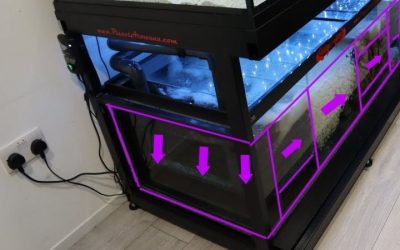
A refugium is one of the most elegant solutions in reef keeping: a separate or partitioned section of your sump where macroalgae grows under a dedicated light, pulling nitrate and phosphate from the water column as it photosynthesizes. The harvested algae carries those nutrients permanently out of the system. What sounds simple becomes a powerful tool for pH stabilization, alkalinity consumption buffering, and copepod cultivation — all without dosing, without reactors, and without ongoing chemical expenditure. Understanding how to build and run a refugium reef tank correctly separates hobbyists who chase parameters from those who simply maintain them.
As an Amazon Associate we earn from qualifying purchases at no extra cost to you.





🛒 Best Price Today on Amazon
Prime members get fast, free shipping on everything above, plus member-only deals. New members get a 30-day free trial — cancel anytime.
Start 30-Day Prime Free Trial →See Today’s Amazon DealsThe Nitrogen Cycle and Why Macroalgae Outperforms Skimming Alone
Protein skimmers strip dissolved organics before they mineralize into ammonia. They are excellent at reducing the input side of the nitrogen cycle. But skimmers cannot remove nitrate or phosphate that already exist in the water column — those compounds require either a biological reduction pathway (anaerobic denitrification) or export via algae biomass. Macroalgae in a refugium handles the export pathway: chaetomorpha, in particular, grows rapidly, sequesters dissolved inorganic nitrogen and phosphorus into its tissue, and can be harvested weekly. A mature refugium running chaeto under an appropriate grow light can maintain nitrate below 5 ppm in heavily fed SPS tanks without water changes.
Chaetomorpha vs. Caulerpa: The Macroalgae Choice
Chaetomorpha (chaeto) is the near-universal recommendation for refugium use. It grows as a tangled mass of single-cell-wide filaments, does not go sexual and crash, and harvests cleanly without fragmenting. It requires moderate flow to tumble and expose all portions to light, and responds well to a 5,500–6,500K spectrum grow light at 50–100 PAR.
Caulerpa grows faster and tolerates lower light but carries the risk of going sexual — releasing gametes into the display tank in a sudden “crash” that can spike ammonia and cloud the water. Taxifolia and racemosa are invasive species in some jurisdictions and should be avoided entirely. If you choose caulerpa, run it in a sealed, dedicated section and harvest aggressively before it reaches reproductive density. For most hobbyists, chaeto is the safer, lower-maintenance choice.
Refugium Setup Products




As an Amazon Associate we earn from qualifying purchases. Product prices and availability are accurate as of the date/time indicated.


As an Amazon Associate we earn from qualifying purchases. Product prices and availability are accurate as of the date/time indicated.


As an Amazon Associate we earn from qualifying purchases. Product prices and availability are accurate as of the date/time indicated.
Refugium Parameter and Design Reference
| Parameter | Recommended Range | Notes |
|---|---|---|
| Refugium volume | 10–25% of display volume | Larger = more buffering capacity |
| Chaeto light spectrum | 5,000–6,500 K | Red-blue grow spectrum works well |
| Chaeto light intensity | 50–100 PAR at algae surface | Too high causes bleaching |
| Lighting schedule (reverse) | Display off hours | Stabilizes pH swing |
| Flow through refugium | 5–10x refugium volume/hr | Enough to tumble chaeto |
| Harvest frequency | Weekly to biweekly | Remove 20–30% of mass per harvest |
| Copepod seeding | Monthly top-off | Supports mandarin/wrasse feeding |
Reverse Lighting and pH Stabilization
Coral reefs experience a natural pH swing of 0.1–0.3 units across the day-night cycle. In closed systems, CO2 buildup at night can push pH below 7.9 — a range that stresses SPS calcification. Running the refugium light on a reverse schedule (on when the display lights are off) dampens this swing significantly. As chaeto photosynthesizes, it consumes dissolved CO2, raising pH. Combining a well-lit refugium with fresh-air ventilation in the sump area can maintain pH between 8.0–8.3 around the clock without CO2 scrubbers or limewater addition — though for demanding SPS tanks, kalkwasser supplementation provides an additional pH buffer.
Copepod Refugium: Adding a Live Food Dimension
Chaeto’s three-dimensional structure is an ideal refuge for Tigger pods, Tisbe, and Apocyclops copepod populations. Copepods recruit naturally from live rock and sand but establish faster when seeded into a refugium with established macroalgae. The refugium protects copepods from fish predation while the population grows; overflow spills pods into the sump and display tank as a continuous live food source. This is the primary means of sustaining mandarin dragonets and finicky wrasses without daily supplementation. Seed 2,000–3,000 copepods monthly until population is self-sustaining, then reduce to quarterly top-offs.
A refugium works best when paired with appropriate protein skimming and salt chemistry. Review our protein skimmer guide for skimmer sizing relative to bioload. For salt selection that supports the chemistry the refugium stabilizes, our marine salt mix comparison covers NSW-grade and synthetic options. Advanced reefers running SPS colonies should also read our calcium reactor guide — refugiums and calcium reactors address different problems and work synergistically.
Related Guides
- Best Saltwater Aquarium Water Change Kit 2026
- Saltwater Coral Care Guide: Essential Products for Healthy Reef Corals
- Aquarium Hang On Back Nano Protein Skimmer
- Best Saltwater Aquarium Testing Kit 2026
Frequently Asked Questions
How large should a refugium be relative to the display reef tank?
A refugium sized at 10–25% of the display tank volume provides meaningful nutrient export and copepod production. Smaller refugiums (under 10%) can still help but require more frequent harvesting and offer limited pH buffering. If sump space allows, a larger refugium is almost always beneficial — there is no practical upper limit beyond what your stand and plumbing can accommodate.
Does a refugium reef tank replace the need for a protein skimmer?
No — they address different parts of the nutrient cycle. A skimmer removes dissolved organics before they mineralize; a refugium exports the resulting inorganic nutrients. Running both is standard practice on stocked reef systems. Lightly fed FOWLR tanks with very low bioloads can sometimes run a refugium alone, but a reef with corals and fish benefits from both operating in tandem.
Why is my chaeto not growing in the refugium?
The most common causes are insufficient light intensity (below 30 PAR), wrong spectrum (blue-heavy display LEDs are poor for macroalgae), insufficient flow causing chaeto to pack rather than tumble, or low nutrient levels — paradoxically, a very clean tank starves chaeto. Test nitrate and phosphate; if nitrate is below 1 ppm and phosphate is undetectable, the tank may be too nutrient-poor for active growth. Increase feeding slightly or reduce water change frequency temporarily.
Can I run a refugium on a non-drilled tank without a sump?
Yes, using a hang-on-back refugium chamber. These clip to the tank rim and use a small pump to circulate water through a chaeto chamber. They are smaller than sump refugiums but provide real nutrient export and copepod production for tanks that cannot be drilled. Flow rate through the chamber should be 5–10x the refugium chamber volume per hour for adequate water exchange.
How often should I harvest chaetomorpha from a refugium reef tank?
Harvest when chaeto has doubled in volume from its seeding mass, typically every 1–3 weeks depending on nutrient load and light intensity. Remove 25–30% of the total mass rather than all of it — leaving established chaeto maintains the population structure and copepod refuge. Discard or compost harvested algae; some hobbyists use it as garden fertilizer.
Ready to decide? Our #1 pick for 2026 is the Refugium volume.
Live price & availability on Amazon.
Related Reviews & Guides

Best Wavemaker for SPS Dominant Reef: Smart Top Picks
Best Protein Skimmer for a Mixed Reef: Top Expert Picks