Last Updated: October 21, 2026
How much water to change in aquarium tanks is a dilution calculation rather than a preference. Changing 30 percent of the water removes 30 percent of the nitrate and nothing else. This guide covers the baseline percentage, how to pick a larger number safely, and when a big change causes more harm than good.
As an Amazon Associate we earn from qualifying purchases.

enomol Gravel Vacuum for Aquarium Water Changer Fish Tank Cleaning Tools,Siphon Universal Quick Pump Aquarium Water Changing (30ft)
Included for 'How Much Water to Change in Aquarium: Percentages That Work' as a representative aquarium product in this roundup; selection reflects the product set returned for this topic.
View on Amazon
API TAP WATER CONDITIONER Aquarium Water Conditioner 16-Ounce Bottle
Included for 'How Much Water to Change in Aquarium: Percentages That Work' as a representative aquarium product in this roundup; selection reflects the product set returned for this topic.
View on Amazon
MiOYOOW Aquarium Water Changer, PVC Hanging Fish Tank Hook Filler | Aquarium Water Filler with Flow Switch, For 1/2", 5/8", 3/4" Hose
Included for 'How Much Water to Change in Aquarium: Percentages That Work' as a representative aquarium product in this roundup; selection reflects the product set returned for this topic.
View on Amazon
API TAP WATER CONDITIONER Aquarium Water Conditioner 4-Ounce Bottle, TAP WATER COND. 4 OZ
Included for 'How Much Water to Change in Aquarium: Percentages That Work' as a representative aquarium product in this roundup; selection reflects the product set returned for this topic.
View on Amazon
Aquarium Water Change Diffuser for Rimless Fish Tanks (Black, Medium) | Spill-Proof Water Changer Attachment, Protects Substrate, Plants & Decorations, Gentle Flow Design Safe for Fish & Shrimp
Included for 'How Much Water to Change in Aquarium: Percentages That Work' as a representative aquarium product in this roundup; selection reflects the product set returned for this topic.
View on Amazon
Luigi's Fish Tank Cleaner - Turtle Tank Accessories - Gravel Vacuum for Aquarium - Hand Siphon Hose to Remove and Change Water or Sand in Minutes - Aquarium Cleaning Tools
Included for 'How Much Water to Change in Aquarium: Percentages That Work' as a representative aquarium product in this roundup; selection reflects the product set returned for this topic.
View on Amazon
AQUANEAT Aquarium Vacuum Siphon, Fish Tank Water Changer, Gravel Cleaner, Hand Pump
Included for 'How Much Water to Change in Aquarium: Percentages That Work' as a representative aquarium product in this roundup; selection reflects the product set returned for this topic.
View on Amazon
API Fishcare 52Q API TAP Aquarium Water Conditioner 32-Ounce Bottle
Included for 'How Much Water to Change in Aquarium: Percentages That Work' as a representative aquarium product in this roundup; selection reflects the product set returned for this topic.
View on AmazonBy David Nguyen
Measure Before Deciding How Much Water to Change in Aquarium Tanks
The percentage is a tool for moving one particular number, and picking it sensibly requires knowing where that number currently sits. Two readings and a single volume calculation settle the question in a couple of minutes standing at the tank.
The numbers that decide the percentage
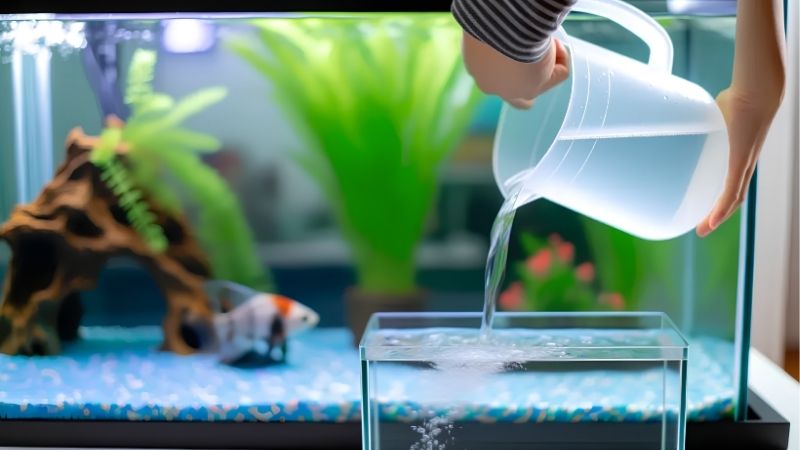
Start from 20 to 30 percent weekly, which holds most community tanks below 40 ppm nitrate. The arithmetic is direct: a 30 percent change on a tank reading 40 ppm leaves 28 ppm, so the percentage you choose is the proportion of nitrate you remove.
Work from real volume rather than the label. A tank sold as 20 gallons (76 L) holds nearer 17 gallons (64 L) after substrate and hardscape, so 30 percent is about 5 gallons (19 L), and using the label figure quietly under-changes every week.
Fifty percent is the practical ceiling for a single change in a well-maintained tank. Beyond that, temperature, pH and dissolved solids all move enough to matter, and the correction is better split across consecutive days than forced into one session.
Reading nitrate to pick how much water to change in aquarium tanks
Under 20 ppm needs nothing beyond the routine 20 percent, and 20 to 40 ppm suggests 30 percent weekly. Above 40 ppm calls for 30 to 50 percent straight away, followed by a look at feeding and stocking rather than a permanently larger weekly change.
Above 80 ppm in a neglected tank changes the answer entirely. Several 15 to 20 percent changes on consecutive days bring the reading down without swinging pH and hardness, which is the real risk in any tank that has drifted for months without attention.
| Nitrate before change | Change this much | Frequency | Caution |
|---|---|---|---|
| Under 20 ppm | 20% | Weekly | Still removes organics |
| 20-40 ppm | 30% | Weekly | The standard working range |
| 40-80 ppm | 30-50% | Now, then weekly | Check feeding and stocking |
| Above 80 ppm, drifted tank | 15-20% | Daily for several days | Avoid one large correction |
| Ammonia above 0.25 ppm | 25-50% | Immediately, repeat daily | Feed less, find the cause |
| Shrimp tank, any reading | 10-20% | Weekly | Limits TDS and GH swings |
When the percentage is not the lever
Sometimes the number is right and the result still disappoints, which means the problem sits upstream of the water change entirely. Two causes between them account for nearly all of those cases in practice, and neither is fixed by a bigger percentage.
If nitrate returns to 50 ppm within a week of a 50 percent change, the production rate is the problem. Feeding is the usual culprit, then stocking, then a filter slowed by clogging that lets waste settle in dead spots instead of passing through media.
Tap water sets a floor that no percentage clears. Where the supply carries 20 ppm nitrate, a tank will never read below that figure regardless of how much is changed, which makes lighter stocking and fast-growing plants the only remaining options.
Working Out Your Number Step by Step
Three steps turn how much water to change in aquarium tanks from a guess into a figure you can repeat every week without thinking about it again. The whole calculation takes considerably longer to explain here than it does to carry out at the tank.
Step one: calculate the real volume in the aquarium
Take the label figure and subtract roughly 15 percent for substrate, hardscape and equipment displacement. A 29 gallon (110 L) tank holds nearer 25 gallons (95 L), and every dose and percentage from then on should be calculated against that smaller number.
Mark the bucket rather than estimating. Measuring once and marking the fill line at the target volume removes the guesswork permanently, which matters because consistently changing 20 percent when you intended 30 is invisible until nitrate starts climbing.
Step two: pick the percentage from the reading
With the real volume known, the reading chooses the number for you. The only judgement involved is whether the tank is in good order or has drifted badly over time, since that alone decides between a single change and several smaller ones.
Test nitrate immediately before the change and choose from the table above. Keep single changes at or below 50 percent, and remember that two 25 percent changes on the same day remove less than one 50 percent change because the second dilutes already-diluted water.
Adjust for livestock as well as chemistry. Shrimp tanks do better on 10 to 20 percent weekly because dissolved solids and hardness swing less, and stability matters more to them during moulting than a slightly lower nitrate figure ever will.
Step three: match the method to the tank
Measure the distance from the tank to the tap and the height of the stand before buying equipment, since a hose that will not reach turns a planned 30 percent into whatever the buckets manage. Access decides how much gets changed in practice.
Volume decides the method. Under 20 gallons (76 L) a bucket and siphon are fastest, while a 55 gallon (208 L) tank moving 17 gallons (64 L) at 30 percent is a genuine piece of work that a faucet-connected changer reduces to a matter of minutes.
Deciding How Much Water to Change in Aquarium Tanks Badly
Three mistakes turn a sensible correction into a problem in its own right, and all three of them come from treating a bigger percentage as being automatically better for the tank and for the fish that are living in it.
Do not change 100 percent to fix cloudy water
Cloudiness in a new tank is a bacterial bloom that clears on its own, and in an established tank it usually follows a disturbed substrate. A full change swings temperature, pH and hardness all together while doing nothing about either underlying cause.
Do not make one large change on a drifted tank
A tank neglected for months has lower pH and depleted carbonate hardness, so replacing most of the water at once raises both of them sharply. Several 15 to 20 percent changes across consecutive days reach exactly the same place without the swing.
Do not increase the percentage instead of finding the cause
Ammonia or nitrite appearing in an established tank means the colony is behind the load. Water changes buy time and are the correct first response, and the fix is in feeding, stocking or recent filter maintenance rather than a permanently larger change.
Holding Your Water Change Percentage Steady
Once the right percentage has been established, the question of how much water to change in aquarium tanks stops being a weekly decision at all. It only needs revisiting when something in the tank itself has actually changed since it was set.
The routine that keeps it stable
Change the chosen percentage every seven days with water matched to within 1 to 2 °F (about 1 °C) and treated for chlorine and chloramine, vacuuming a rotating third of the substrate as you go. Test nitrate before the change rather than after it.
Feed only what is eaten in one to two minutes. Feeding sets the production rate the percentage has to offset, so the most common reason a working number stops working is a quiet increase in portions rather than anything wrong with the schedule.
What changes the required number
A percentage that worked for six months and then stopped working is reporting a change in the tank rather than a flaw in the arithmetic. Three things move the requirement upward or downward over time, and two of them are very easy to miss entirely.
New fish raise production immediately, and a heavier feeding habit usually follows them within a fortnight. Plant growth works the other way, with fast-growing stems and floaters taking up nitrate directly and lowering the percentage a tank needs.
Seasons shift it too. Indoor heating in winter dries the air and accelerates evaporation, so top-offs become frequent while removing nothing, and dissolved nitrate concentrates in the remaining volume between changes rather than staying level.
Signs the percentage is wrong
Nitrate climbing week on week means the number is too small or the input too large. Algae returning within days of scrubbing points the same way, as does a tank that only looks properly clear for a day or two immediately after each weekly change.
Conversely, readings that sit under 10 ppm every week suggest room to reduce slightly, though weekly changes still remove dissolved organics no test kit shows. Stability is worth more than an unnecessarily large weekly disturbance to the tank.
Frequently Asked Questions
These come up once a routine is running and the nitrate reading is not quite doing what the schedule was expected to achieve, which usually becomes obvious somewhere in the second month of running the tank properly.
How much water to change in aquarium tanks each week?
Twenty to 30 percent of real volume, which is roughly 15 percent below the label figure. Test nitrate before each change and move toward the upper end of that range if the reading climbs past 40 ppm between changes, rather than adding extra sessions.
Is a 50 percent change safe?
Yes in a well-maintained tank, provided the new water is matched within 1 to 2 °F (about 1 °C) and properly treated. It stops being safe in a tank that has drifted for months without maintenance, where several smaller changes are the better approach.
Can I change too much water in an aquarium?
Beyond 50 percent in a single session the risk rises, and the concern there is the swing in temperature, pH and hardness rather than the volume itself. Fish handle a large well matched change far better than they handle a small mismatched one.
Does the percentage change during cycling?
Yes. In a fishless cycle, change only to correct ammonia above 5 ppm or a pH below 6.5. With fish present, change 25 to 50 percent whenever ammonia passes 0.25 ppm or any nitrite registers at all, repeating that daily until both readings clear.
See More:
Choosing Your Percentage
How much water to change in aquarium tanks starts at 20 to 30 percent of real volume weekly, rises to 30 to 50 percent when nitrate passes 40 ppm, and splits into several 15 to 20 percent changes where a tank has been left neglected for months.
How to Choose a Rimless Aquarium: Complete Expert Guide
Common Mistakes When Buying an Aquarium Rack: Top Smart Tips