Last Updated: October 21, 2026
How often to change aquarium water is set by what the tank measures, not by a rule copied from a forum. Weekly at 20 to 30 percent is the sensible starting point, and the nitrate trend measured across three consecutive weeks tells you whether to tighten that schedule or leave it exactly as it is. Start by testing.
As an Amazon Associate we earn from qualifying purchases.

API TAP WATER CONDITIONER Aquarium Water Conditioner 4-Ounce Bottle, TAP WATER COND. 4 OZ
Included for 'How Often to Change Aquarium Water: A Schedule by Numbers' as a representative aquarium product in this roundup; selection reflects the product set returned for this topic.
View on Amazon
MiOYOOW Aquarium Water Changer, PVC Hanging Fish Tank Hook Filler | Aquarium Water Filler with Flow Switch, For 1/2", 5/8", 3/4" Hose
Included for 'How Often to Change Aquarium Water: A Schedule by Numbers' as a representative aquarium product in this roundup; selection reflects the product set returned for this topic.
View on Amazon
Aquarium Water Change Diffuser for Rimless Fish Tanks (Black, Medium) | Spill-Proof Water Changer Attachment, Protects Substrate, Plants & Decorations, Gentle Flow Design Safe for Fish & Shrimp
Included for 'How Often to Change Aquarium Water: A Schedule by Numbers' as a representative aquarium product in this roundup; selection reflects the product set returned for this topic.
View on Amazon
API Stress Coat Aquarium Water Conditioner 16-Ounce Bottle
Included for 'How Often to Change Aquarium Water: A Schedule by Numbers' as a representative aquarium product in this roundup; selection reflects the product set returned for this topic.
View on Amazon
enomol Gravel Vacuum for Aquarium Water Changer Fish Tank Cleaning Tools,Siphon Universal Quick Pump Aquarium Water Changing (30ft)
Included for 'How Often to Change Aquarium Water: A Schedule by Numbers' as a representative aquarium product in this roundup; selection reflects the product set returned for this topic.
View on Amazon
AquaPrintsByRay Aquarium Water Change Diffuser - Gentle Flow Designed for Smooth Water Changes (Clear, Small Tank (1–9 gal))
Included for 'How Often to Change Aquarium Water: A Schedule by Numbers' as a representative aquarium product in this roundup; selection reflects the product set returned for this topic.
View on Amazon
API Fishcare 52Q API TAP Aquarium Water Conditioner 32-Ounce Bottle
Included for 'How Often to Change Aquarium Water: A Schedule by Numbers' as a representative aquarium product in this roundup; selection reflects the product set returned for this topic.
View on Amazon
API Betta Water, 64 OZ
Included for 'How Often to Change Aquarium Water: A Schedule by Numbers' as a representative aquarium product in this roundup; selection reflects the product set returned for this topic.
View on AmazonBy David Nguyen
Measure Before Setting a Water Change Schedule
A schedule copied from someone else describes their stocking, not yours. How often to change aquarium water follows from one measurement taken repeatedly over time, and the first job is to establish what your own tank actually does in between changes.
The numbers that set the frequency
Start at 20 to 30 percent weekly and treat that as a baseline rather than a rule. Ammonia and nitrite should read 0 ppm throughout, and nitrate is the number that decides everything, staying below 20 ppm for planted and shrimp tanks and below 40 ppm otherwise.
Test nitrate immediately before each change rather than after it, since that is the peak the fish actually live in. Three consecutive weekly readings tell you the plateau, and a plateau that sits comfortably under target means the current schedule is working.
Temperature belongs in the check too. New water should come in within 1 to 2 °F (about 1 °C) of the tank, which is harder in winter, when tap water can arrive at 45 to 50 °F (7 to 10 °C) and needs mixing or standing before it goes into the tank.
Reading the trend to pick a schedule
Nitrate holding steady week to week below 40 ppm means the schedule matches the load and nothing needs changing. Nitrate climbing week on week means production has outrun removal, and the fix is more water, less food or fewer fish rather than a different product.
A plateau that sits under 10 ppm suggests room to relax slightly, though weekly changes still remove dissolved organics that no test kit shows. Dropping below one change a fortnight is where tanks start drifting in pH and hardness without any obvious warning.
| Situation | Nitrate before change | Frequency | Amount | Note |
|---|---|---|---|---|
| Standard community | 20-40 ppm | Weekly | 20-30% | The default starting point |
| Lightly stocked, planted | Under 10 ppm | Weekly or fortnightly | 20% | Still removes organics |
| Heavily stocked | Above 40 ppm | Twice weekly | 30% | Check feeding and stocking too |
| Shrimp tank | Under 20 ppm | Weekly | 10-20% | Small changes limit TDS swings |
| Nano under 10 gallons | Any | Weekly, never skipped | 25-30% | Small volume swings fast |
| Neglected for months | Above 80 ppm | Several small changes | 15-20% daily | Avoid one large correction |
When frequency is not the problem
If nitrate climbs quickly despite weekly changes, the input is too high rather than the schedule too loose. Feeding is the usual cause, followed by stocking, and adding a second change each week treats the symptom while the underlying load stays exactly where it was.
Test the tap water before blaming the tank. Many supplies carry 5 to 20 ppm nitrate before it reaches the aquarium, which puts a floor under the reading that no schedule can get beneath and makes lighter stocking the only real lever available.
How Often to Change Aquarium Water: Working It Out
The process takes three weeks and settles the question permanently. Deciding how often to change aquarium water this way replaces guesswork with a figure that reflects your own stocking level, your feeding habits and your local water supply.
Step one: run the baseline for three weeks
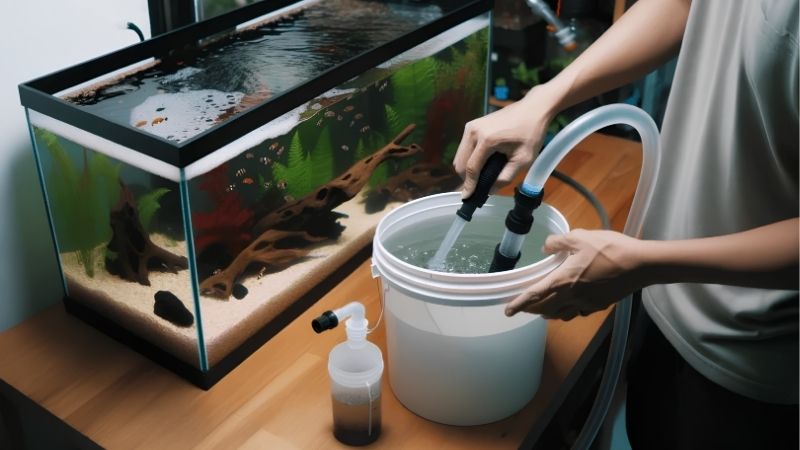
Change 20 to 30 percent every seven days, testing nitrate immediately before each one and writing the number down. Match temperature to within 1 to 2 °F (about 1 °C), treat for chlorine and chloramine, and vacuum roughly a third of the substrate each time.
Keep everything else constant during those three weeks. Adding fish, changing feeding or cleaning the filter mid-test all move the result, and the point of the exercise is to see what the tank does under a stable routine rather than under a changing one.
Step two: read the plateau and adjust
Compare the three readings. Steady and under target means keep the schedule; rising means increase the percentage before increasing the frequency, since one 40 percent change removes more than two 20 percent changes spread across the same week.
Falling readings mean the tank is lightly loaded, and the schedule can stretch toward a fortnight if you accept slower removal of organics. Recheck after a month, because stocking grows quietly and a schedule set in spring often no longer fits by autumn.
Step three: fit the routine to the room
Measure the distance from the tank to the nearest tap and the height of the stand before buying equipment, since a hose that will not reach turns a fifteen minute job into a bucket relay. Access decides whether a schedule survives a busy month.
Match the method to the volume. Under 20 gallons (76 L) a bucket and siphon are quicker than any hose, while a 55 gallon (208 L) tank moving 11 to 17 gallons (42 to 64 L) every week justifies a faucet-connected changer purely on the time it saves.
What Not to Do With the Schedule
Three habits undo an otherwise sound routine, and each one produces a specific and predictable problem rather than a vague risk. All three are common enough to be worth naming clearly before any schedule is settled on and written into a routine.
Do not skip weeks and then change everything
A tank left for two months drifts in pH, hardness and dissolved solids, and a sudden 80 percent change swings all three of them at once. Correct a neglected tank with several 15 to 20 percent changes on consecutive days instead of one large session.
Do not count topping up as a change
Evaporation removes water and leaves everything dissolved in it behind, so topping up dilutes nothing and concentrates nitrate over time. This matters most in winter, when indoor heating dries the air and the water line falls noticeably faster.
Do not deep clean the filter in the same week
A thorough substrate vacuum and a filter clean both remove colony sites, and doing them together can produce a small ammonia reading days later. Alternate them, rinse mechanical media in removed tank water only, and leave biological media alone.
Keeping the Schedule Sustainable
A routine only works if it survives a busy fortnight, so the practical question behind how often to change aquarium water is really what makes the job quick enough to happen every single week without it starting to feel like a chore.
Equipment that keeps it short
The single biggest predictor of whether a schedule holds is how long each change takes. Fifteen minutes gets done every week for years on end, while an hour with buckets gets postponed the first time something else comes up on a Sunday morning.
A gravel vacuum sized to the tank, a dedicated bucket and a dechlorinator rated for chloramine cover the basics. On tanks above 40 gallons (151 L) a faucet-connected changer removes the carrying entirely, which is usually what determines whether the schedule holds.
Keep a spare bottle of dechlorinator and a working thermometer. Running out mid-change is how an ordinary Sunday job turns into untreated water going into the tank, and an inaccurate heater dial is how new water arrives several degrees off.
Adjusting through the year
The percentage stays the same across the seasons while the practical work around it does not. Two things shift enough to matter across a year, and both of them affect how long each change takes rather than how often it actually needs doing.
Winter tap water arrives much colder, so mixing hot and cold or letting it stand takes longer and the temperature check matters more. Summer runs the other way, and warm water holds less oxygen, which makes a missed change more noticeable to the fish.
Holidays need planning rather than improvisation. A fortnight away with an automatic feeder usually returns nitrate well above the plateau, so schedule a larger change on return instead of resuming the normal percentage and wondering why the reading stays high.
Signs you should change aquarium water more often
A schedule that fitted the tank in spring may not fit it by autumn, and the tank reports that fact through the readings long before anything visibly looks wrong in the tank itself. Two signals in particular are worth watching between changes.
Nitrate creeping up month on month, algae returning within days of scrubbing, or any ammonia or nitrite reading all indicate the routine no longer matches the tank. Check feeding and stocking first, then increase the percentage rather than the frequency.
A tank that suddenly needs more attention usually had something added. New fish, a heavier hand at feeding, or a filter that has slowed through clogging each raise the load, and identifying which one prevents the schedule from creeping upward permanently.
Frequently Asked Questions
These come up once a routine has been running for a month or two and the readings have started to suggest that the chosen interval may not be quite right for the particular tank it was originally set up for.
How often to change aquarium water in a planted tank?
Weekly at 20 to 30 percent still works, and heavily planted tanks with light stocking often hold under 10 ppm nitrate on a fortnightly schedule. Test before each change and let the trend decide rather than assuming plants replace the routine.
How often to change aquarium water: is monthly enough?
Rarely, and only in lightly stocked planted tanks with confirmed low nitrate. Monthly schedules allow pH and hardness to drift between changes, which is what makes the eventual large correction risky rather than the interval itself being harmful.
How often to change aquarium water while cycling?
Only to correct a specific problem. In a fishless cycle, change water if ammonia passes 5 ppm or pH falls below 6.5. With fish already present, change 25 to 50 percent of the water whenever ammonia passes 0.25 ppm or any nitrite appears at all.
Does a bigger filter mean fewer changes?
No. Filtration converts ammonia into nitrate rather than removing nitrogen, so a larger filter increases processing capacity and changes nothing about the end product. Only water changes, plant uptake and reduced input lower nitrate in a freshwater tank.
See More:
Settling on Your Interval
How often to change aquarium water comes down to a three week measurement rather than a rule: 20 to 30 percent weekly as a baseline, nitrate tested immediately before each change, and the schedule adjusted upward only if that plateau climbs past target.
How Much Does A Large Aquarium Setup Cost: Top Ultimate
Nano Aquarium Setup Guide: How It Works and What to Watch