Last Updated: October 17, 2026
- Catappa Leaves at a Glance
- What Catappa Leaves Actually Do
- What Does the Evidence Say About Antimicrobial Claims?
- How Many Leaves Per Gallon?
- Preparing Leaves Step by Step
- Using Catappa Leaves for Bettas
- Using Catappa Leaves for Shrimp
- Troubleshooting
- Staining and Practical Concerns
- Frequently Asked Questions
Indian almond leaves (catappa leaves, from Terminalia catappa) release tannins and other plant compounds that tint the water amber, lower pH slightly in soft or lightly buffered water, and give shrimp and small fish a surface for biofilm, but their antimicrobial benefits are supported mostly by laboratory work and extract studies, not by controlled trials in home aquariums. Hobby guides commonly suggest starting with roughly one medium leaf per 10 gallons (amounts vary widely between sources), with pH checked as the leaf breaks down. They are a supplement for blackwater-style setups, not a medicine.
Quick answer: Our top pick in 2026 is the What are they? — our #1 rated choice. See the full ranked comparison, alternatives and buying advice below.
Catappa Leaves at a Glance
| Question | Short answer |
|---|---|
| What are they? | Dried leaves of the tropical almond tree, Terminalia catappa |
| What do they release? | Tannins, humic and fulvic acids, flavonoids, saponins and related compounds |
| Effect on pH | Gradual and mild in buffered water; larger in soft water, where a fast fall can be risky |
| Typical dose (hobby guidance) | Commonly about 1 medium leaf per 10 gallons; shrimp guides often start lower; sources vary |
| Lifespan in the tank | Commonly reported as a few weeks up to about six weeks, depending on leaf thickness, temperature and flow |
| Best for | Bettas, tetras, rasboras, dwarf cichlids, many soft-water shrimp, fry |
| Not suited to | Hard-water, high-pH species and shrimp that prefer minerals |
| Evidence for health claims | Lab antibacterial/antifungal data; a few extract studies in fish (tilapia, betta); mostly anecdotal for shrimp |
| Side effect | Brown tint, which is harmless but visible |
What Catappa Leaves Actually Do
Tannins and water colour
As the leaves soak and decompose, they release tannins, humic acids and fulvic acids that colour the water from pale tea to dark amber. This resembles the blackwater streams where many South American and Southeast Asian fish live, where fallen leaves are a major feature. The tint is harmless to fish and plants, though heavy staining can reduce light for planted tanks. Activated carbon or frequent water changes remove the colour, and carbon also strips the tannins, so skip it if the tannins are the aim.

Premium Indian Almond Leave. Aquarium Decorations Size 6-9" Pack 50g(20-25 Leaves). Catappa Leaves Rich in Tannin. Superb to be Health Better, Vitality, Succesful Breeding! of Shrimp & Betta Fish Tank
Included for 'Indian Almond (Catappa) Leaves for Aquariums: Benefits and How to Use' because the listing specifies Vitality and Succesful Breeding! of Shrimp & Betta Fish Tank, details this guide uses to compare options.
View on Amazon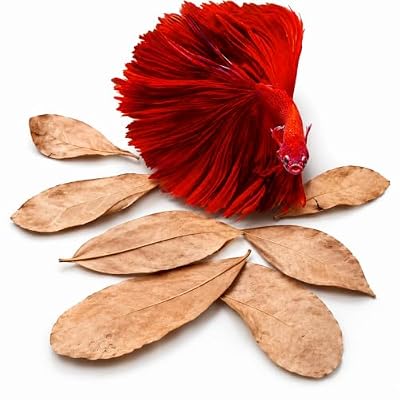
SunGrow 50 pcs Catappa Indian Almond Leaves – 2” Water Conditioner for Betta Fish Tank, Aquarium Leaf for Fish Breeding, Shrimp, Goldfish, Guppy & Frogs
Included for 'Indian Almond (Catappa) Leaves for Aquariums: Benefits and How to Use' because the listing specifies 2” Water Conditioner for Betta Fish Tank and Aquarium Leaf for Fish Breeding, details this guide uses to compare options.
View on Amazon
SunGrow 10 Indian Almond (Catappa) Leaves 4″-7″ for Betta Fish – Natural Aquarium Water Conditioner, Adds Tannins, Lowers pH, Fin Growth and Enhances Color, Stress Relief, Water Softening Treatment
Included for 'Indian Almond (Catappa) Leaves for Aquariums: Benefits and How to Use' because the listing specifies Natural Aquarium Water Conditioner and Adds Tannins, details this guide uses to compare options.
View on Amazon
LeonBach 100 Pcs Indian Almond Leaves for Aquariums, 5-8 Inches | 250g Large Catappa Leaves for Betta Fish, Creates Native Environment, Fish Shrimp Tank Decorations, Water Conditioner
Included for 'Indian Almond (Catappa) Leaves for Aquariums: Benefits and How to Use' because the listing specifies 5-8 Inches and 250g Large Catappa Leaves for Betta Fish, details this guide uses to compare options.
View on AmazonpH softening
The acids released by the leaves can reduce pH, but the effect depends on the water. Hobby guides generally report a small drop in buffered tap water and larger changes in soft water, though published numbers are scarce and results depend on leaf count, volume and buffering. Hard water with high mineral content resists change, while soft or reverse-osmosis water is vulnerable to rapid acidification. Hobbyist reports of several leaves in a small volume pushing pH down to around 6.0 within a few days are anecdotes, not studies.
This is why a pH test kit is more reliable than a rule of thumb. A cautious rule of thumb is to treat any fast pH fall as a sign that too many leaves were added; this is a hobby guideline, not a tested threshold.
Biofilm and grazing
Soaking leaves develop a film of bacteria, fungi and microscopic organisms. Shrimp, baby shrimp and small snails graze on this film, and fry may peck at it. Shrimp-focused guides credit both the biofilm and the leaf compounds in the water, although controlled evidence for the second part is lacking. The leaf is a natural, edible surface that breaks down over weeks.
What Does the Evidence Say About Antimicrobial Claims?
Many sellers claim catappa leaves fight fungus, bacteria and parasites. The reality is more modest.
- Laboratory work: Extracts of Terminalia catappa contain tannins, flavonoids, saponins and related compounds, and laboratory studies document antibacterial and antifungal activity against some fish pathogens.
- Fish studies: A Thai study on Nile tilapia (Chitmanat and colleagues, 2005) reported that a concentrated leaf solution eliminated the external parasite Trichodina at about 800 ppm and reduced fungal infection in tilapia eggs. A published study on 90 betta (Nugroho and colleagues, 2016) kept fish for 30 days at extract concentrations from 0 to 625 ppm and reported higher survival, red blood cell counts and haemoglobin above about 375 ppm, with pH dropping to about 5 at the top dose. Those are measured doses of an extract, not a few leaves in a community tank, and the fish species and doses differ from home setups.
- Water quality: The betta extract study above also found pH falling as extract dose rose, and decomposing leaf matter adds organic load, so ammonia can rise in weakly filtered tanks.
- Shrimp: Evidence is mostly anecdotal. Hobby sites describe mild benefits, but no controlled shrimp studies were found.
The sensible reading is that catappa leaves may offer mild support for fish living in conditions that suit them, but they should never replace quarantine, clean water or veterinary advice. Shrimp guides say plainly not to use them as medicine. If a fish is sick, diagnose the cause and follow an appropriate treatment.
How Many Leaves Per Gallon?
Dosing is subjective, and different keepers use different amounts. The table below is a rough hobby-style guide built around the common one-leaf-per-10-gallons starting point, not a tested rule:
| Tank volume | Light tint | Moderate tint | Blackwater look |
|---|---|---|---|
| 5 gallons | 1 small leaf | 1 medium leaf | 2-3 leaves |
| 10 gallons | 1 medium leaf | 1-2 leaves | 3-4 leaves |
| 20 gallons | 1-2 leaves | 2-3 leaves | 5-6 leaves |
| 30 gallons or more | 2-3 leaves | 3-4 leaves | 6 or more leaves |
Published suggestions range from about one medium leaf per 10 gallons to one or two large leaves per 15 gallons, often with fewer leaves for shrimp tanks. Leaf size varies a great deal, so these figures are approximate. Start at the low end, test pH and ammonia over the first week, and add more only if the water stays stable.
Be careful in small or soft-water tanks. A sudden pH fall can stress fish, and a very low pH can slow nitrifying bacteria, which can lead to ammonia spikes. Decomposing leaves also add organic load, and in a tank with a poor filter, ammonia can rise.
Preparing Leaves Step by Step
- Source leaves carefully. Choose leaves sold for aquarium use. Leaves from pesticide-treated trees or roadside trees are unsafe.
- Rinse briefly in dechlorinated or clean water to remove dust.
- Choose a method:
- Rinse and drop: the simplest, and keeps biofilm benefits.
- Boil or steep for about 10 minutes: softens leaves so they sink and releases tint more evenly, though some tannins are lost; some keepers also use it to reduce surface contaminants.
- Brew an extract in a separate container: allows precise control of tint and pH, then discard the leaf.
- Weigh down if needed. Dry leaves float for a day or two. Soaking first helps them sink, or a smooth stone can pin them.
- Monitor for the first week with a pH and ammonia test.
- Replace when the leaf is skeletonised, which keepers report takes anywhere from a couple of weeks to about six weeks, or sooner if debris accumulates.
Why prepare at all? Dry leaves can carry dust or surface microbes, and soaking reduces floating and the chance of a sudden tannin dump in a small tank.
Using Catappa Leaves for Bettas
Bettas come from slow, shallow, often tannin-stained waters in Southeast Asia, so many keepers use leaves for the natural look and for the surface a leaf offers as a resting place near the surface. Some bettas rest on a floating leaf. A leaf or two in a well-cycled tank of adequate size is a reasonable choice. The leaf is not a fix for a tank that is too small, unheated or unfiltered, and it does not cure fin rot or other infections.
Bettas need a heater and a tank sized for the species, and any signs of illness such as clamped fins, bloating, white patches or lethargy should be assessed for causes like water quality first. Seek a vet experienced with fish if an animal does not improve.
Using Catappa Leaves for Shrimp
Shrimp keepers value leaves for biofilm and grazing surface. Neocaridina species (such as cherry shrimp) are generally described as tolerant of a range of pH, while many Caridina species prefer soft, slightly acidic water, where tannins are compatible. Shrimp guides generally advise starting low, for example no more than the one-leaf-per-10-gallons figure above, and adding more only if the parameters stay steady. Leaves are not suitable where shrimp need hard, high-pH water.
Shrimp are sensitive to sudden shifts, so add leaves gradually and avoid dropping a large number at once. Leaves left in until they break down continue to feed shrimp, so remove only the leftovers that foul the tank.
Troubleshooting
| Problem | Cause | Fix |
|---|---|---|
| Water too dark | Too many leaves or little water change | Remove leaves, do water changes, use carbon if the tint is unwanted |
| pH falling quickly | Soft water, too many leaves | Remove some, increase buffering or water changes |
| Ammonia rising | Heavy decomposition, weak filter | Remove leaves, water change, check filtration |
| White fuzzy film on leaf | Normal biofilm or harmless fungus | Usually fine; shrimp eat it. Remove if it spreads onto fish |
| Leaves will not sink | Dry leaf trapped air | Pre-soak or weigh down |
| Cloudy water | Bacterial bloom from decomposition | Reduce leaves, more frequent water changes |
The white film is a frequent worry, but it is generally a normal part of decomposition and biofilm development.
Staining and Practical Concerns
Tannin staining can colour white sand, silicone and decor slightly, and the tint can reduce light for plants and make it harder to see fish or spot problems. Planted tanks with demanding plants may do better with a lighter dose or periodic carbon use. The leaf litter also adds debris that needs occasional siphoning.
Frequently Asked Questions
Do Indian almond leaves really lower pH?
They release acids that can lower pH gradually, especially in soft or low-buffer water. In hard, well-buffered water the effect is small. Test pH after adding them and remove some if it falls faster than expected.
How long do catappa leaves last in an aquarium?
Hobby guides report anywhere from a couple of weeks to roughly six weeks before a leaf is mostly broken down. Thick leaves last longer, and warm, high-flow tanks break them down faster. Replace them as they disintegrate.
Can I use fresh leaves from a tree?
It is safer to use dried leaves sold for aquarium use. Fresh or collected leaves may carry pesticides, pollutants or pests, and fresh leaves break down differently. Pesticide residues can be especially harmful to shrimp.
Are catappa leaves a cure for fin rot or fungus?
No. Laboratory and extract studies suggest antimicrobial properties, but this does not mean leaves treat established disease. Poor water quality is the usual cause of fin rot, so address water quality first and see a vet if the problem persists.
Are Indian almond leaves safe for shrimp?
Generally yes for species that like soft or neutral water, in modest amounts. Start low, watch pH, and avoid them if your shrimp need hard, mineral-rich water.
Do I need to remove the leaves?
Not necessarily. Decomposing leaves can stay unless they foul the water, and shrimp may continue to graze them. Remove debris that clogs the filter or is rotting heavily.
Will catappa leaves stain my water permanently?
No. The tint fades with water changes and leaf removal, and activated carbon removes it quickly. If you want clear water again, take out the leaves and change water in stages.
Ready to decide? Our #1 pick for 2026 is the What are they?.
Live price & availability on Amazon.
Related Reviews & Guides
6 Best Fish Tank Decorations 2026
Discus Fish Care: Best Products for Success