Last Updated: October 21, 2026
- Top Pick: Aquarium Maintenance Log Book: Daily Fish Tank Tracker for Water Parameters, Feeding Schedule, Tank Maintenance & Fish Health for Freshwater and Saltwater Aquariums
- Best Value: Aquarium Maintenance Notebook: Maintenance Journal for Fish Tanks Care
- Premium Choice: Aquarium Maintenance Logbook: Document & Track Feeding, Tank Conditions, Water Test Readings & Other Important Information | Fish Keeping Record Book for Aquarists of All Levels
Aquarium maintenance schedule work divides into five intervals, from a daily glance to an annual replacement list. The tables below give every task with its interval and its target number, so nothing depends on memory. Read the first table for the schedule itself, then adjust the quantities to your own stocking using the second one.
As an Amazon Associate we earn from qualifying purchases.
As an Amazon Associate we earn from qualifying purchases at no extra cost to you.


By David Nguyen
The Aquarium Maintenance Schedule Table
An aquarium maintenance schedule is built around one weekly figure and a handful of longer intervals. The table is the whole answer, and the sections after it explain where each number comes from, how far it can be adjusted, and what breaks if it is ignored.

The numbers this schedule runs on
The weekly change is 20 to 30 percent of real water volume, which sits roughly 15 percent below the label figure once substrate and hardscape are counted. Everything else in the schedule exists to support that one task or to catch equipment failing between them.
| Interval | Task | Target number | Why it matters |
|---|---|---|---|
| Daily | Count fish, check temperature, feed | 76-80 °F (24-27 °C), 1-2 min of food | A missing fish decays unseen |
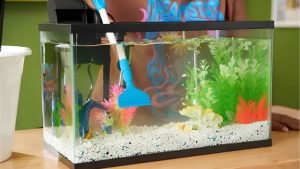
| Weekly | Water change and substrate vacuum | 20-30%, one third of the substrate | Removes nitrate and trapped waste |
| Weekly | Test ammonia, nitrite, nitrate | 0 ppm, 0 ppm, under 40 ppm | Catches problems before fish do |
| Monthly | Rinse mechanical media in tank water | Flow back to normal | Restores turnover without killing bacteria |
| Monthly | Check impeller, hoses and heater dial | Within 1-2 °F (1 °C) of thermometer | Heaters drift out of calibration |
| Quarterly | Replace mechanical floss, inspect seals | No weeping at silicone or gaskets | Leaks start small and slowly |
| Annually | Replace airstones, test reagents, check cords | Reagents in date, no cracked insulation | Expired reagents read wrong |
The rule behind the weekly number
Every interval in the table exists for a reason, and the weekly one carries the most weight because it is the only task that removes nitrogen from the system. The rest either support that task or catch equipment failing between sessions.
Nitrate rises until removal matches production, then holds at a plateau. Changing 30 percent removes exactly 30 percent of the nitrate, so a tank changing 30 percent weekly settles near three times its weekly production regardless of how long it has been running.
That gives the schedule its only real lever. If the plateau sits above 40 ppm, raise the percentage before adding a second session, since one 40 percent change removes considerably more than two separate 20 percent changes spread across the same seven days.
How to read the table
Intervals are maximums rather than appointments, so a task done early costs nothing while a task done late accumulates. The one exception is the monthly filter service, which should never fall in the same week as a thorough substrate vacuum.
Numbers in the target column are action thresholds, not averages. Ammonia above 0.25 ppm, any nitrite, or nitrate past 40 ppm each mean acting on that day rather than waiting for the next scheduled slot to come round later in the week.
Adjusting the Aquarium Maintenance Schedule to Your Tank
The intervals hold across most freshwater setups while the quantities shift. The second table covers the common variations, and the sections below explain which factors move the numbers, in which direction they move them, and by roughly how much.
| Tank type | Weekly change | Testing | Filter service | Watch for |
|---|---|---|---|---|
| Standard community | 20-30% | Weekly | Monthly rinse | Nitrate above 40 ppm |
| Heavily stocked | 30% twice weekly | Twice weekly | Every 2-3 weeks | Feeding creep |
| Planted, low stocking | 20% weekly | Weekly | Monthly rinse | Nitrate too low for plants |
| Shrimp tank | 10-20% weekly | Weekly plus TDS | Sponge rinse monthly | Copper in any additive |
| Nano under 10 gallons | 25-30% weekly | Weekly, never skipped | Monthly rinse | Fast parameter swings |
| Goldfish or cichlid | 30-40% weekly | Weekly | Every 2-3 weeks | Turnover at 8-10x volume |
Adjusting for stocking and feeding
Two factors set how much waste the schedule has to remove each week, and both are under direct control. Neither of them appears in the table, because they belong to the household routine rather than to the tank itself.
Stocking sets the production rate that the weekly change has to offset. Goldfish and cichlids produce several times the waste of the same length of tetra, which is why their row calls for 30 to 40 percent weekly rather than the standard figure.
Feeding moves the number just as much and far more quietly. A portion increase after new fish arrive raises the plateau permanently, so a schedule that stops working usually reflects a change in the kitchen rather than any fault in the tank itself.
Adjusting for plants, substrate and layout
Fast-growing stems and floating plants take up nitrate directly and can hold a lightly stocked tank under 10 ppm, which allows the lower end of the change range. Slow growers such as anubias and java fern contribute very little to that figure.
Substrate changes the vacuuming task rather than the schedule. Sand is cleaned by hovering the tube about 1 in (2.5 cm) above the surface, planted areas are worked around rather than through, and deep beds are left largely undisturbed near the roots.
Tank size, placement and fit
Measure the distance from the tank to the nearest tap and the height of the stand before buying equipment, since a hose that will not reach turns a fifteen minute job into a bucket relay. Access decides whether a schedule survives a busy month.
Volume decides the method rather than the intervals. Under 20 gallons (76 L) a bucket and siphon are quickest, while a 55 gallon (208 L) tank moving 11 to 17 gallons (42 to 64 L) weekly justifies a faucet-connected changer on time saved alone.
Where This Schedule Stops Working
Any fixed aquarium maintenance schedule is an average built from typical tanks, and three situations break it entirely. Recognising them in advance prevents the routine being followed straight off a cliff months later.
When the tank is still cycling
A cycling tank follows different rules, since removing ammonia removes the food the colony needs. Change water only to correct ammonia above 5 ppm or a pH below 6.5 in a fishless cycle, and change on the 0.25 ppm threshold whenever fish are already present.
When the tank has been neglected for months
Returning to a routine after a long gap is the situation where following the table literally does the most harm. The reason is that the water in the tank is no longer chemically similar to the water coming out of the tap at all.
A drifted tank has lower pH, depleted carbonate hardness and high dissolved solids, so resuming a normal 30 percent change swings all three at once. Use several 15 to 20 percent changes on consecutive days to reach the same place far more gently.
What the table cannot account for
Tap water nitrate sets a floor no schedule clears, and supplies carrying 20 ppm make lighter stocking the only remaining lever. Medication in the tank also overrides the routine, since a change removes part of the dose and carbon strips it entirely.
Checking the Schedule Against Reality
A schedule is a hypothesis about the tank, and the test kit is what confirms it. This part of the aquarium maintenance schedule covers how to verify the intervals themselves and how often the equipment behind them needs rechecking as well.
Tools and how accurate they are
A liquid test kit is the reference instrument, and strips drift quickly once the container has been opened in a humid room. An independent thermometer matters as much, because budget heaters routinely run 2 to 4 °F (1 to 2 °C) away from the dial setting.
Nitrate is the reading most often wrong. The second reagent bottle needs vigorous shaking for 30 seconds or more, and an under-shaken test reads low, which quietly turns a rising plateau into an apparently stable and entirely reassuring one.
How often to recheck the numbers
Verification has its own interval, and it is longer than the maintenance itself. Once a plateau is established the tank rarely surprises you, provided nothing about the stocking or the daily feeding has quietly shifted.
Test nitrate immediately before each weekly change for the first month, then monthly once a plateau is established. Recheck after any change in stocking, feeding or filtration, since each of those moves the production rate the schedule was built around.
Recheck the whole schedule twice a year. Stocking grows quietly, plants fill in, and a routine set in spring often no longer matches the tank by autumn, without anything obvious having happened at any point in between.
Equipment that drifts over time
Nothing in an aquarium fails on a schedule, and most of it degrades slowly enough to go unnoticed for months. The monthly and annual rows exist to catch that drift before it turns into a bad reading or a lost fish.
Heaters lose calibration, filter impellers wear and reduce flow, airstones clog and coarsen their bubbles, and LED fixtures lose output slowly enough that plants notice first. None of these announce themselves, which is why the monthly checks exist.
Test reagents expire whether used or not, and winter is when that matters most. Tanks given as gifts in December reach their worst readings in January, which is exactly the point at which an out-of-date kit produces its most expensive wrong answer.
Frequently Asked Questions
These come up once a routine has been running long enough for the intervals to start feeling either excessive or insufficient for the particular tank and stocking they were written for.
Can I follow this aquarium maintenance schedule fortnightly?
Only in a lightly stocked planted tank with confirmed nitrate below 20 ppm. Fortnightly schedules allow pH and hardness to drift between changes, which is what makes the eventual correction rather riskier than the long interval itself.
Should the filter be cleaned every month?
Rinse mechanical media monthly in removed tank water and leave biological media alone unless it is visibly clogged. Never service the filter in the same week as a thorough substrate vacuum, since the two together remove colony sites from both places at once.
What happens if I miss a week of the maintenance schedule?
Very little in a stable tank, provided the next change happens on time. Missing several weeks is different, because nitrate climbs and pH drifts, and the correction then needs splitting across several days rather than being done in one session.
Does a planted tank need less maintenance?
Less water changing, potentially, and more trimming and fertilising. Plants take up nitrate directly, so lightly stocked planted tanks often hold under 10 ppm on 20 percent weekly, while every one of the equipment checks stays exactly the same.
See More:
Using the Schedule
An aquarium maintenance schedule is only useful if the weekly slot is short enough to survive a busy month, so match the equipment to the tank and treat the intervals as maximums to work within rather than as appointments written in a diary.

How Often to Feed Fish: The Right Schedule and Portions
New Fish Acclimation Guide: How to Safely Introduce Fish to Your Aquarium