Last Updated: October 21, 2026
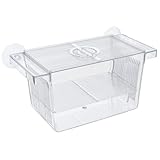
- Top Pick: Pawfly Aquarium Fish Breeding Box Acrylic Hatchery Incubator Tank with Suction Cups Small Isolation Box for Baby Small Fish Shrimp and Betta
- Best Value: AQUANEAT Fish Tank, 1 Gallon Betta Fish Tank, Small Aquarium Kit with LED Light and Water Filter Pump
- Premium Choice: Penn-Plax Undergravel Aquarium Filter for 10 Gallon Tanks – Two 9.5” x 9.5” Plates – Under Gravel System for Clear, Clean Water – Safe for Freshwater and Saltwater Tanks
Fish staying at bottom of tank is one of the least specific signals in the hobby, which is exactly why it is worth working through in order. Temperature, water quality and normal species behaviour explain the large majority of cases, and all three of them can be checked in about ten minutes with a test kit.
As an Amazon Associate we earn from qualifying purchases.
As an Amazon Associate we earn from qualifying purchases at no extra cost to you.


By David Nguyen
Temperature, Chemistry or Normal Behaviour
Sitting low is not a diagnosis. Some species live there, some retreat there when stressed, and some do it because the water is too cold. Fish staying at bottom of tank becomes informative only once you know which of those three you are looking at.
Test These Four Numbers Before Anything Else
Test ammonia, nitrite, nitrate and temperature with a liquid kit. Ammonia above 0.25 ppm or nitrite above 0 ppm explains lethargy and bottom-sitting directly, since both impair gill function and leave fish conserving energy rather than swimming.
Temperature is the most common single cause and the easiest to miss. Tropical fish below their species range slow down markedly, and a tank at 70 °F (21 °C) that should be at 78 °F (26 °C) produces exactly this behaviour across the whole population.
Then count two more things. How many fish are affected, and whether the behaviour started suddenly or appeared over a week. A whole tank changing at once points to the environment, while one individual among healthy tankmates points somewhere else entirely.
The Biology: Why Fish Settle Low
Cold slows metabolism. Fish are ectothermic, so their activity level tracks water temperature directly, and below the species range they reduce movement, stop feeding and rest on the substrate. Warming the tank to the correct range reverses it within hours.
Gill impairment from ammonia or nitrite produces a similar picture through a different route. Oxygen uptake falls, the fish conserves energy, and it often sits near the bottom rather than near the surface if the water column still holds oxygen.
Stress from tankmates, bright light or a bare layout puts fish low for behavioural reasons. A fish with nowhere to hide will use the substrate and hardscape shadows as cover, and it will do this in perfectly clean water at the correct temperature.
Recent change is worth weighing separately. Fish moved into a new tank, or into a tank where the layout was rearranged, commonly sit low for a day or two while they establish where cover is, which is adjustment rather than distress.
Normal Ranges Against Action Thresholds
The table pairs each pattern with its likely cause. Take the readings first, because the behaviour looks the same across every row and only the numbers and the pattern of who is affected tell them apart.
| What you observe | Readings | Most likely cause | First action |
|---|---|---|---|
| All fish low, slow, not eating | Temp below species range | Water too cold, metabolism slowed | Check heater, warm gradually |
| All fish low, breathing fast | Ammonia above 0.25 ppm or nitrite above 0 | Gill impairment | Change 50%, add aeration |
| One fish low, others normal | All four readings normal | Not environmental | Observe, seek professional advice |
| Fish low and hiding, new tankmates | All four readings normal | Social stress or aggression | Add cover, review compatibility |
| Bottom-dwelling species resting | All four readings normal | Normal behaviour for the species | Nothing, this is expected |
What This Means in a Real Tank
The same behaviour carries different weight depending on which fish is doing it and what the tank looks like. Layout, temperature stability and stocking all shape how often fish staying at bottom of tank turns out to mean anything at all.
Tank Size, Placement and Fit
Small tanks swing in temperature faster, which is why fish staying at bottom of tank shows up in nano setups first. A 5 gallon (19 L) tank tracks room temperature closely, so an unheated room overnight can drop it several degrees while a 55 gallon (208 L) tank barely moves, and the smaller tank shows the behaviour first.
Placement matters more than most people expect. A tank against an exterior wall, under a window or near a door loses heat overnight, and a tank in a room that gets switched off at night follows the room down.
Heater sizing follows the same logic. A baseline of 3-5 watts per gallon covers roughly a 10 °F (about 6 °C) difference from room temperature, so a cold room needs more. Measure before you order: heater length against water depth, and stand capacity against roughly 10 lb/gallon (about 1 kg/L) filled.
How This Differs Across 10, 20 and 55 Gallon Tanks
Water quality moves faster in small volumes too. A 10 gallon (38 L) tank can go from clean to 0.5 ppm ammonia in a day after a filter disruption, so bottom-sitting in a nano tank warrants testing sooner than the same behaviour in a large one.
Layout depth changes behaviour independently of chemistry. A 55 gallon (208 L) tank has room for planted cover, open swimming space and shaded areas, so fish distribute across it. A sparse 10 gallon tank offers the substrate as the only refuge available.
Turnover affects comfort as well as filtration. A baseline of 4-6 times tank volume per hour suits community stocking, but that same flow in a small tank can be too strong for bettas and long-finned species, which then hold position low where current is weakest.
How Species and Stocking Change the Picture
Plenty of fish belong on the bottom. Corydoras, loaches, plecos and many catfish spend most of their time there by design, and a corydoras resting between feeding bouts is behaving exactly as expected rather than signalling anything.
Shoaling species kept in inadequate numbers hide low. Tetras, danios and rasboras generally need six or more of their own kind, and a group of two or three will often press into cover instead of using the open water they were bought for.
Winter brings the temperature version in volume. Heating systems that drop overnight, cold snaps and rooms left unheated during holidays all pull tank temperature down, and an undersized or failing heater shows itself in January far more often than in June.
The same season produces the other pattern too. Tanks given as gifts in December reach weeks two to six in the new year, which is when ammonia and nitrite peak in a system that was stocked before it finished cycling, so lethargy across a whole young tank in January usually has a reading behind it.
Common Mistakes and Myths to Retire
Three responses to fish staying at bottom of tank turn an ambiguous signal into a real problem. Each involves adding something to the tank before the readings have said anything at all.
Myth: Bottom-Sitting Means the Fish Needs Medication
Fish staying at bottom of tank is an observation, not a condition, and dosing a tank based on it means treating an unknown. Medications stress fish, many harm the biological filter, and several contain copper which is lethal to shrimp and snails.
The replacement sequence: test the four numbers, check temperature against the species range, count how many fish are affected, and look at cover and tankmates. If everything checks out and one fish remains affected, that is a question for an aquatic veterinarian or an experienced fish store.
Myth: Raising Temperature Quickly Will Help
If the tank is genuinely too cold, it needs warming gradually rather than in one move. A rise of more than about 2 °F (1 °C) in a short period stresses fish already conserving energy, and it also drives dissolved oxygen down as the water warms.
Warm at roughly 2 °F (1 °C) per day toward the species range, and add surface agitation while you do it. A tank moving from 68 °F (20 °C) to 78 °F (26 °C) should take five days rather than an afternoon.
Myth: A Big Water Change Is Always the Safe Response
It is safe when ammonia or nitrite is present, and unhelpful otherwise. A large change in a tank with clean readings swings temperature and chemistry for no benefit, and in hard tap water going into a soft tank it can stress fish further.
Keep changes at 20-30% with temperature matched to within 1-2 °F (about 1 °C). Escalate to 50% only when a reading justifies it, and never to a full change, which strips minerals and removes none of the bacteria doing the work.
Preventing It Long Term
Most recurring cases come down to two things: a heater that cannot hold the range in cold weather, and a layout that gives fish nowhere to be except the bottom. Both are fixable before winter rather than during it.
What to Do on a Schedule
Check the tank thermometer daily, using a separate thermometer rather than the heater dial. Test ammonia and nitrite weekly for the first three months then monthly, and always within a week of adding fish, replacing media or returning from time away.
Keep water changes at 20-30% weekly adjusted by measured nitrate, and observe the tank at feeding time. Feeding response is the most reliable early indicator you have, because fish go off food before they change position in the water column.
Stock in small groups spaced two to three weeks apart rather than all at once. That pacing gives the biological filter time to catch up and gives existing fish time to adjust, which removes both the chemical and the social version of this problem.
Gear That Degrades and How It Shows Up
Heaters are the relevant failure here and they fail in both directions. Failing off drops the tank to room temperature over a day, and budget units commonly drift ±2-4 °F (±1-2 °C) from the dial even while working, which is enough to sit below a species range unnoticed.
Check the separate thermometer rather than trusting the setting, and prefer units with automatic shutoff when uncovered. Every powered device beside water belongs on a GFCI outlet with a drip loop and a UL or ETL mark.
Filters lose 30-50% of rated flow as media loads, which reduces circulation and lets cold spots form in larger tanks. Test reagents expire and read low with age, which matters because the ammonia number is what separates two very different causes here.
The Twelve-Month Running Cost
Budget for continuous heater and filter power, replacement mechanical media, test reagents and dechlorinator. A spare heater is worth holding, because a failure in a cold month is the one equipment fault that can empty a tank within a couple of days.
Plants and hardscape are largely a one-off cost that pays back continuously here. Cover reduces stress-driven hiding, and a planted tank gives shoaling species the confidence to use open water, which removes the behavioural version of this problem entirely.
Frequently Asked Questions
These five come up most often when one fish, or an entire tank, has settled on the substrate and stopped moving much.
My corydoras sit on the bottom all day. Is that normal?
Yes. Corydoras, loaches and most catfish are bottom-dwelling by design and rest there between feeding bouts. Concern begins if they stop responding to food, breathe rapidly, or stay in one position for days without moving at all.
Should I test the water even if the fish looks physically fine?
Always, and first. Ammonia and nitrite produce lethargy long before anything visible appears, and a reading takes five minutes. Testing rules out the two causes that need immediate action and costs nothing but the reagent.
Could the current be too strong?
It can. Bettas, fancy goldfish and long-finned varieties struggle in strong flow and will hold position low where the current is weakest. Baffling the outflow or using a sponge filter resolves it without reducing filtration.
One fish sits low and the rest are fine. What now?
Confirm all four readings are clean and the temperature is correct, then watch for aggression from tankmates and check whether it is eating. When fish staying at bottom of tank affects one individual in a healthy tank, that is the point to seek professional advice rather than to dose.
How cold is too cold for a tropical community tank?
Most tropical community species want 74-80 °F (23-27 °C), and sustained temperatures below about 72 °F (22 °C) produce visible lethargy. Check the specific range for your species rather than working from a general figure, since it varies considerably.
The Bottom Line on Bottom-Sitting Fish
Fish staying at bottom of tank is a starting point rather than an answer. Test ammonia, nitrite, nitrate and temperature, then ask how many fish are affected and whether the species belongs down there anyway. Cold water and a reading above zero cover most cases, and both have clear responses: warm gradually at about 2 °F (1 °C) per day, or change 50% of the water. Add cover and keep shoaling species in groups of six or more. Reach for professional advice only once the numbers are clean and one fish is still affected.
New Tank Syndrome: Why New Aquariums Lose Fish and How to Prevent It
How Are Giant Aquarium Tanks Emptied and Cleaned?