Last Updated: October 4, 2026
Quick answer: Our top pick in 2026 is the Bright natural window — our #1 rated choice. See the full ranked comparison, alternatives and buying advice below.
The Short Answer
Yes—if your plants do not receive enough bright natural light for several hours each day. If a sunny window already provides suitable light, you may not need an LED grow light at all. The decision depends less on the season or the plant’s appearance and more on the amount, intensity, and consistency of light reaching its leaves.
A north-facing window, a shaded room, or a shelf several feet from glass may look bright to you but still be too dim for many houseplants. An LED grow light can fill that gap, especially during short winter days or in rooms where windows are blocked by buildings, curtains, or trees. In 2026, small clip-on lamps are also inexpensive enough to be a practical fix rather than a major equipment purchase.
As an Amazon Associate we earn from qualifying purchases at no extra cost to you.

What You Actually Get
A plant LED is designed to provide usable light for photosynthesis on a predictable schedule. Unlike a regular table lamp, it typically produces a daylight-style color temperature or a broader spectrum and is intended to sit close to the foliage.
For most houseplants, the setup is simple: position the lamp above or beside the plant, plug it in, and run it for a consistent daily period. A timer is useful because plants benefit from a regular dark period as well as light. Start with about 10 to 12 hours per day, then adjust based on the plant’s response. Seedlings, herbs, succulents, and flowering plants may have different requirements.
Distance matters. A small clip-on lamp may need to sit roughly 6 to 12 inches from the leaves, while a weaker lamp placed 2 or 3 feet away may have little effect. Keep the light close enough to be useful without allowing the leaves to become hot or bleached. If new growth is stretched, pale, or widely spaced, the plant may need more light. If leaves develop scorched patches or curl from heat, move the lamp farther away.
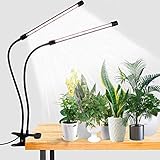
The two related products illustrate the main choices. The GooingTop Grow Light is a 6000K full-spectrum indoor plant lamp priced at about under $20. Its daylight-like color is generally more comfortable in a living space than a strongly purple lamp. The other option costs about under $20 and uses 84 LEDs, two flexible heads, three spectral modes, 10 dimming levels, and a 3-, 9-, or 12-hour timer. Those controls can make it easier to cover two plants or adjust the setup as foliage grows.
Do not assume that a larger LED count automatically means a stronger light. For comparison, look for the lamp’s actual power draw in watts, coverage area, mounting distance, and whether the timer repeats automatically. Small desk-style lights commonly fall in the approximate 5- to 20-watt range, but the number printed in a product listing should be treated as the deciding specification.
Pros
- More consistent growth: A scheduled light source can prevent the thin, leaning growth caused by an inconsistent window.
- Works away from windows: You can keep plants on a bookcase, kitchen counter, office desk, or basement shelf.
- Useful year-round: An LED can supplement weak winter sun or help maintain tropical plants through darker months.
- Low operating cost: A small 10-watt lamp running 12 hours daily uses about 0.12 kilowatt-hours per day, before local electricity rates.
- Compact options are easy to install: Clip-on models take up little space and do not require a dedicated plant cabinet.
- Better control: Dimming, multiple heads, spectral modes, and timers let one lamp serve plants with different positions or needs.
- Helpful for propagation and seedlings: Young plants often benefit from close, steady illumination when a windowsill is unavailable.
Cons
- It adds another daily task: Even with a timer, you must position the lamp correctly and occasionally adjust it as the plant grows.
- Cheap lights vary in strength: A lamp can advertise “full spectrum” or hundreds of LEDs without delivering enough intensity for demanding plants.
- Coverage is limited: A single clip-on light may illuminate one small plant or a narrow group rather than an entire shelf.
- The look is not always attractive: Cords, clamps, and visible fixtures can make a plant display feel more utilitarian.
- Too much light can cause problems: Bleached leaves, dry soil, curled foliage, and heat near the canopy are signs to reassess distance or duration.
- It may not solve every plant problem: Yellow leaves can also result from overwatering, poor drainage, pests, root damage, or nutrient issues.
- Timers and clamps may be basic: Lower-priced lamps can have limited adjustment, a loose clip, or a timer that controls duration rather than a fully customizable schedule.
Who Should Buy It
Buy an LED grow light if your plant sits more than about 2 to 4 feet from a bright window, receives only indirect light, or repeatedly produces small, pale, or stretched new leaves. It is also a sensible purchase for apartments with few windows, offices, bathrooms, north-facing rooms, and homes where winter daylight is noticeably weak.
A small lamp is particularly worthwhile for high-light plants such as many succulents, cacti, herbs, seedlings, and flowering plants. These plants generally need more intensity than a low-light pothos or snake plant. If you are caring for several plants in different locations, the under-$20 two-head option may offer more flexibility because its goosenecks can point at separate pots and its dimming levels allow gradual adjustment.
The under-$20 6000K GooingTop model may suit shoppers who want a straightforward daylight-colored fixture for one plant or a small display. In either case, measure the shelf first. A light that cannot be positioned within the recommended distance is unlikely to perform well, regardless of its advertised spectrum.
Who Should Skip It
Skip a grow light if your plant already receives several hours of strong, appropriate window light and is producing compact, healthy new growth. Adding a lamp will not necessarily make a healthy plant grow faster, and extra equipment can create unnecessary heat, glare, or clutter.
You can also skip it if you only keep genuinely low-light plants in a bright room and are willing to move them seasonally. A lamp is not a substitute for basic care: proper drainage, suitable watering, and a pot that matches the root system still matter. Finally, avoid buying based only on colorful marketing language. If the listing does not clearly state power draw, coverage, mounting distance, and timer behavior, comparison shopping becomes difficult.
Cheaper Alternatives
| Option | Cost | Trade-off |
|---|---|---|
| Bright natural window | $0 | Free, but light changes with weather, seasons, window direction, and nearby buildings. |
| Move plants closer to existing glass | $0 | Can help immediately, but the best spot may be cold, drafty, crowded, or unavailable. |
| Basic white LED household bulb, 8–12W | About $5–$15 | Often cheaper, but it may not provide enough intensity, coverage, or a convenient fixture for plants. |
| Single-head clip-on plant light | About $10–$25 | Affordable and compact, but usually covers one small plant and may lack a reliable repeating timer. |
| GooingTop 6000K full-spectrum lamp | About $20 | A simple daylight-style option; confirm its wattage, coverage, and mounting range before buying. |
| 84-LED, two-head adjustable lamp | About $15 | Offers timers, three modes, and 10 dimming levels, but more controls do not guarantee greater light intensity. |
FAQ
Can a regular LED bulb replace a grow light?
Sometimes, especially for a low-light plant or as a supplement to window light. A regular white LED bulb is less convenient because the fixture may not aim downward, the coverage may be narrow, and the light intensity may be unknown. For seedlings, herbs, succulents, or flowering plants, a purpose-built grow light is usually easier to position and schedule.
How many hours should I leave an LED grow light on?
Begin with 10 to 12 hours daily and provide a consistent period of darkness. Use the plant’s response as feedback rather than increasing the schedule indefinitely. If the foliage fades, dries, or feels warm, reduce intensity or increase distance. If growth remains thin and angled, move the light closer or increase the daily duration gradually.
Can an LED grow light burn houseplant leaves?
Yes, although small indoor lamps are generally less risky than powerful commercial fixtures. Leaves can suffer from excessive intensity or heat when the lamp is too close. Start at the manufacturer’s recommended distance, keep the lamp above rather than pressed against foliage, and check the leaves after several days. White or tan patches, curling, and unusually dry soil indicate that the setup needs adjustment.
Is a 6000K light good for indoor plants?
A 6000K lamp produces a cool, daylight-like appearance and can be a practical choice for leafy growth and general supplementation. Color temperature alone does not tell you how much usable light reaches the plant, however. Check wattage, coverage, distance, and timer features too. For most shoppers, the best answer is not the light with the highest LED count; it is the one that can be placed close enough, run consistently, and fit the plant’s actual location.
Ready to decide? Our #1 pick for 2026 is the Bright natural window.
Live price & availability on Amazon.
Related Reviews & Guides
6 Best Fish Tank Stand 125-Gallons 2026
Signs Aquarium Is Cycled: The Test That Actually Proves It