Last Updated: October 21, 2026
How to lower aquarium pH safely starts with a question worth answering honestly: does it need lowering at all. Where it genuinely does, the limit is 0.2 to 0.3 units per day and the method depends entirely on carbonate hardness in the tank. Test the KH first, then work through the three steps below in the order given.
As an Amazon Associate we earn from qualifying purchases.
As an Amazon Associate we earn from qualifying purchases at no extra cost to you.



By David Nguyen
Measure Before Lowering Anything
pH is a result rather than a setting, so moving it means changing what produces it. Working out how to lower aquarium pH safely begins with three readings that determine whether the job is straightforward, difficult or simply unnecessary.
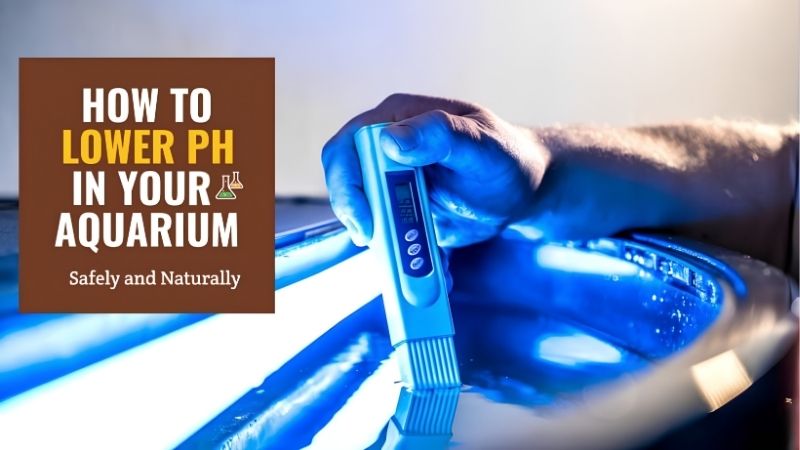
The numbers to take first
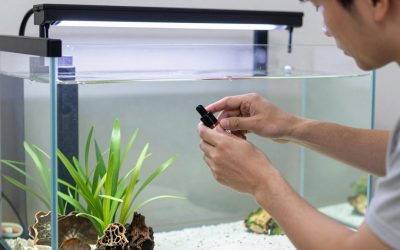
Test pH, KH and GH on both the tank and the tap. Carbonate hardness is the decisive figure: above about 6 dKH (107 ppm) the water resists change strongly, while below 3 dKH (54 ppm) it moves easily and is already at risk of moving on its own.
The safe rate is 0.2 to 0.3 pH units in twenty-four hours, and slower is better. Because the scale is logarithmic, a full unit represents a tenfold change in acidity, which is why apparently small numbers here describe large biological events.
Check ammonia and nitrite before starting as well. Lowering pH shifts ammonia toward its less harmful ionised form, so a tank with an ammonia problem is being masked rather than actually fixed if the reading is dropped at the same time.
Reading the results to choose a method
Carbonate hardness decides which methods can work at all, so the KH result narrows the options before any preference is involved. Getting this the wrong way round is why most attempts at it fail.
High KH with a high pH means dilution with reverse osmosis water is the only approach that holds, since anything acidic added to the tank is simply neutralised by the buffer and produces a swing rather than a lasting shift.
Low KH with a high pH usually points at hardscape, most often crushed coral, limestone rock or a shell-based substrate. Removing the source lowers the reading gradually and permanently, which no additive on a shelf can match.
| Situation | KH reading | Method that works | What to avoid |
|---|---|---|---|
| High pH, high KH from the tap | Above 6 dKH (107 ppm) | Dilute with RO or distilled water | Acid buffers, they rebound |
| High pH from hardscape | Any | Remove coral, limestone or shells | Leaving the source in place |
| Slightly high for soft water fish | 3-6 dKH (54-107 ppm) | Driftwood, peat, catappa leaves | Expecting a fast result |
| Planted tank, want a lower daytime pH | Any | CO2 injection to about 30 ppm | Running CO2 without a drop checker |
| pH fine, fish look unwell | Any | Test ammonia, nitrite, temperature | Adjusting pH as a first response |
| KH already very low | Below 3 dKH (54 ppm) | Leave it, restore buffer instead | Lowering further, risk of a crash |
When lowering pH is the wrong response
Fish behaving abnormally in water with a stable high pH almost never have a pH problem. Test ammonia, nitrite, nitrate and temperature first, since all four cause visible symptoms far more often than an alkaline reading within the normal range does.
Most commercially bred fish tolerate a stable figure well outside their published wild range. Changing the water chemistry for a species raised in local tap water for generations adds risk without adding benefit, and the swing itself becomes the stressor.
How to Lower Aquarium pH Safely, Step by Step
Where a genuine reason exists, the work is gradual and mostly happens outside the tank. These three steps cover how to lower aquarium pH safely without producing a damaging swing along the way.
Step one: remove what is raising it
The first step is subtraction rather than addition, and it is the one most often skipped. Something in the tank is usually holding the reading up, and taking it out achieves more than anything poured in.
Check the substrate and hardscape for crushed coral, limestone, shells or aragonite sand, all of which dissolve slowly and hold pH up. Removing them lowers the reading over days rather than in minutes, which is exactly the rate you want here.
Measure the gap behind the tank and the water line against the heater before ordering any new equipment for this job, since none of it can be adjusted afterwards. Removing decor is also easier to do before the tank is fully stocked and grown in.
Step two: dilute rather than acidify
Dilution is the only approach that reliably holds in hard water, because it lowers the buffer itself rather than fighting against it. It is also slow to take effect, which in this context is a feature.
Where the tap itself is hard, mix reverse osmosis or distilled water into the replacement water rather than treating the tank. Start at 25 percent RO in the change water, measure the resulting pH, then adjust the ratio gradually over several weeks.
Prepare and test the mix in the bucket before it goes anywhere near the fish. That way the tank only ever sees water it can absorb, and the change happens across many weekly changes instead of all in a single session.
Step three: use tannins for gentle, small shifts
Driftwood, catappa leaves and peat release tannins that lower pH modestly in soft water and barely at all where KH is high. The effect is slow, unpredictable and safe, which makes it well suited to closing a small gap rather than a large one.
Expect tinted water as part of the result. Activated carbon removes both the tannins and the colour, so the two cannot be run together if the tannins are there for a reason rather than simply by accident.
How to Lower Aquarium pH Safely: What Not to Do
Three approaches cause most of the losses attributed to pH problems, and each of them has a specific mechanism behind it rather than being a matter of preference.
Do not use acid buffers in buffered water
In water with meaningful carbonate hardness the buffer neutralises the product and the reading returns, so repeated dosing produces a sawtooth pattern. That swing is considerably worse for fish than the steady high reading it was meant to correct.
Do not lower pH quickly
More than 0.3 units in a day is a large change on a logarithmic scale, and the effects appear hours later as clamped fins, hiding or gasping. Where a gap needs closing, plan on weeks of small steps rather than a single afternoon of adjustment.
Do not lower pH to mask an ammonia problem
A lower pH shifts ammonia toward the less harmful ionised form, which changes the risk without removing the nitrogen. The reading on the kit stays the same, the cause remains, and the situation returns as soon as the pH recovers.
Holding the New Reading
A lowered pH only stays useful if it stays steady, and that depends on maintaining enough buffer to prevent it drifting further. This is where most otherwise successful adjustments quietly fail a few months later.
The routine that keeps it stable
A lowered pH is only as stable as the water used to maintain it, so the recipe matters more than the destination. Changing the mix halfway through undoes weeks of careful adjustment in one single session.
Keep changing 20 to 30 percent weekly using the same water recipe every time, whether that is a fixed RO ratio or straight tap water. Consistency in the replacement water is what holds the reading, since every change nudges the tank toward it.
Test pH and KH monthly, and immediately after any change to the supply. A tank running on diluted water has less buffer than it did, which means it needs the routine more rather than less if it is to stay where it has been put.
What can go wrong afterwards
Every parameter in the tank now depends on a routine rather than on the tap, which is a trade rather than a free improvement. Two failure modes follow from that, and both arrive quietly over months.
The main risk is a pH crash in water that now has very little carbonate hardness left. Below about 3 dKH (54 ppm) the reading can fall sharply overnight, particularly in a heavily stocked tank where nitrification consumes the remaining buffer.
Winter adds a second effect. Indoor heating dries the air and accelerates evaporation, and topping up with pure RO water dilutes the buffer further while topping up with tap water pushes the reading straight back the other way.
Early signs to act on
The risk after a successful adjustment is the opposite of the original problem, so the readings worth watching change once the target has been reached. Two of them give useful warning well in advance.
KH falling toward 3 dKH (54 ppm) is the warning worth acting on, and the response is more frequent water changes rather than further adjustment. Fish gasping or hiding after a change points at the rate of change rather than the destination.
If behaviour continues once the water tests within range, that is the point to consult an aquatic vet or an experienced local shop rather than making further chemistry changes on top of the ones that have already been made.
Frequently Asked Questions
These come up when a species profile lists a lower pH than the tap water provides, and adjusting the water seems like the obvious response to that gap.
How to lower aquarium pH safely without chemicals?
Dilute the change water with reverse osmosis or distilled water, remove any carbonate hardscape, and add driftwood or catappa leaves for a gentle final adjustment. All three work gradually, which is precisely what makes them safe to use.
How to lower aquarium pH safely, and how fast?
No more than 0.2 to 0.3 units in twenty-four hours. Because the scale is logarithmic, that represents a substantial change in acidity, and moving faster produces the visible stress people usually attribute to the new value rather than the rate.
Does driftwood lower pH reliably?
Only in water with low carbonate hardness. Where KH is above about 6 dKH (107 ppm) the buffer absorbs the effect and the reading barely moves, which is why driftwood suits fine-tuning rather than correcting a large gap on its own.
Should I lower pH for soft water fish?
Usually not, if the tank is stable. Commercially bred tetras and dwarf cichlids adapt well to a steady figure up to about 7.8, and the swing involved in adjusting is more harmful than the slightly higher reading they were sold into.
See More:
Doing It Gradually
How to lower aquarium pH safely comes down to three rules: test carbonate hardness before anything else, move no more than 0.2 to 0.3 units in a day, and change what produces the reading rather than dosing the reading itself.
Ammonia During Fish Tank Cycling: What the Numbers Mean

Aquarium Feeding Ring Floating Fish Food