Last Updated: October 17, 2026
A koi betta is not a separate species or a hybrid with koi; it is a Betta splendens (Siamese fighting fish) with a marble colour pattern of red, orange, black, blue and white patches that resembles the markings of an ornamental koi. Because it is an ordinary betta, it needs the same care as any other betta: a heated, filtered tank of at least 5 gallons (10 gallons or more is often recommended), a peaceful setup, and a varied protein-rich diet, plus an understanding that its colours can keep changing as the fish ages.
Quick answer: Our top pick in 2026 is the Species — our #1 rated choice. See the full ranked comparison, alternatives and buying advice below.
Koi Betta at a Glance
| Feature | Details |
|---|---|
| Species | Betta splendens, a colour and pattern variety (marble type) |
| Not a species or hybrid | Not a cross between a koi and a betta; it does not occur in the wild |
| Size | About 2.5 to 3 inches (6 to 8 cm); Seriously Fish gives up to 2.8 inches for Betta splendens |
| Tank size | At least 5 gallons for one fish, with 10 gallons recommended by some guides; 10 to 15 gallons or more if tank mates are added (Fishstores, Aquariadise). Seriously Fish lists a larger base of 45 x 30 cm (about 41 litres) for the species |
| Temperature | About 76 to 82 F (24 to 28 C) in most care guides; Seriously Fish gives a wider tolerance of 72 to 86 F |
| pH | Seriously Fish gives about 6.0 to 8.0; many care guides aim for near neutral |
| Diet | Protein-rich: betta pellets plus frozen or live foods |
| Temperament | Males are aggressive toward other males; keep males singly |
| Colour stability | Colours can change over weeks to months and throughout life |
| Health note | Selective breeding is linked to fin rot, swim bladder problems and tumours in some guides; typical lifespan is reported as about 2 to 4 years, sometimes 5 |
What “Koi Betta” Actually Means
The name koi betta describes how the fish looks, not what it is. Aquariadise defines it as a selectively bred variation of Betta splendens with patterns that look like those of koi. Breeders developed the marble betta, and koi-style fish are marble bettas whose patches of red, orange or yellow, black and white or blue sit in a mottled pattern. Within the trade, labels such as “koi”, “nemo”, “galaxy” or “candy” are marketing terms for specific colour combinations and are not recognised species or standardised varieties. The same fish can be sold under different names by different sellers.

Koi Betta (Pair of Male and Female) - Live Freshwater Aquarium Fish - 2 Day Shipping
Included for 'Koi Betta Fish: Colors, Genetics and Care' because the listing specifies Live Freshwater Aquarium Fish and 2 Day Shipping, details this guide uses to compare options.
View on Amazon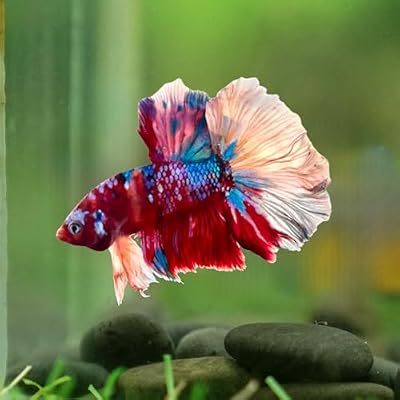
D&A Tropical Live Fish-1 Male Halfmoon Betta Live Fish- Live Betta Fish for Pond, Fish Tank or Aquarium, Live Fish Freshwater (Koi Galaxy Nemo)
Included for 'Koi Betta Fish: Colors, Genetics and Care' because the listing specifies Fish Tank or Aquarium and Live Fish Freshwater (Koi Galaxy Nemo), details this guide uses to compare options.
View on Amazon
D&A Tropical Koi Betta Fish - Male Fancy Plakat, Assorted Color - For Pond, Aquarium or Fish Tank
Included for 'Koi Betta Fish: Colors, Genetics and Care' because the listing specifies Male Fancy Plakat and Assorted Color, details this guide uses to compare options.
View on Amazon
Aquarium Plants Discounts Betta Koi Male 2-3 Inches - Freshwater Live Tropical Fish
Included for 'Koi Betta Fish: Colors, Genetics and Care' because the listing specifies Freshwater Live Tropical Fish, details this guide uses to compare options.
View on AmazonKoi bettas are often short-finned plakat types, though long-finned koi also exist. Aquariadise notes that many have the short tails of plakat bettas. Colours may be bright and bold or pale and watercolour-like. A seller can describe a fish as koi even if the pattern is mostly red and white, so judge the individual fish rather than the label.
The Genetics: Why Koi Bettas Change Colour
The marble pattern is linked to transposons, often called jumping genes, which are sections of DNA that can move to different positions in the genome. Fishstores and a number of hobbyist and breeder sources attribute the marble effect and the colour shifts to this mechanism, although the explanation is widely repeated rather than firmly established in published betta genome research. When a transposon inserts into a pigment gene it can switch that gene off, and when it moves out the gene can switch back on. Because pigment cells keep dividing as the fish grows, patches can appear, disappear or change shade over time. This is why a young koi betta may look quite different as an adult.
A few points are worth being careful about. Details about how many copies of the gene a fish carries and how patch size relates to genotype come largely from hobbyist forums rather than published research, so treat them as informal observations. The same goes for claims about nearly weekly or overnight changes, which sound exaggerated. Most keepers report gradual change across months.
| Question | Reasonable answer |
|---|---|
| Will my koi betta change colour? | Possibly, and it is normal; many do, particularly while young |
| Will it keep its current pattern? | There is no guarantee |
| Does colour loss mean illness? | Not by itself; Fishstores says a healthy marble loses and gains pigment with no change in appetite, fin posture or activity |
| Do breeding pairs produce marble offspring? | Not reliably; hobbyists report that many offspring come out solid-coloured |
| Is the pattern a special species trait? | No, it is a colour variation inside Betta splendens |
Colour Change or Illness? How to Tell
| What you see | Likely cause | What to do |
|---|---|---|
| New patches of red or black, others fading, fish behaving normally | Marble genetics | Nothing; maintain good care |
| Overall dulling with clamped fins and hiding | Stress or illness | Test water, check temperature, look for disease signs |
| Dark stress stripes after moving or a fight | Stress | Remove the cause and give the fish quiet and hiding places |
| Frayed or shrinking fins, discolouration at edges | Fin rot or fin damage | Improve water quality; seek advice if it spreads |
| White fuzz or cotton-like patches | Fungal or bacterial infection | Isolate, check water, ask an experienced keeper or aquatic vet |
| Lumps or swelling | Possible tumour or other disease | Consult a vet; some lumps are not treatable |
Koi Betta Care Basics
Care follows ordinary betta guidelines. Several care guides recommend a minimum of 5 gallons for one betta, with 10 gallons preferred and 10 to 15 gallons or more when adding other animals; Seriously Fish lists a larger base of 45 x 30 cm (about 41 litres) for the species. Smaller containers cannot hold heat or water quality well, and the old idea that bettas thrive in a cup or tiny bowl is a myth that harms fish. Fishstores suggests 76 to 82 F with an adjustable heater, and Aquarium Co-Op gives 78 to 82 F. Pick a stable temperature in that range, around 78 F, and check with a reliable thermometer.
- Heater and thermometer. Bettas are tropical fish; unheated rooms often drop below their comfort range.
- Gentle filtration. A sponge filter or a filter with an adjustable flow suits their fins. Strong currents tire them out.
- Lid. Bettas are good jumpers, and they breathe air from the surface, so leave a small air gap beneath the lid.
- Plants and hiding places. Live or soft artificial plants, caves and a floating leaf give cover and rest areas. Avoid sharp decor that can tear fins.
- Cycled tank. Cycle the tank before adding the fish, so ammonia and nitrite stay at zero.
- Water changes. Regular partial water changes keep nitrate low; the amount depends on tank size and stocking.
Feeding
Bettas are carnivores. Fishstores suggests a small number of pellets per day, split into one or two feedings, with frozen foods such as bloodworms or daphnia a few times a week and a weekly fasting day to help prevent bloating. Treat the exact count as a starting point and adjust to the pellet size and the individual fish. Overfeeding is a common cause of constipation and swim bladder trouble, which are already noted risks in bred bettas. Remove uneaten food after a few minutes, because it fouls the water quickly.
Male vs Female Koi Betta
| Feature | Male | Female |
|---|---|---|
| Colour | Typically more intense, per Aquariadise | Usually slightly paler, though marble females can still be vivid |
| Fins | Longer and more ornate in most forms; short in plakat types | Shorter and less ornate |
| Body | Longer, slimmer | Rounder, with a small white egg spot (ovipositor) between ventral fins |
| Behaviour | Aggressive toward other males; keep singly | Less aggressive but can still be territorial |
| Housing | Alone, 5 gallons or more | Alone, or in a large, heavily planted group only if experienced |
A group of females, often called a sorority, is a more advanced setup, and Seriously Fish notes that only a single betta can be kept per tank in most cases. Hobbyists who try it use a large, heavily planted tank and must be able to separate fish quickly if bullying starts. It is not a good choice for a first-time betta keeper.
Tank Mates
| Tank mate | Compatibility |
|---|---|
| Another male betta | Avoid: fights can be fatal |
| Nerite snails | Usually fine in a larger tank |
| Pygmy corydoras, ember tetras, pygmy rasboras | Listed as possible in a 10 gallon or larger tank with cover (Fishstores); Seriously Fish advises keeping a betta alone in most cases |
| Ghost shrimp or cherry shrimp | Risky: some bettas hunt them (Amano shrimp in a large, planted tank are listed as an option by Fishstores) |
| Guppies and other colourful, flowing-finned fish | Avoid: they can trigger aggression |
| Fin nippers such as many barbs | Avoid: they will damage fins |
Many koi bettas live best alone. A betta may be calm with one tank mate and aggressive with another, so keep a backup plan for separation.
Health and Welfare Considerations
Aquariadise notes that koi bettas are susceptible to fin rot, swim bladder disease and tumours due to selective breeding. That does not mean every fish becomes ill, but it does mean that stable water quality and sensible feeding are important. Fishstores gives a typical lifespan of about 2 to 4 years, occasionally 5 with good care, and other sources vary. If a fish stops eating, stays at the bottom, has swelling or lumps, or shows rapid breathing, test the water first and ask an experienced keeper or aquatic vet for advice. Do not add medications without knowing the problem, because unneeded treatments can stress the fish and harm beneficial bacteria.
Buying a Koi Betta Responsibly
- Look for a fish that is alert, with intact fins, clear eyes and no white spots, and which responds to movement.
- Avoid fish kept in tiny cups with cloudy water, since long-term stress shortens life.
- Do not buy based on the colour you see today alone; remember that the pattern can change.
- Prepare a heated, cycled tank before bringing the fish home, then acclimate slowly.
Frequently Asked Questions
Is a koi betta a different species?
No. A koi betta is Betta splendens with a marble colour pattern, just like other bettas. The name refers to the look of the colours and is not a scientific category. It is not a hybrid with koi.
Why is my koi betta changing colour?
Hobbyist and breeder sources explain the marble pattern with jumping genes called transposons, which are thought to switch pigment genes on and off as cells divide, although this has not been firmly confirmed in published research. Whatever the mechanism, marble bettas are well known for changing colour as they grow. If the fish eats and behaves normally, colour change is generally considered normal.
How big does a koi betta tank need to be?
Care guides recommend at least 5 gallons for a single fish, and some prefer 10 gallons. A tank of 10 to 15 gallons or more is better if you want to add compatible tank mates. Smaller containers make it hard to keep the water warm and clean.
Can koi bettas live together?
Males should not, because they fight, often to injury or death. Females can sometimes be kept in a well-planted group, but this is an advanced setup that requires a large tank and constant monitoring. Most keepers are safer housing one betta per tank.
How can I tell if my koi betta is male or female?
Males usually have brighter colours, longer bodies and, in most forms, longer fins. Females are rounder and show a small white egg spot near the belly fins. Young fish are harder to sex, so confirm with an experienced seller if it matters.
Are koi bettas harder to keep than other bettas?
Their care is the same as other bettas, but selective breeding may make some prone to fin rot, swim bladder problems and tumours. Clean, stable water and careful feeding lower the risks. Colour change by itself is not a sign of poor care.
What should I feed a koi betta?
Offer a quality betta pellet as a staple with occasional frozen or live foods such as bloodworms or daphnia. Keep portions small and consider a weekly fasting day to prevent bloating. Remove anything not eaten within a few minutes.
Ready to decide? Our #1 pick for 2026 is the Species.
Live price & availability on Amazon.
Related Reviews & Guides
Best Nitrate Remover for Aquarium: A Careful Buyer Guide
Best Aquarium Water Test Kit for Shrimp Keepers: Buyer Guide