Last Updated: October 17, 2026
- Koi Types at a Glance
- How Koi Are Classified
- The Gosanke: Kohaku, Sanke and Showa
- Other Main Types
- Black, White, Orange and Yellow Koi
- How to Pick a Variety
- Welfare Reality: Size, Lifespan and Housing
- Buying and Grading Basics
- Maintenance Schedule for a Koi Pond
- Why Pattern and Colour Change as Koi Grow
- Frequently Asked Questions
Koi (nishikigoi) are ornamental varieties of the common carp, Cyprinus carpio, sorted into more than 100 recognised varieties in a number of groups (sources count roughly 11 to 16), and the best-known types are Kohaku (red and white), Sanke (red, white and black), Showa (black with red and white), Shiro Utsuri (black and white), Asagi (blue-grey net pattern), Ogon (single-colour metallic), butterfly koi (long fins) and ghost koi (a metallic hybrid developed in the 1980s). Koi are pond fish that grow large and live for decades, so they are not suited to ordinary home aquariums.
Quick answer: Our top pick in 2026 is the Kohaku — our #1 rated choice. See the full ranked comparison, alternatives and buying advice below.
Koi Types at a Glance
| Variety | Colours and pattern | Group or category | Quick identifier |
|---|---|---|---|
| Kohaku | White body with red pattern only | Gosanke | No black at all |
| Sanke (Taisho Sanshoku) | White with red and small black markings | Gosanke | Small black spots sit above the lateral line; a classic Sanke has none on the head |
| Showa (Showa Sanshoku) | Black body with red and white | Gosanke | Black on the head and in bands wrapping the body; often a black base on the pectoral fins (motoguro) |
| Shiro Utsuri | Black with white | Utsurimono | Two colours only |
| Hi Utsuri, Ki Utsuri | Black with red, black with yellow | Utsurimono | Black base, one other colour |
| Asagi | Blue-grey reticulated (net-like) scales on the back, red on belly, cheeks and fin bases | Asagi / Shusui lines | Net pattern on the back |
| Shusui | Scaleless (Doitsu) form of Asagi, with a row of large scales along the back | Asagi / Shusui | Smooth sides, single line of scales |
| Ogon | Single metallic colour such as platinum, gold (yamabuki) | Hikarimono (metallic) | Mirror-bright single colour |
| Bekko | White, red or yellow base with black spots | Bekko | Tortoiseshell look |
| Butterfly koi | Many patterns, long flowing fins | Fin type, not a colour group | Long pectoral and tail fins, slimmer body |
| Ghost koi | Metallic highlights on a darker body | Hybrid of Ogon and a dark mirror or wild carp | Dark body with bright markings |
How Koi Are Classified
Koi are classified by colour, pattern and scalation, not by species. According to Wikipedia, citing the Zen Nippon Airinkai, there are more than 100 varieties arranged in 16 groups, although other koi dealers and societies count anywhere from about 11 to 16 groups, with the most prestigious category being the Gosanke, or “big three”: Kohaku, Taisho Sanshoku (Sanke) and Showa Sanshoku. The remaining groups include Utsurimono (black-based), Asagi and Shusui (blue and net-patterned), Bekko, Hikarimono (metallic), Kawarimono (miscellaneous), Koromo (white with blue or black-edged scales over the pattern) and Kinginrin (with sparkling scales). Tancho (a single red spot on the head) and Doitsu (scaleless or mirror-scaled) are descriptors that apply across several varieties. A variety name may combine descriptors, so a fish may be a “Doitsu Showa,” meaning a Showa with the scaleless pattern.
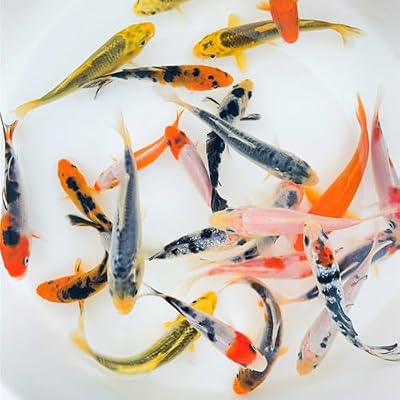
Toledo Goldfish Standard Fin Koi, Variety of Colors and Patterns - Beautiful Live Fish Perfect for Ponds, Tanks, and Aquariums - 3-4 Inches, 20 Count
Included for 'Types of Koi Fish: Varieties, Colors and Patterns Explained' because the listing specifies Variety of Colors and Patterns and Beautiful Live Fish Perfect for Ponds, details this guide uses to compare options.
View on Amazon
Kaytee Koi's Choice Floating Fish Food for Koi, Goldfish & Pond Fish | Supports growth. Fish food pellets for all seasons. 35% protein, fish meal first, highly digestible koi food
Included for 'Types of Koi Fish: Varieties, Colors and Patterns Explained' because the listing specifies Goldfish & Pond Fish and fish meal first, details this guide uses to compare options.
View on Amazon
Tetra Pond Koi Vibrance Soft Sticks, Floating Pond Fish Food, 5.18 lbs | Daily Diet for Koi Fish and Ornamental Goldfish, Feed When Water is Above 50 Degrees, Highly Digestible, Clean & Clear Water
Included for 'Types of Koi Fish: Varieties, Colors and Patterns Explained' because the listing specifies Floating Pond Fish Food and 5.18 lbs, details this guide uses to compare options.
View on Amazon
select 10 Pack of 3-4 inch Live koi Fish
Included for 'Types of Koi Fish: Varieties, Colors and Patterns Explained' as a relevant option in this category; details come from the product listing.
View on AmazonIt helps to think of three layers when decoding a koi name:
- Colour and pattern base: for example Kohaku, Showa or Ogon.
- Scale type: normal scales, Doitsu (mostly scaleless with a row of large scales along the back, created by crossbreeding with scaleless German carp), or Gin Rin (sparkling scales).
- Fin type: normal fins or butterfly (long fins).
The Gosanke: Kohaku, Sanke and Showa
Kohaku
Kohaku is white with a red pattern and nothing else. It is the classic benchmark for judging other varieties. According to Wikipedia, it was established in the late nineteenth century. Quality is judged by how clean the white is, how deep and even the red is, and how well the pattern is balanced along the body.
Sanke
Sanke is essentially a Kohaku with small black markings (sumi) added. Koi dealer guides describe the black as small spots sitting above the lateral line and, in a classic Sanke, not on the head. This head rule is a useful tell when separating Sanke from Showa, although it is not absolute: modern Showa with a lot of white can look Sanke-like, and a small mark near the gill covers is sometimes tolerated.
Showa
Showa is a black koi with red and white laid over it. The black comes in large bands that wrap around the body and usually appears on the head, and a solid black base on the pectoral fin, called motoguro, points to a Showa (Sanke tend to show black stripes through the fin instead). Neither rule is absolute. Showa colours develop and shift as the fish ages, so young fish may look different from adults.
Other Main Types
Shiro Utsuri and the Utsurimono
Shiro Utsuri has a black body with white markings, and it is the most popular of the three Utsuri types. Hi Utsuri (black and red) and Ki Utsuri (black and yellow) make up the rest. Because it has two colours and Showa has three, white-and-black fish with no red are generally Shiro Utsuri.
Asagi and Shusui
Asagi are among the oldest nishikigoi varieties, with a light blue reticulated net pattern on the back and red or orange below the lateral line, often extending to the cheeks and fin joints. Shusui is the scaleless version, showing a clean back with a single line of large mirror scales.
Ogon
Ogon are single-colour metallic koi. Platinum (metallic white) and Yamabuki (metallic gold) are among the most common. Retail guides note that Ogon, Hariwake, Kujaku, Bekko and Shiro Utsuri hold their looks well and usually cost less than Gosanke of similar quality, which makes them a common pick for hobbyists.
Butterfly koi
Butterfly koi, sometimes called longfin koi or dragon carp, have long, flowing fins and are naturally more slender. Wikipedia places their emergence, along with ghost koi, in the 1980s; sources disagree on exactly where and how they were first bred. Breeders have produced butterfly versions of many patterns, including Kohaku, Sanke, Showa, Utsuri and Ogon. The long fins can be more vulnerable to damage and parasites, so water quality matters.
Ghost koi
Ghost koi are a cross between a single-colour metallic koi and a common or mirror carp, which gives metallic highlights on a dark body. Some koi keepers do not consider them true nishikigoi, but they are the same species, Cyprinus carpio. Size estimates vary by source, from roughly 45-65 cm on average to about 90 cm or more at maximum. They are often cheaper than purebred koi but are still large fish that need a large pond.
Black, White, Orange and Yellow Koi
| Colour you see | Possible varieties |
|---|---|
| Mostly white with red | Kohaku |
| White with red and black | Sanke, or Showa if black is on the head |
| Mostly black | Shiro Utsuri (white), Hi Utsuri (red), Ki Utsuri (yellow), Showa |
| Black and white | Shiro Utsuri, Bekko with white base, some ghost koi |
| All orange | Orenji Ogon or Hi Ogon, a metallic orange |
| All yellow | Yamabuki Ogon (metallic gold) or Ki Utsuri |
| All white | Platinum Ogon (metallic) or Shiro Muji (matte white) |
| Blue-grey with a net pattern | Asagi or Shusui |
Colour terms vary between sellers, so the same fish may carry different names. A written variety and scale-type description is more reliable than a general colour.
How to Pick a Variety
| Pick this if… | Choice |
|---|---|
| You want a classic, widely loved look | Kohaku, Sanke or Showa |
| You want a striking contrast but fewer colours | Shiro Utsuri |
| You want a metallic shimmer and easier colour maintenance | Ogon |
| You prefer flowing fins and a softer silhouette | Butterfly koi, with careful water quality |
| You prefer a rugged, lower-priced fish | Ghost koi, understanding it still grows large |
| You want a muted, natural look | Asagi or Shusui |
Welfare Reality: Size, Lifespan and Housing
Whatever the variety, koi are large, long-lived fish. Wikipedia notes they do well at 15-25 C (59-77 F), and that lifespans of 100-200 years have been claimed. Those extreme claims are unreliable, and pond-supply sources give more modest figures, with 25-35 years or more often quoted (and some lower estimates). The safe message is that koi can live for decades, so buying one is a long commitment. Ghost koi are commonly given as reaching about 90 cm, though estimates vary.
Pond guidance from retailers and Fishkeeper is consistent in spirit: a koi pond should be deep (most pond guides give at least about 90 cm, or 3 feet, with 1.2 m or more preferred in cold climates) and large, with strong filtration. Volume guidance varies widely, from several hundred US gallons to 1,000 gallons or more depending on the source and the number of fish. Different sources give different numbers, so treat these as guidelines and consult a koi specialist. A typical home aquarium cannot house adult koi, and small tanks lead to stunted growth, poor water quality and shortened lives. Juveniles sold as “tosai” are tiny, but that stage is brief.
Koi can be affected by parasites, bacterial disease and koi herpesvirus. Quarantine new fish, avoid overstocking, and see an aquatic vet if fish are flashing, lethargic, gasping or showing sores. Medication choices, especially salt and antibiotics, should follow professional advice rather than guesswork.
Buying and Grading Basics
- Pattern balance: clean edges and symmetrical placement are valued in show koi.
- Skin quality: look for smooth, glossy skin without lesions.
- Body shape: a torpedo shape with straight, even fins is prized, though butterfly koi are slimmer by nature.
- Source: a reputable dealer who can show the fish’s quarantine and health history reduces disease risk.
- Future growth: a young koi’s pattern changes, so what you buy is not always what you will keep.
Maintenance Schedule for a Koi Pond
| Frequency | Task |
|---|---|
| Daily | Observe behaviour and feeding; check pump and aeration |
| Weekly | Test ammonia, nitrite and nitrate; partial water change as needed |
| Monthly | Clean filter media gently, preserving bacteria; check for parasites |
| Seasonally | Adjust feeding with temperature; reduce food in cold water and follow seasonal care for your climate |
Why Pattern and Colour Change as Koi Grow
A young koi is a work in progress. Red areas can deepen, fade or spread, black markings can appear later, and pale fish may develop more definition as they age. Showa in particular are known for shifting black patterns over the first years. Water temperature, diet, sunlight and genetics all influence colour, and a koi that looks average as a juvenile may become striking, or the reverse. This is why breeders cull heavily when raising stock, and why buyers of small koi should expect surprises. Colour-enhancing foods exist, but a balanced diet and clean water are the more reliable basics, and overfeeding to push growth can damage water quality. Fish kept in shaded or indoor conditions tend to look paler than those in a sunlit outdoor pond, and some metallic types such as Ogon can look different under varying light. If you are choosing fish for a pond, look at several individuals of the variety in person where possible and ask the dealer about the age of the fish, since a photograph of a mature champion does not predict what a small juvenile will become.
Frequently Asked Questions
What are the three main koi types?
The Gosanke are Kohaku, Sanke (Taisho Sanshoku) and Showa (Showa Sanshoku). They are the most prestigious group and the base for many other varieties.
What is the difference between Sanke and Showa?
Sanke is white with red and small black markings that sit above the lateral line and not on the head. Showa is a black-based fish with red and white, black on the head and often black at the pectoral fin base.
What is a ghost koi?
A ghost koi is a hybrid of a metallic Ogon koi and a common or mirror carp. It shows metallic highlights on a darker body and is commonly said to reach about 90 cm, though size estimates vary.
What are butterfly koi?
They are koi with long, flowing fins and a slimmer body, bred in many colour patterns. The long fins need good water quality and care.
Are black and white koi a specific variety?
Often, yes. A black and white koi with no red is typically a Shiro Utsuri, though some Bekko and ghost koi also look black and white.
Can koi live in an aquarium?
Not long term. Koi can grow large and live for decades, so they need a big, deep, well-filtered pond. A small tank is only a short-term holding setup for young fish.
How many koi varieties are there?
The Zen Nippon Airinkai, as cited by Wikipedia, reports more than 100 varieties in 16 groups, while other dealers and societies count fewer groups. Breeders continue to create new ones, and naming varies somewhat between dealers.
Ready to decide? Our #1 pick for 2026 is the Kohaku.
Live price & availability on Amazon.
Related Reviews & Guides
Fish Tank Bacteria Bloom: What It Is and How Long It Lasts
10 Best Fish Tank Stands For 40 Gallon 2026