Last Updated: October 21, 2026
Aquarium GH vs KH is the most commonly confused pair of readings in freshwater keeping, and the confusion causes real losses. They measure entirely different things, move independently of each other, and need adjusting for different reasons. This comparison covers what each one does and which of them to change first.
As an Amazon Associate we earn from qualifying purchases.
As an Amazon Associate we earn from qualifying purchases at no extra cost to you.



By David Nguyen
What Aquarium GH vs KH Actually Compares
Both readings are called hardness and quoted in the same units, which is where the trouble starts. In practice one describes biology and the other describes chemistry, and knowing which is which decides what to do about a problem reading.
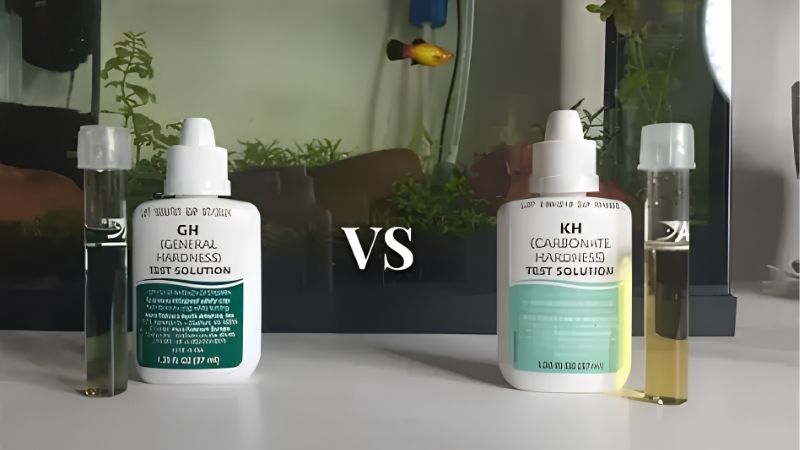
The numbers that separate them
General hardness measures dissolved calcium and magnesium, quoted in dGH or ppm, where 1 dGH is about 17.9 ppm. Most community tanks sit comfortably at 4 to 12 dGH, which is 72 to 215 ppm on the same scale.
Carbonate hardness measures carbonates and bicarbonates, the buffer that resists a change in pH. Target 3 to 8 dKH, or 54 to 143 ppm, and treat anything below 3 dKH as an action threshold because pH becomes unstable beneath it.
The two move independently. A tank can hold high GH with almost no KH, or the reverse, and neither reading tells you anything reliable about the other without measuring it separately with its own test.
What each one is responsible for
GH is biological. Fish, shrimp and snails use calcium and magnesium for osmoregulation, shell formation and moulting, and shrimp in particular fail at the moulting stage when it sits outside their range for any length of time.
KH is structural. It holds pH steady against the acids produced by nitrification and by dissolved carbon dioxide, and when it runs down the pH stops holding still and can fall sharply overnight in a stocked tank.
Tank size, placement and fit
Measure the filter chamber and the gap behind the tank before buying any mineral media or reactor, since neither fits comfortably once the tank is running. A media bag outside the flow path does very little whatever it contains.
Volume decides how quickly either reading moves rather than what it should be. A 10 gallon (38 L) tank on soft water can lose its buffer within a fortnight, while 40 gallons (151 L) with the same stocking takes considerably longer.
The Two Readings Compared by Need
The practical question in aquarium GH vs KH is which one your tank actually needs attention on. The table sorts them by what they govern, and the sections below cover each in turn.
| Aspect | General hardness (GH) | Carbonate hardness (KH) |
|---|---|---|
| Measures | Calcium and magnesium | Carbonates and bicarbonates |
| Target range | 4-12 dGH (72-215 ppm) | 3-8 dKH (54-143 ppm) |
| Action threshold | Outside the species range | Below 3 dKH (54 ppm) |
| Governs | Osmoregulation, shells, moulting | pH stability |
| Raised by | Mineral salts, harder tap water | Crushed coral, aragonite, limestone |
| Lowered by | Dilution with RO water | Dilution with RO water, peat |
| Test how often | Monthly, or when stocking changes | Monthly, weekly on soft water |
GH for fish that need minerals
Livebearers, goldfish and rift lake cichlids all do better toward the upper end, from 8 to 15 dGH (143 to 268 ppm). Low GH shows up over months as poor growth and weak colour rather than as a sudden problem.
The trade is that raising GH for these species usually raises KH and pH alongside it, which suits them and rules out keeping soft water species in the same tank. Choose one group rather than compromising between the two.
GH for shrimp and snails
Neocaridina want 6 to 8 dGH (107 to 143 ppm) and caridina prefer 4 to 6 dGH (72 to 107 ppm). Both fail at moulting when GH is too low, and snails develop pitted, eroded shells in the same conditions.
The limitation worth knowing is that GH supplements for shrimp are formulated differently from general mineral products, and some aquarium additives contain copper, which is lethal to shrimp at concentrations far below what fish notice.
GH for soft water fish and plants
Many tetras, rasboras and dwarf cichlids do best from 2 to 8 dGH (36 to 143 ppm), and most plants are indifferent within that band. Chasing a very low figure adds cost without adding much benefit for commercially bred stock.
The drawback here is that low GH usually comes with low KH, which means the pH stability problem arrives alongside it. Soft water tanks need the water change routine kept up more strictly, not less.
KH for stability in any tank
Anything above roughly 4 dKH (72 ppm) holds pH steady through ordinary nitrification. This is the reading to check first when a pH result looks strange, because a low buffer explains far more unstable readings than any other single cause.
The limitation is that KH says nothing about whether the fish have the minerals they need. A tank buffered with sodium bicarbonate can hold a perfectly stable pH while leaving shrimp and snails short of calcium entirely.
KH for planted tanks with CO2
Injected CO2 pushes pH down through the photoperiod, and adequate KH is what keeps that swing inside a range the fish tolerate. Running CO2 on a tank at 1 or 2 dKH is where sudden overnight drops come from.
The trade-off is that higher KH means more CO2 is needed to reach the same dissolved concentration. A drop checker holding green at roughly 30 ppm remains the practical reference rather than the pH reading itself.
KH for tanks on very soft supplies
Where the tap arrives below 2 dKH (36 ppm), a slow mineral source such as crushed coral in the filter raises it over weeks. Start small, measure after seven days, and add more only if the reading has barely moved.
The drawback is that coral dissolves faster in more acidic water, so the effect is self-limiting but not always gentle. Testing daily for the first week catches a rise faster than the 0.2 to 0.3 pH units per day that is safe.
Aquarium GH vs KH: Which One to Change First
Most tanks need neither adjusting, and where one does, the order matters. Getting aquarium GH vs KH the wrong way round is how people end up with a stable pH and unhealthy shrimp, or healthy minerals and a pH that will not stay still.
The pair most often confused
A low pH almost always means low KH rather than low GH, so KH is the reading to check when stability is the complaint. A shrimp moulting problem almost always means GH, and the pH may be perfectly steady throughout.
Testing both takes five minutes with two titration kits, and doing it once on the tap water before stocking prevents most of these decisions from ever arising. Choose livestock to suit the supply rather than adjusting it indefinitely.
When neither should be touched
A tank holding steady readings inside the species range needs nothing, even if the figures sit away from a published ideal. Adjusting a stable tank toward a chart introduces movement, and movement is the thing that actually harms fish.
Where fish look unwell in water that tests correctly on both, the cause is elsewhere. Test ammonia, nitrite, nitrate and temperature, and consult an aquatic vet if behaviour continues once those four come back clean.
The cheaper route in most cases
Test the tap once, write the figures down, and stock accordingly. That costs a single afternoon against an indefinite commitment to reverse osmosis water, mineral supplements and the storage containers both require.
Where adjustment is genuinely needed, a slow mineral source in the filter beats dosing the tank. It moves both readings gradually and stops when the water no longer dissolves it, which is a safety margin no liquid product offers.
Running Costs, Failure Points and the 12-Month View
Both readings need equipment to monitor and consumables to adjust, and the failure modes differ. This is where the practical difference between aquarium GH vs KH shows up over a year rather than in a single test.
What goes wrong with the measurements
Titration kits count drops until a colour change, so miscounting or a partially blocked dropper produces a wrong result that looks perfectly plausible. Repeating a surprising reading before acting on it is worth the two minutes it costs.
Reagents expire whether used or not, and both kits drift low as they age. Note the purchase date on the box, since a low KH result from an old kit prompts an adjustment the tank never needed in the first place.
Consumables and what they cost
Crushed coral is cheap, lasts months and needs topping up rather than replacing. Reverse osmosis units are the opposite: a real ongoing commitment with membranes and cartridges to replace, plus wastewater and storage to accommodate.
Mineral supplements for shrimp are the recurring cost in a caridina tank, since every change involves remineralising RO water from scratch. Budget for that as a subscription rather than as a one-off purchase at setup.
Safety, certification and what to avoid
Any powered device used alongside these methods, from an RO booster pump to a heater in a mixing barrel, should carry a recognised certification such as UL or ETL and be paired with a GFCI outlet and a drip loop.
On the chemical side, the one hard rule is copper. It appears in some general aquarium products and is lethal to shrimp and snails at concentrations fish never notice, so read the ingredients before anything goes into an invertebrate tank.
Frequently Asked Questions
These come up once a full test kit is in the house and two readings that sound identical come back with different numbers on them.
What is the difference in aquarium GH vs KH?
GH measures calcium and magnesium that fish, shrimp and snails need biologically. KH measures the carbonate buffer that holds pH steady. They are separate tests, move independently, and are adjusted by different methods.
Which matters more for shrimp?
GH, for moulting and shell formation, with neocaridina at 6 to 8 dGH (107 to 143 ppm). KH still matters for stability, and caridina keepers deliberately run it near zero, which makes the water change routine more important rather than less.
Can I raise KH without raising GH?
Sodium bicarbonate does exactly that, and it is rarely the right answer. It leaves the tank buffered but mineral-poor, which suits nothing living in it, so crushed coral or aragonite raising both together is usually the better route.
How often should both be tested?
Monthly in a stable tank, and weekly where the tap is very soft or the tank is heavily stocked. Also test after any change to the water supply, since utilities switch sources seasonally without announcing it clearly.
See More:
Choosing Which to Watch
Aquarium GH vs KH comes down to a division of labour: GH supplies what the animals need at 4 to 12 dGH (72 to 215 ppm), and KH holds the pH still at 3 to 8 dKH (54 to 143 ppm).
Check KH first when stability is the problem and GH first when shrimp, snails or growth are. For most tanks the correct action is to test the tap once, stock to suit it, and leave both readings alone.

Best Aquarium Setup for a Classroom: A Top Compared Guide

Aquarium Fish Food Types: Complete Guide & Best Picks