Last Updated: October 21, 2026
- Top Pick: Tetra Complete 20 Gallon Fish Tank Kit for Freshwater & Saltwater Fish
- Best Value: Tetra Color Complete 20 Gallon Fish Tank Kit for Freshwater, Saltwater Fish
- Premium Choice: Coospider 20 Gallon Glass Fish Tank, Aquarium Starter Kit, Simple Self-Cleaning Aquarium with 3-Color LED Lights, with Quiet Filter Pump, with Temperature Monitoring for Fish, Shrimp, Kids Gift Ideas
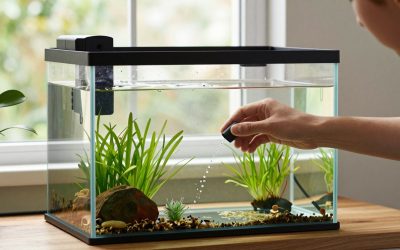
20 gallon aquarium setup for beginners works because the volume is large enough to forgive early mistakes and small enough to sit in an ordinary room. This guide explains what happens chemically inside those 20 gallons, which numbers decide the build, and what the tank will ask of you over its first year.
As an Amazon Associate we earn from qualifying purchases.
As an Amazon Associate we earn from qualifying purchases at no extra cost to you.


By David Nguyen
How a 20 Gallon Aquarium Setup for Beginners Works
Everything in this build follows from volume. A 20 gallon aquarium setup for beginners holds enough water to slow chemical swings down to a manageable pace, and every piece of equipment is sized against that volume rather than picked by brand, price or appearance.
The numbers that define the build
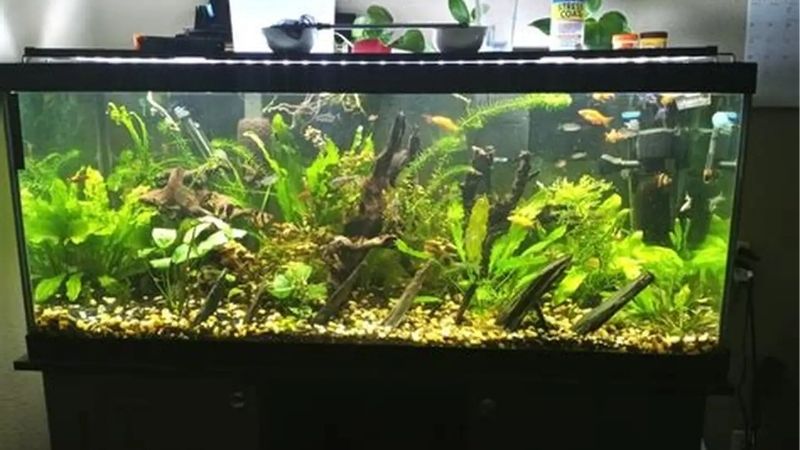
A 20 gallon long measures 30 x 12 x 12 in (76 x 30 x 30 cm) and a 20 gallon high measures 24 x 12 x 16 in (61 x 30 x 41 cm). Both hold 76 L on paper, and both weigh roughly 225 lb (102 kg) once filled, which is the figure the stand carries every day for years.
Usable volume is lower than the label. After 1 to 2 in (2.5 to 5 cm) of substrate and some hardscape, expect 17 to 18 gallons (64 to 68 L) of actual water, which is the figure to use for dosing, turnover and stocking rather than the number printed on the box.
Four items are not optional: a filter moving 80 to 120 GPH (303 to 454 LPH), a heater of 60 to 100 W, a dechlorinator for every refill, and a liquid test kit. Anything else, including decor and a second light, can wait until the tank is running.
The nitrogen cycle inside 17 gallons
Fish waste and uneaten food break down into ammonia. Nitrosomonas bacteria convert ammonia to nitrite, then Nitrobacter and relatives convert nitrite to nitrate. Those colonies live in filter media and substrate, not the water, so media handling matters more than water clarity.
Building that colony takes three to eight weeks with a steady ammonia source dosed to 2 to 4 ppm. It is cycled when a dose clears to 0 ppm ammonia and 0 ppm nitrite within 24 hours and nitrate is measurable. Warmth and oxygen speed it up; chlorinated water stalls it.
Twenty gallons matters here because the same waste load spreads through twice the water of a 10 gallon. Readings climb more slowly, giving you days rather than hours to react. The full nitrogen cycle explainer covers the chemistry in more depth.
Normal ranges and action thresholds
Target ranges for a tropical community are 76 to 80 °F (24 to 27 °C), pH stable anywhere from 6.5 to 7.8, and nitrate under 20 to 40 ppm. Stability beats any particular value, so chasing a textbook pH usually causes more harm than accepting what your tap water gives.
Action thresholds are different from targets. Ammonia above 0.25 ppm, any nitrite above 0 ppm, or nitrate past 40 ppm all call for a water change now rather than at the weekend. Those three readings, plus temperature, are the four numbers to check before changing anything else.
| Parameter | Target in a 20 gallon | Action threshold | How to check |
|---|---|---|---|
| Ammonia (NH3) | 0 ppm | Above 0.25 ppm | Liquid test kit, weekly |
| Nitrite (NO2) | 0 ppm | Any reading above 0 | Liquid test kit, weekly |
| Nitrate (NO3) | Under 20 ppm | Above 40 ppm | Liquid test kit, shake bottle 2 |
| Temperature | 76-80 °F (24-27 °C) | Drift over 2 °F (1 °C) daily | Separate thermometer, daily |
| Turnover | 80-120 GPH (303-454 LPH) | Visible drop in outflow | Watch return, monthly |
| Water change | 20-30% weekly | Nitrate climbing week to week | Bucket or siphon volume |
Putting the Numbers Into a Real Room
The same 20 gallon aquarium setup for beginners behaves very differently depending on where it sits and what ends up living in it. Placement, tank shape and stocking between them decide how much work the equipment has to do every single week.
Tank size, placement and fit
Measure the stand top, the gap behind the tank and the height above it before ordering, since nothing can be moved once filled. Hang-on-back filters need 4 to 6 in (10 to 15 cm) of clear wall, and the heater must stay fully submerged at the lowest water line during a change.
At 225 lb (102 kg) the tank needs a purpose-built stand or furniture rated for the load, sitting level and across floor joists. Keep it out of direct sun to limit algae, away from heating vents, and near an outlet so every cord can form a drip loop below the socket.
How 20 gallons differs from 10 and 55
Volume changes behaviour more than it changes the shopping list, since the same four items appear at every size and only their ratings move. What shifts is how much time a mistake gives you before it shows in the fish, and how much water you move each week to correct it.
Against a 10 gallon (38 L), the extra water halves the concentration of any mistake and slows temperature drift enough that a single cold night stops being an emergency. That margin is the main reason this size is recommended over the smaller tank on the same shelf.
Against a 55 gallon (208 L), the trade runs the other way. The larger tank is more stable still, but 625 lb (283 kg) makes it permanent, and weekly changes mean moving 11 to 17 gallons (42 to 64 L). Twenty gallons keeps a change to two buckets and twenty minutes.
Stocking by species and bioload
Adult size decides stocking, not the size at the shop. A school of six to eight small tetras or rasboras plus a group of corydoras suits a 20 gallon long, while goldfish and most cichlids outgrow it entirely and produce waste at several times the rate of the same length of tetra.
Bioload also sets filter choice. Messy or heavily stocked tanks want the upper end of the 80 to 120 GPH (303 to 454 LPH) range, and box ratings are measured with no media fitted, so real flow drops 30 to 50 percent once cartridges and hoses are in place.
Myths That Cause Most First-Year Losses
Three ideas do most of the damage to a 20 gallon aquarium setup for beginners, and each one has a specific number that replaces it. None of them are obscure claims, and all three still appear on shop shelves, forum threads and product boxes.
Myth: one inch of fish per gallon
This rule ignores body mass, waste output and swimming space. A 3 in (7.6 cm) goldfish and three 1 in (2.5 cm) tetras are not equivalent, and the goldfish produces far more ammonia. Stock by adult size, species temperament and required school size instead of totalling inches.
Myth: the kit contains everything
Most 20 gallon kits ship with a light, a hood and an undersized filter, and omit the heater and test kit. Budget for both before the tank arrives, and check whether the included filter uses proprietary cartridges, which lock you into a recurring purchase you cannot substitute.
Myth: rinse the filter media under the tap
Chlorine and chloramine in tap water kill the bacteria the filter exists to hold, which can restart the cycle. Rinse sponges and bio media in a bucket of tank water pulled during a change, squeeze gently, and replace only the mechanical floss rather than the biological media.
Keeping the Tank Running Past the First Year
A 20 gallon aquarium setup for beginners is equipment that runs continuously, so the honest question is what recurs and what degrades over time. Most of the work is a short weekly routine plus a handful of predictable replacements across the year.
The recurring schedule
The work is the same whichever way the tank is stocked, and it is short enough to fit comfortably into a Sunday morning. What changes with volume is the amount of water moved each week, the size of bucket the job needs, and how long it takes.
Weekly: change 20 to 30 percent, roughly 4 to 6 gallons (15 to 23 L), matching new water to within 1 to 2 °F (about 1 °C) and dechlorinating it. Vacuum a third of the substrate each time, and test ammonia, nitrite and nitrate before deciding whether to change more.
Monthly: rinse mechanical media in tank water, check the impeller for grit, and confirm the heater matches an independent thermometer. Feed only what is eaten in one to two minutes, once or twice daily, since overfeeding causes most climbing readings.
What degrades and when
Heaters drift out of calibration and eventually fail either stuck on or stuck off, which is why an independent thermometer matters more than the dial. Impellers wear and grow noisy, airstones clog, and LED fixtures lose output slowly enough that plants notice first.
Season changes expose all of it. In winter a colder room pushes the heater to a much higher duty cycle, and dry heated air speeds evaporation, so top-off frequency climbs and minerals concentrate in the water left behind. Size wattage against the coldest room.
Test reagents also expire quietly and then read wrong, particularly nitrate bottles that need vigorous shaking. Write the purchase date on the box, and be sceptical of a suspiciously perfect reading during a cycling problem rather than trusting an old kit.
The 12-month running cost
Cost here behaves like a subscription rather than a purchase, and it is the part that buyers most often miss entirely. Nothing on the list is expensive on its own, but all of it recurs on a schedule set by water volume and by the number of fish.
Recurring items are dechlorinator, food, mechanical filter media, test reagents and electricity. The heater dominates power use because it cycles against room temperature, while a small filter draws single digit watts and the light runs six to eight hours a day.
December gift tanks make this visible on a schedule. Tanks given over the holidays reach weeks two to six in January, exactly when ammonia and nitrite peak, which is why new tank problems cluster after the new year. A written maintenance schedule prevents most of it.
Frequently Asked Questions
These are the questions that come up once the tank is home and the equipment is out of the boxes, usually in the weeks before any fish have been bought and while the tank is still working its way through the nitrite stage of the cycle, when readings change fastest.
Is a 20 gallon aquarium setup for beginners better than a 10 gallon?
Yes, for stability. Twice the water dilutes the same waste to half the concentration and slows temperature swings, so mistakes appear as small test readings instead of losses. The cost is a 30 in (76 cm) footprint and 225 lb (102 kg) needing a proper stand.
How long before I can add fish?
Three to eight weeks for a fishless cycle. The tank is ready when a dose of ammonia to 2 to 4 ppm clears to zero ammonia and zero nitrite within 24 hours and nitrate is present. Bottled bacteria may shorten this but does not remove the need to test.
What size heater does a 20 gallon need?
Plan 3 to 5 W per gallon, so 60 to 100 W, and choose the upper end for a cold room. Wattage depends on the gap between room temperature and target rather than on volume alone, and a separate thermometer is the only reliable way to know whether the dial is honest.
Long or high: which 20 gallon should I buy?
The long, in most rooms. Same volume, but 30 x 12 in (76 x 30 cm) gives about a quarter more floor and surface area than the high, which helps bottom dwellers and gas exchange. Choose the high only when shelf length is the binding constraint.
See More:
Getting the Build Right
A 20 gallon aquarium setup for beginners succeeds on four numbers: 17 to 18 gallons (64 to 68 L) of real water, 225 lb (102 kg) of supported weight, 80 to 120 GPH (303 to 454 LPH) of turnover, and 60 to 100 W of heat. Everything else is preference.
Buy the tank, stand, filter, heater, dechlorinator and test kit together, then cycle the tank before any fish arrive. If you are still weighing sizes against each other, the tank size comparison sets this build against every realistic alternative.
Fish Tank Setup Complete Guide 2026: Everything Beginners Need
Beginner Fish Tank Setup: What It Costs and What to Skip