Last Updated: October 21, 2026
Choosing a stand is a measurement problem, not a guess. Learning how to choose an aquarium rack comes down to a short, ordered workflow: identify the exact tank and its footprint, find the full loaded weight, match a stand’s rating and support, then check the floor, and each step rules out a wrong option before the next.
As an Amazon Associate we earn from qualifying purchases.
By David Nguyen
Find the Right Aquarium Rack Requirements
Before comparing any stands, you gather four inputs that a gallon number alone will not give you. The criteria below collect them in order: your exact tank model and footprint, the full setup weight, the aquarium’s required support style, and the floor and final location where the tank will live.
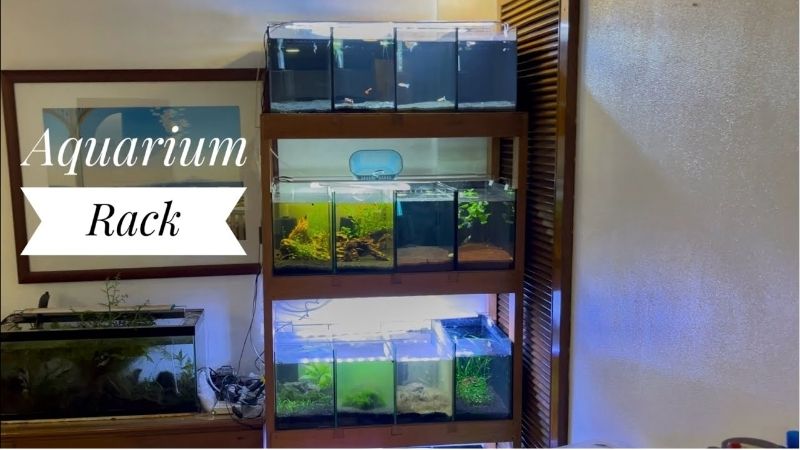
Identify Your Exact Tank Model and Footprint
Start with the tank, not the stand. A 20 High measures about 24 by 12 inches and a 20 Long about 30 by 12, so identifying your exact model and its base dimensions is the first input, because two tanks in the very same gallon class can need completely different stand tops entirely.
So write down the real length and width before shopping at all. That footprint is what you match a stand to, and fixing it first means every later step compares only stands that could actually fit, rather than sorting through options by a volume figure that hides the base you need.
Establish the Full Setup Weight
Next, work out in full what the finished setup actually weighs. Petco’s quick-reference table puts a filled 29 near 330 pounds, a 40 Breeder near 458, a 55 near 625 and a 125 near 1,400, which is the loaded figure to plan a stand around rather than water weight alone, which understates it.
Use a real full-setup weight wherever you can find one. Aqueon’s roughly 10-pounds-per-gallon figure is useful only as preliminary planning shorthand, so treat it as a first estimate and replace it with the reference or measured weight for your exact tank before settling on a stand.
Check the Aquarium’s Required Support Style
Different tanks need different support underneath them. Aqueon distinguishes aquariums that need full, entire-bottom support, such as many acrylic tanks, from some framed glass configurations, so the support style your tank requires is a separate input from its footprint and its weight.
So confirm how your tank is meant to be carried before choosing a top. A stand that suits an edge-supported glass tank may not suit an acrylic one needing continuous support, which is why checking the required support geometry keeps the later stand choice matched to the tank you own.
Check the Floor and Final Location
The last input is where the tank will finally stand. Aqueon calls for a level base that does not wobble, and for aquariums of 100 gallons or more it recommends a load-bearing wall or sturdy flooring, so the site itself is part of the requirements gathered here, not just a late afterthought.
So treat the floor as its own gate alongside the stand. A rack is only one link in the chain, and a heavy system on an unsuitable floor is a problem the stand cannot solve, which is why the location and its structure belong squarely in the requirements you gather up front before shopping.
Fix It Step by Step
With the four inputs in hand, the selection itself is a short sequence, each step eliminating wrong options before the next. The table lays out the order, and the steps below walk through measuring the base, using full setup weight, verifying the stand rating and support, and finally leveling on a suitable floor.
| Step | Input | Example | Decision |
|---|---|---|---|
| 1 | Exact base length by width | 40 Breeder is about 36 by 18 in | Eliminate the wrong footprints |
| 2 | Full loaded weight | About 458 lb reference for a 40 Breeder | Set the minimum support load |
| 3 | Stand rating and design | Brooklyn 40 is rated 660 lb | Confirm the rating exceeds the setup |
| 4 | Floor and site | Level and structurally appropriate | Install only after the site check |
Step 1: Measure Length and Width
Begin by carefully measuring the tank’s base, not by reading its gallon count. The length and width define the footprint every candidate stand must match, so this measurement is what eliminates the wrong options first, before rating, support or price enters the decision at all in this step.
So record the exact base dimensions and shortlist only stands built for them. Starting here means a stand that cannot physically fit is ruled out immediately, which keeps the later comparison focused on options that could actually carry your specific tank across its whole footprint.
Step 2: Use Full Setup Weight
With the footprint fixed, set the load the stand must carry. Use a manufacturer or reference full-setup weight when it is available, such as roughly 458 pounds for a 40 Breeder, rather than a plain water-weight estimate that quietly leaves out substrate, equipment and heavy decor.
Treat the per-gallon rule as strictly preliminary. Aqueon’s roughly 10 pounds per gallon helps you plan, but it is shorthand rather than an exact figure, so the number you actually size the stand against should really be the loaded weight of your own particular setup in the very end.
Step 3: Verify the Exact Stand Rating and Support Geometry
Now confirm a stand whose rating clears that weight. The Brooklyn 40, for example, states a 660-pound limit, which sits about 44 percent above a 458-pound filled 40 Breeder reference, giving published headroom without you assuming any extra hidden capacity beyond that stated number.
Read that margin as capacity over a reference, not a certified safety factor. Confirm the stated rating exceeds your setup with room to spare and that the support geometry suits your tank, since the published maximum is the figure to respect rather than a soft target to push past later.
Step 4: Level the Stand and Evaluate the Floor
The final step moves from the stand out to the site itself. Level the stand so it does not wobble and evaluate the floor, which becomes especially important as the system’s total mass climbs toward hundreds or even thousands of pounds concentrated on a single small footprint underneath.
So install only after the site passes its check. For very large tanks Aqueon flags load-bearing walls and sturdy flooring, so a level stand on a suitable floor is the last gate, because the strongest rack still depends entirely on the surface and structure carrying it all underneath the tank.
Frequently Asked Questions
These answers settle the questions that come up mid-selection, since a clear figure keeps the workflow moving. Each opens with the direct answer and the reference behind it, so a rough rule or a gallon label never replaces the measured footprint, loaded weight and level floor the steps rely on.
How Strong Should an Aquarium Rack Be?
Strong enough for the full setup within the maker’s documented rating, not merely for the water. That means the stand’s stated limit should clear the loaded weight of your specific tank, counting substrate, equipment and decor rather than a plain water-only estimate of the total load.
So size strength to the real load with margin. A rating that comfortably exceeds the full setup leaves room for the extras a tank accumulates, which is why the documented limit matched against a loaded weight, not a water figure, is the honest measure of strong enough for the job.
Can I Estimate Aquarium Weight by Gallons?
As a rough start, yes: Aqueon’s practical shorthand is around 10 pounds per gallon. But that is a planning approximation, so it should be replaced with the exact tank and equipment weight when you actually select the final stand rather than being treated as a precise figure to buy from.
So use the rough estimate to narrow the field and the real weight to decide. The per-gallon figure gets you close enough to shortlist stands, while the loaded weight of your particular setup is what confirms a given rating is genuinely adequate before you finally commit to buying anything.
Does My Aquarium Rack Need to Be Level?
Yes, always, without exception. Aqueon specifically recommends a level base that does not wobble, because an uneven stand can load a tank unevenly, and that uneven stress is a real risk regardless of how high the stand’s own rating happens to be printed on paper in the product listing.
So leveling is a required step, not merely a nicety. Square the stand and confirm stable, even contact with the floor before the tank goes on, since a level base spreads the load as intended while a wobble concentrates it in uneven ways that a strong rating simply cannot offset later.
When Should I Think About Floor Structure?
Aqueon specifically flags aquariums of 100 gallons and larger for load-bearing wall and sturdy-floor consideration, so that is the point where floor structure moves from a minor concern to a real part of the decision about where a large, heavy tank can safely and permanently live in the home.
So for big systems, evaluate the floor before the stand. A 125-gallon setup near 1,400 pounds concentrates serious weight on a small footprint, which is why the structure beneath the stand, not just the stand itself, has to be a real part of the plan at that kind of scale and weight.
Final Thoughts
Knowing how to choose an aquarium rack means following the inputs in order: identify the exact tank and footprint, establish the full loaded weight, verify a stand whose rating and support suit it, then level it on a suitable floor. Treat 10 pounds per gallon as a rough start, not an exact figure.

Fish Tank Cycling Beginner Guide

Fish Tank Setup Step by Step: How the First Eight Weeks Go