Last Updated: October 21, 2026
- Top Pick: MICROBE-LIFT Nite-Out II Aquarium Bacteria for Start-up, Instantly Cycle Aquariums, Add Fish on Day 1, Rapid Ammonia and Nitrite Reducer for Freshwater & Saltwater Fish Tank, 8 Ounces (NITEH08)
- Best Value: MICROBE-LIFT Nite-Out II Aquarium Bacteria for Start-up, Instantly Cycle Aquariums, Add Fish on Day 1, Rapid Ammonia and Nitrite Reducer for Freshwater & Saltwater Fish Tank, 16 Ounces (NITEH16)
- Premium Choice: Fluval Cycle Biological Enhancer, Aquarium Water Treatment, 16.9 Oz., A8351
Nitrate level after aquarium cycle is usually high, and that is the expected result rather than a problem with the tank. Weeks of dosing ammonia produce nitrate with nothing removing it. This guide covers what the reading should be, where it comes from, and how water changes set the level you live with.
As an Amazon Associate we earn from qualifying purchases.
As an Amazon Associate we earn from qualifying purchases at no extra cost to you.




By David Nguyen
What Nitrate Level After Aquarium Cycle Should Be
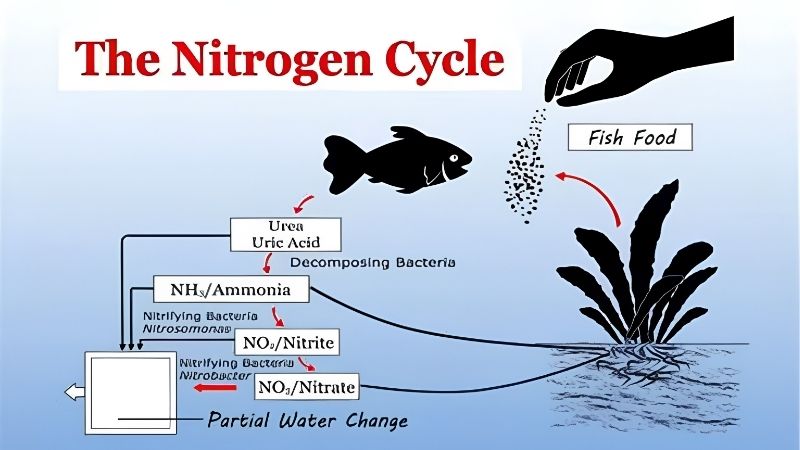
Nitrate is where the whole process ends up, and unlike ammonia and nitrite it does not convert into anything else in a normal freshwater tank. The nitrate level after aquarium cycle therefore reflects how much waste was processed, not how well the filter works.
The numbers that matter
Immediately after a fishless cycle, expect anything from 40 ppm to well over 100 ppm, depending on how many ammonia doses the tank consumed. That figure is confirmation the colony worked rather than a fault, and it needs correcting before fish arrive.
The working target once stocked is below 20 ppm for planted tanks, shrimp and fry, and below 40 ppm for a general freshwater community. Treat 40 ppm as the action threshold: above it, change water now rather than waiting for the usual weekly slot.
Before stocking, change enough water to bring the reading under 20 ppm, which after several weeks of dosing usually means 50 percent or more. Match the new water to within 1 to 2 °F (about 1 °C) and treat it for chlorine and chloramine first.
Where the nitrate actually comes from
Two sources feed the number, and only one of them is inside the tank. Separating them is the first useful step, because the fix for a tank producing its own nitrate is entirely different from the fix for nitrate arriving already in the tap water.
Most of it is produced inside the tank as the end point of nitrification, so every gram of food added eventually appears as nitrate. Stocking level and feeding rate between them set the production rate, and no filter media removes it in a standard freshwater setup.
Tap water is the source people overlook entirely. Many supplies carry 5 to 20 ppm nitrate straight from the tap, and a few run higher in agricultural areas, which puts a floor under the tank that no amount of water changing will get beneath.
Test the tap separately before drawing conclusions about the tank. If the supply reads 20 ppm, a tank sitting at 25 ppm is producing very little of its own, and the fix is stocking or a different water source rather than more frequent changes.
| Nitrate reading | What it means | Typical cause | Action |
|---|---|---|---|
| 0 ppm, cycle finished | Suspect the test | Under-shaken reagent bottle | Shake bottle 2 hard, retest |
| 5-20 ppm | Healthy working range | Normal production and changes | Continue weekly routine |
| 20-40 ppm | Acceptable for most fish | Moderate stocking, weekly change | Tighten schedule if climbing |
| Above 40 ppm | Action threshold | Overstocked, overfed, or overdue | Change 30-50%, reduce feeding |
| Above 100 ppm, new tank | Normal after fishless cycle | Weeks of ammonia dosing | Change 50%+ before stocking |
| Never falls below 20 ppm | Floor set by tap water | Nitrate in the supply | Test tap, adjust stocking |
Normal ranges and action thresholds
A settled tank reads 0 ppm ammonia, 0 ppm nitrite and nitrate somewhere between 5 and 40 ppm depending on stocking, held at 76 to 80 °F (24 to 27 °C) for a tropical community. Of the three nitrogen readings, only nitrate is expected to be present at all.
What matters more than the absolute figure is the direction. Nitrate climbing week on week means production has outrun the change schedule, which is a stocking or feeding question rather than evidence that anything has gone wrong with the filter.
Managing Nitrate in a Real Tank
The nitrate level after aquarium cycle settles at a plateau rather than a fixed number, and that plateau is set by fairly simple arithmetic. Understanding how it works turns nitrate from a recurring worry into an ordinary scheduling decision.
Tank size, placement and fit
Measure the stand top, the gap behind the tank and the water line against the heater before ordering equipment, since none of it adjusts once the tank is full. Access to a tap matters more here than anywhere else, because nitrate control is water changing.
Volume decides how much work each change does. A 20 percent change on 10 gallons (38 L) moves 2 gallons (8 L), while the same percentage on 55 gallons (208 L) means 11 gallons (42 L), which is a bucket problem rather than a chemistry problem.
The arithmetic of the plateau
Nitrate behaves differently from the other two readings because nothing consumes it in an ordinary freshwater tank. That makes it predictable, and it means the number you end up living with is chosen by the routine rather than by the filter.
Nitrate rises until removal matches production, then holds steady. A tank changing 30 percent weekly settles at roughly three times its weekly production, so a tank producing 10 ppm each week plateaus somewhere near 30 ppm regardless of how long it runs.
That gives two levers and only two. Doubling the change percentage roughly halves the plateau, and halving the input by feeding less or stocking lighter does the same, while adding a third weekly change of the same size produces a smaller gain than expected.
Evaporation works the other way and catches people out in winter. Topping up with fresh water replaces what evaporated but removes nothing, so dissolved nitrate concentrates in the remaining volume as indoor heating dries the air and the water line falls faster.
What plants and equipment actually do
Plants and products both get credited with more than they deliver here, though neither is useless. The honest position is that they shift the plateau at the margins, while the water change schedule is what decides where that plateau actually sits.
Fast-growing stem plants and floating species take up nitrate directly and can hold a lightly stocked tank below 10 ppm on their own. Slow growers such as anubias and java fern contribute very little, so plant choice matters more than plant quantity here.
Chemical nitrate-removing resins exist and work for a period before needing regeneration or replacement, which makes them a recurring cost rather than a solution. Deep substrate can host slow anaerobic denitrification, and it is unpredictable enough not to plan around.
Misreadings That Cause Unnecessary Panic
Three mistakes account for most of the confusion about the nitrate level after aquarium cycle, and two of them are testing errors rather than genuine tank problems. Each one has a simple check that settles the question in a couple of minutes at the tank.
Myth: zero nitrate means the cycle failed
Far more often it means the second reagent bottle was not shaken hard enough. Nitrate kits need vigorous shaking of that bottle, often 30 seconds or more, and then the vial itself, and an under-shaken test reliably reads low or reads nothing at all.
Myth: nitrate is harmless because it is the end product
It is far less toxic than ammonia or nitrite, and chronic exposure above 40 ppm still stresses fish, slows growth in young stock and feeds algae. Shrimp and fry are noticeably more sensitive, which is why planted and shrimp tanks aim below 20 ppm.
Myth: a bigger filter lowers nitrate
Filtration produces nitrate rather than removing it, so upgrading the filter increases capacity for waste processing and changes nothing about the end product. Only water changes, plant uptake and reduced input move the number in a standard freshwater tank.
Holding the Number Steady Long Term
Once the tank is stocked, the nitrate level after aquarium cycle becomes the main indicator that the maintenance routine matches the livestock. It moves slowly, which makes it a better long-term signal than either of the other two readings.
The weekly routine that sets the level
Change 20 to 30 percent weekly with dechlorinated water matched to within 1 to 2 °F (about 1 °C), and vacuum part of the substrate each time to remove trapped waste before it breaks down. Test nitrate before the change rather than after it.
Feed only what is eaten in one to two minutes. Feeding is the input the whole chain runs on, so a small permanent increase in portions raises the plateau permanently, which is usually why a stable tank starts creeping upward a month after new fish arrive.
What makes the number drift upward
A plateau that has held for months and then starts climbing is reporting a change somewhere in the tank. Finding that change is far more useful than simply adding another water change to the week and quietly hoping the number holds.
Stocking additions are the obvious cause, and a heavier feeding habit after those additions is the usual hidden one. A filter that has slowed through clogging also concentrates waste in dead spots, where it decomposes without passing through the media.
Holiday periods produce a predictable spike. Tanks left with an automatic feeder for a fortnight, or fed heavily before a trip, come back with nitrate well above the usual plateau, which is worth a larger change on return rather than a normal one.
The recurring cost of keeping it low
Dechlorinator and test reagents are the real ongoing costs, and both scale with how much water is moved. A faucet-connected changer removes the bucket work on larger tanks, which matters because a routine that is tiring is a routine that gets skipped.
Reagents expire whether used or not, and the nitrate bottles are the ones that quietly go wrong first. Note the purchase date on the box and replace them on schedule, since a kit that reads low turns a rising plateau into an invisible problem.
Frequently Asked Questions
These come up in the week after a cycle finishes, when the ammonia and nitrite readings have finally settled at zero and the nitrate result on the same set of tests looks genuinely alarming by comparison with the other two readings.
What nitrate level after aquarium cycle is safe to stock at?
Below 20 ppm is the sensible figure to stock into, and below 40 ppm is acceptable for a hardy community afterwards. After a fishless cycle that usually means a single change of 50 percent or more before any fish at all are added to the tank.
Why is my nitrate always around 20 ppm?
Test the tap water. Many supplies contain 5 to 20 ppm nitrate before it reaches the tank, which sets a floor no water change can go beneath. Where that is the case, lighter stocking and more fast-growing plants are the practical levers available to you.
Can I lower nitrate without water changes?
Only partially. Fast-growing plants take up a useful amount, and reducing feeding and stocking lowers production directly. Chemical resins work for a period and then need replacing, so water changes remain the reliable method in a freshwater tank.
Does high nitrate cause algae?
It contributes rather than causes. Algae needs light, nutrients and time together, so a tank sitting at 60 ppm nitrate with eight hours of light will show far more growth than the same tank sitting at 20 ppm with six hours on a timer instead.
See More:
Setting Your Own Plateau
The nitrate level after aquarium cycle starts high, comes down with one large water change, and then settles wherever production and removal balance. Aim below 20 ppm at stocking and below 40 ppm thereafter, and treat a rising trend as the real signal.
Test the tap first so you know the floor you are working against, shake the second reagent bottle properly, and remember there are only three levers: change more water, feed less, or stock lighter. Everything else adjusts the number at the margins.
Can You Cycle a Tank With Fish: Risks and Safer Options
How to Set Up a Freshwater Aquarium Without Losing Fish