Last Updated: October 21, 2026
- What “Tropical Fish” Actually Means
- The Right Temperature
- Heater Sizing Logic
- Cycling: The Step Beginners Skip
- Stocking Rules That Work Better Than “One Inch per Gallon”
- Quick Facts: A Typical Tropical Community Tank
- 12 Easy Tropical Species for a First Tank
- Feeding and Weekly Maintenance
- Common Problems and Fixes
- Mistakes That Cost Beginners Fish
- Frequently Asked Questions
Tropical fish are freshwater or marine species from warm regions that need a heated aquarium held steadily at roughly 74 to 80°F (23 to 27°C), and most community species do well at 76 to 78°F. A reliable heater, a fully cycled filter and a sensible stocking plan matter far more than the exact number on the thermometer. This guide explains what the term covers, how to size a heater, how to cycle a tank, how to stock it, and which 12 easy species suit a first tropical tank.
What “Tropical Fish” Actually Means
“Tropical” describes where a species evolves, not a family of fish. Tropical species come from rivers, streams, floodplains and reefs in warm latitudes: the Amazon basin, Southeast Asia, West Africa, Central America and the Indo-Pacific. Their metabolism, immune response and digestion are tuned to water that rarely drops below the low 70s Fahrenheit. In a cool room without a heater they become sluggish, stop eating well and are far more prone to infections such as ich.

hygger Small Aquarium Betta Heater, Submersible Fish Tank Heater 10W/25W/50W/100W with LED Digital Display, Suitable for Marine Saltwater and Freshwater up to 5/10/16/26 Gallon
Included for 'Tropical Fish Care Basics: Heater, Temperature and 12 Easy Species' as a relevant option in this category; details come from the product listing.
View on Amazon
Orlushy Submersible Aquarium Heater, Adjustable Fish Tahk Heater with Free Thermometer Suitable for Marine Saltwater and Freshwater
Included for 'Tropical Fish Care Basics: Heater, Temperature and 12 Easy Species' as a relevant option in this category; details come from the product listing.
View on Amazon
HiTauing Aquarium Heater, 50W/100W/200W/300W/500W Submersible Fish Tank Heater with Over-Temperature Protection and Automatic Power-Off When Leaving Water for Saltwater and Freshwater
Included for 'Tropical Fish Care Basics: Heater, Temperature and 12 Easy Species' as a relevant option in this category; details come from the product listing.
View on Amazon
Orlushy Submersible Aquarium Heater, Adjustable Fish Tahk Heater with Free Thermometer Suitable for Marine Saltwater and Freshwater
Included for 'Tropical Fish Care Basics: Heater, Temperature and 12 Easy Species' as a relevant option in this category; details come from the product listing.
View on AmazonThe term is usually applied to freshwater community fish in hobby shops, although marine reef fish are also tropical. This article focuses on freshwater species, which are the practical starting point for most keepers.
Tropical vs Coldwater Fish
Coldwater fish come from temperate regions and tolerate, or need, cooler water. Goldfish are the classic example. They are often sold as the easy first pet, yet they grow large, produce heavy waste and need generous tank space, so “coldwater” does not mean “low maintenance”. Mixing the two groups in one tank is a common mistake, because goldfish are generally kept cooler than tropical species, and a neon tetra kept below its usual range of roughly 70 to 77°F becomes stressed.
| Feature | Tropical freshwater | Coldwater freshwater |
|---|---|---|
| Typical temperature | 74 to 80°F (23 to 27°C) | Roughly 60 to 72°F (16 to 22°C), depending on species |
| Heater needed | Yes, in nearly every home | Usually no |
| Example species | Guppy, neon tetra, betta, corydoras | Fancy goldfish, white cloud mountain minnow, hillstream loach |
| Oxygen in water | Holds less oxygen, so surface movement matters | Holds more oxygen at the same agitation |
| Metabolism and feeding | Faster, smaller frequent meals | Slower in cool water |
| Mixing with the other group | Not advised | Not advised |
A few popular fish sit in the overlap. Seriously Fish gives about 57 to 72°F for white cloud mountain minnows and about 64 to 77°F for zebra danios, so both are often kept unheated or only lightly heated. Their ranges only partly overlap the warmer settings that most tetras and livebearers prefer, and Seriously Fish notes that keeping white clouds warm year-round is likely to shorten their lifespan, so they are not an ideal match for a tank held at 78°F.
The Right Temperature
Most hobby references place the sweet spot for general tropical communities at roughly 76 to 80°F (24 to 27°C), although individual species profiles give wider ranges. Aiming for the middle, around 77 or 78°F, gives a margin if the room cools overnight. Species with special needs differ: discus are usually kept around 82 to 88°F (28 to 31°C), while corydoras are often happier at the cooler end, with bronze corydoras listed at roughly 70 to 81°F by Seriously Fish. Always pick tank mates whose ranges overlap and set the heater to the middle of that overlap.
Stability matters as much as the setting. Swings of more than a few degrees in 24 hours stress fish and are a classic trigger for white spot disease. A thermometer inside the tank is essential, and a second thermometer in a different corner exposes dead spots and a failing heater.
Heater Sizing Logic
The familiar rule of thumb is 3 to 5 watts per gallon, but it is only a starting point. What a heater really has to do is lift the water a set number of degrees above room temperature and hold it there against heat loss through the glass and surface. The sizing depends on four things:
- Temperature rise needed. A room at 68°F and a target of 78°F is a 10°F lift. A room at 60°F needs an 18°F lift and noticeably more power.
- Water volume. More water needs more total energy to warm, though large tanks lose heat more slowly relative to their volume.
- Heat loss. Open tops, outside walls, drafty windows and basements all increase loss. A tight hood, a lid and a spot away from windows reduce it.
- Tank shape. Long, shallow tanks lose more heat through the surface than tall, narrow ones.
| Tank volume | Typical heater class in a normal heated home | Colder room or drafty spot |
|---|---|---|
| 5 gallons | 25 to 50 watts | 50 watts |
| 10 gallons | 50 watts | 75 watts |
| 20 gallons | 75 to 100 watts | 100 to 150 watts |
| 29 to 40 gallons | 100 to 150 watts | 200 watts |
| 55 gallons | 200 watts, or two 100-watt units | 250 to 300 watts in two units |
Sources do disagree. Some experienced hobbyists argue the 3 to 5 watts per gallon figure is too aggressive for rooms that already sit around 70°F, because an oversized heater that sticks on can overheat a small tank quickly. Others point out that very small tanks lose heat so fast that a failed heater can drop a 5-gallon tank several degrees in an hour. Both points favour the same practice: size sensibly, use an adjustable thermostat-controlled heater, and keep a separate thermometer.
For tanks beyond about 40 gallons, two smaller heaters at opposite ends are often preferred to a single large one. If one fails the water cools slowly instead of crashing, and if one sticks on it cannot overheat the tank as fast. A protective guard prevents fish such as loaches and plecos from resting against the hot glass surface.
Cycling: The Step Beginners Skip
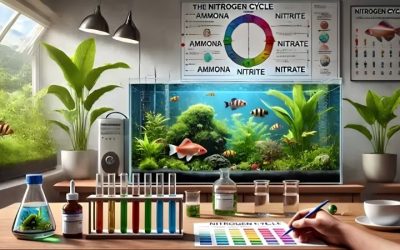
Fish release ammonia through gills and waste, and uneaten food rots into more of it. Ammonia is toxic even at low concentrations. In a mature tank, bacteria colonising the filter media and surfaces convert ammonia to nitrite, and a second group converts nitrite to nitrate, which is far less harmful and removed by water changes and plants. Building that bacterial population is called cycling, and a fishless cycle commonly takes roughly three to eight weeks, sometimes less when seeded with mature filter media.
Fishless Cycling in Five Steps
- Set up the tank with the filter running, heater at about 78°F, and dechlorinated water. Warm water and good oxygenation support the bacteria.
- Add an ammonia source: pure household ammonia without additives or fish food, dosed to around 2 to 4 ppm.
- Test ammonia, nitrite and nitrate every few days with a liquid test kit.
- When ammonia and nitrite both drop to zero within 24 hours of a fresh dose, and nitrate is present, the cycle is done.
- Perform a large water change to bring nitrate down below about 20 to 40 ppm, then stock gradually.
Fish-in cycling is possible but harder on the animals, as it requires frequent partial water changes and very light feeding. Seeding with mature filter media from a healthy established tank can shorten the process considerably, as long as that source is free of disease.
Stocking Rules That Work Better Than “One Inch per Gallon”
The inch-per-gallon rule fails because it ignores body shape, activity, waste output and territory. A 4-inch bristlenose pleco, a 4-inch swordtail and four 1-inch ember tetras do not load a tank in the same way. A better approach checks four things:
- Footprint. Active swimmers such as danios and barbs need tank length, not height. A 20-gallon long offers more usable swimming space than a 20-gallon high for these fish.
- Group size. Schooling species feel secure in groups of at least six, and Seriously Fish suggests 8 to 10 or more for many tetras, rasboras and danios, which show better colour and calmer behaviour in larger groups. A school of eight small tetras in a 10-gallon tank is a legitimate stocking plan; one tetra is not.
- Bioload. Larger and messier fish such as livebearers and plecos produce much more ammonia than tiny tetras of the same total length.
- Filtration and maintenance. A filter rated for several times the tank volume per hour and a weekly water change allow somewhat heavier stocking.
A Worked Stocking Example
Consider a 20-gallon long tank (30 by 12 inches footprint). A balanced community could be: eight ember tetras (about 0.8 inch each, top and middle), eight harlequin rasbora in a second school, five or six peppered or panda corydoras on the substrate, and one dwarf-sized centrepiece fish. That is roughly 23 fish, which looks heavy by the old rule yet is well within what a good filter handles because the fish are tiny and occupy different layers of the water. Swap the tetras and rasbora for six swordtails and the same tank becomes badly overstocked, because adults reach 4 to 6 inches and need much more swimming room.
Add fish in small batches, typically two to three weeks apart, and retest ammonia and nitrite after each addition so the bacteria can catch up with the growing load.
Quick Facts: A Typical Tropical Community Tank
| Parameter | Typical target |
|---|---|
| Temperature | 76 to 80°F (24 to 27°C) |
| pH | 6.5 to 7.8 for most community fish; match to species |
| Ammonia and nitrite | 0 ppm |
| Nitrate | Under about 20 to 40 ppm |
| Minimum tank for a community | 10 gallons, with 20 gallons far more forgiving |
| Water changes | Roughly 20 to 30 percent weekly |
| Care level | Beginner to intermediate |
12 Easy Tropical Species for a First Tank
| Species | Adult size | Tank minimum | Group and notes |
|---|---|---|---|
| Guppy | 1.5 to 2.5 in | 10 gallons | Keep more females than males; breeds rapidly |
| Platy | about 2 in | about 14 gallons or more | Peaceful livebearer; needs harder, alkaline water |
| Swordtail | 4 to 6 in | 29 gallons | Active; males can squabble |
| Neon tetra | about 1.5 in | 10 to 15 gallons | School of eight or more; soft water; buy carefully, as commercially bred stock is often weak |
| Ember tetra | about 0.8 in | 10 gallons | School of eight or more; small mouths; soft, slightly acidic water |
| Harlequin rasbora | about 2 in | 10 to 15 gallons | School of eight or more; peaceful; softer water |
| Cherry barb | about 2 in | 15 to 20 gallons | Group of six or more; milder than most barbs |
| Bronze corydoras | 2.5 to 3 in | 20 gallons | Group of five or more; needs smooth substrate |
| Zebra danio | about 2 in | 20 gallons long | School of eight or more; fast swimmers; tolerates cooler water |
| Betta (female or male, solo) | 2 to 3 in | 5 gallons is the lowest figure cited; about 10 is safer | Warm, filtered, heated tank; males kept alone |
| Kuhli loach | 3 to 4 in | 15 to 20 gallons | Group of five or more; hides; escape-prone |
| Bristlenose pleco | 4 to 5 in | 20 to 30 gallons | Needs wood and vegetable matter; not a cleaner-upper |
Size and tank figures come from Seriously Fish and other commonly cited care sheets; hobby sources vary by about 5 to 10 gallons for some species, so the larger number is the safer choice. Seriously Fish lists a base of about 18 by 12 inches (roughly 11 gallons) for a single betta, while many care sheets accept 5 gallons as a bare minimum. Small tanks of 5 gallons are best reserved for a single betta or a small shrimp colony, not general community stocking.
Feeding and Weekly Maintenance
Feed small amounts once or twice a day, only what the fish eat within about two minutes. Rotate a quality flake or micro-pellet with frozen or live foods such as brine shrimp or daphnia, and add sinking wafers for bottom feeders. Overfeeding is the leading cause of ammonia spikes and algae in new tanks.
| When | Task |
|---|---|
| Daily | Check temperature, feed lightly, look for flashing, clamped fins or missing fish |
| Weekly | Change 20 to 30 percent of the water with dechlorinated, temperature-matched water; vacuum the substrate; wipe glass |
| Every two weeks | Test nitrate and pH; trim plants |
| Monthly | Rinse filter sponge in used tank water, never tap water; check heater and airline tubing |
| Every six months | Replace consumable filter media if needed, keeping the biological media intact; test the heater thermostat against a thermometer |
Common Problems and Fixes
| Symptom | Likely cause | Fix |
|---|---|---|
| White salt-like spots on body | Ich, often after a temperature swing | Raise temperature gradually to about 82 to 86°F if all species tolerate it, use a labelled ich treatment, keep up with water changes |
| Gasping at the surface | Low oxygen, ammonia or nitrite | Test water, change water, increase surface agitation |
| Fish hiding and not eating | Water too cold, bullying or new-tank stress | Check heater, add cover, review tank mates |
| Frayed fins | Fin nipping or poor water quality | Separate aggressors, improve maintenance |
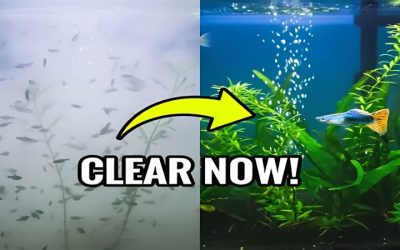
| Cloudy water in a new tank | Bacterial bloom from an immature cycle | Stop overfeeding, wait; it usually clears as the cycle matures |
| Deaths in the first weeks | New tank syndrome from an uncycled filter | Test daily, perform large water changes, consider a fishless cycle next time |
Mistakes That Cost Beginners Fish
- Adding a full stock of fish on day one to an uncycled tank.
- Relying on a preset heater without a separate thermometer.
- Choosing fish only by appearance and ignoring adult size or temperament.
- Keeping schooling fish singly or in pairs.
- Skipping dechlorinator, which removes chlorine and chloramine in tap water.
- Cleaning the filter with untreated tap water and killing the bacteria colony.
Frequently Asked Questions
What temperature should a tropical fish tank be?
Most tropical community tanks do best between 76 and 80°F (24 to 27°C), with 77 to 78°F a common target. Match the setting to the species, because discus want warmer water and some corydoras and danios prefer it a little cooler. Keep it stable, with daily swings under a few degrees.
Do all tropical fish need a heater?
In most homes, yes. Rooms commonly fall below 70°F at night, and most tropical species stay healthier in constantly warm water. A few hardy species such as white cloud mountain minnows tolerate unheated tanks in cool-to-moderate rooms, but they are the exception.
How long should I wait before adding fish to a new tank?
Wait until the tank is cycled, which commonly takes about three to eight weeks without fish. The test is that ammonia and nitrite read zero within 24 hours of adding an ammonia dose while nitrate appears. Stocking before then exposes fish to ammonia and nitrite poisoning.
How many tropical fish can I put in a 10-gallon tank?
It depends on the species, not a fixed inch count. A school of eight ember tetras with a small group of pygmy corydoras is reasonable, while a single swordtail is not. Pick small, non-aggressive species and leave room for growth and for the filter to keep up.
Can tropical and coldwater fish live together?
Generally no. Goldfish prefer cooler water and produce heavy waste, while tropical species need warmth to stay healthy, so one group is always compromised. Keep them in separate tanks.
What are the easiest tropical fish for beginners?
Guppies, platies, harlequin rasboras, cherry barbs, bronze corydoras and zebra danios are widely cited as forgiving (platies and guppies need hard, alkaline water, while harlequin rasboras prefer softer water). Even these need a cycled filter and regular water changes. Easy fish are tolerant of small mistakes, not of neglect.
How often should I change the water?
A weekly change of roughly 20 to 30 percent suits most lightly to moderately stocked tropical tanks. Heavily stocked or small tanks may need larger or more frequent changes. Always treat new water for chlorine and chloramine and match its temperature to the tank.

How Often to Feed Aquarium Fish: A Step by Step Routine
Fish Tank Setup Complete Guide 2026: Everything Beginners Need