Last Updated: October 21, 2026
How to clean a fish tank without removing fish is the standard method rather than a shortcut. Catching fish, holding them in a bucket and returning them causes far more stress than the cleaning does to them. Test the water first, then work through the three steps below in the order they are set out.
As an Amazon Associate we earn from qualifying purchases.
As an Amazon Associate we earn from qualifying purchases at no extra cost to you.







By David Nguyen
Check the Water Before Cleaning Around Fish
Working out how to clean a fish tank without removing fish changes nothing about the chemistry, so the usual readings still govern the job. Knowing how to clean a fish tank without removing fish is mostly about keeping each change small enough that nobody in the tank notices.
The numbers that keep it safe
Remove 20 to 30 percent of real water volume, which sits about 15 percent below the label figure. On a 20 gallon (76 L) tank that is roughly 5 gallons (19 L), and staying inside that range means the fish never experience a meaningful swing.
New water must land within 1 to 2 °F (about 1 °C) of the tank and be treated for chlorine and chloramine. Temperature mismatch is the single most common reason fish look stressed after a clean that was otherwise carried out correctly.
Test ammonia, nitrite and nitrate before starting. Both of the first two should read 0 ppm, and either appearing means the session becomes a response rather than routine maintenance, with 25 to 50 percent of the water changed instead.
Reading the fish while you clean around them
Fish give a running commentary on whether the session is going well, and most of what they do is unremarkable. Knowing which reactions are ordinary and which are worth stopping for keeps the job calm.
Fish retreating to a corner and resuming normal behaviour within minutes is ordinary. Persistent hiding, clamped fins or gasping at the surface after the refill points to temperature or untreated water rather than to the disturbance itself.
A fish that follows the siphon around is simply curious and needs no intervention. The one thing to avoid is cornering anyone with the tube, since a fish trapped against the glass is really the only injury risk in the whole job.
| What you see | When | Likely cause | First action |
|---|---|---|---|
| Fish hide, then resume feeding | During and after | Normal response to disturbance | Nothing, continue as planned |
| Gasping at the surface | Within hours | Untreated water or temperature swing | Aerate, test, check dechlorinator |
| Clamped fins, sitting low | Same evening | New water several degrees off | Stabilise slowly, match next time |
| Ammonia reading next day | 24-48 hours | Filter and substrate cleaned together | Change 25%, feed less |
| Water cloudy afterwards | Hours to days | Fine substrate disturbed | Leave it, it settles |
| Fish caught against the tube | During vacuuming | Cornered by the siphon | Release flow, work more slowly |
When cleaning is not what the tank needs
Cloudy water in a tank under six weeks old is a bacterial bloom rather than dirt, and cleaning harder does nothing for it. Leave the substrate largely alone during that period and let the bacterial colony establish first.
Persistent algae is a light and nutrient problem rather than a cleaning one. Scrubbing weekly without shortening the photoperiod or lowering nitrate simply means the same growth returns within days of every session.
How to Clean a Fish Tank Without Removing Fish Step by Step
The sequence below keeps the disturbance short and the parameters stable throughout. Three steps cover cleaning a fish tank without removing fish on a normally stocked freshwater tank of any size.
Step one: prepare, unplug and scrape
Prepare the replacement water first, matched within 1 to 2 °F (about 1 °C) and dechlorinated. Unplug the heater before the water line drops, and the filter as well if the level will fall below its intake, since both of them fail when run dry.
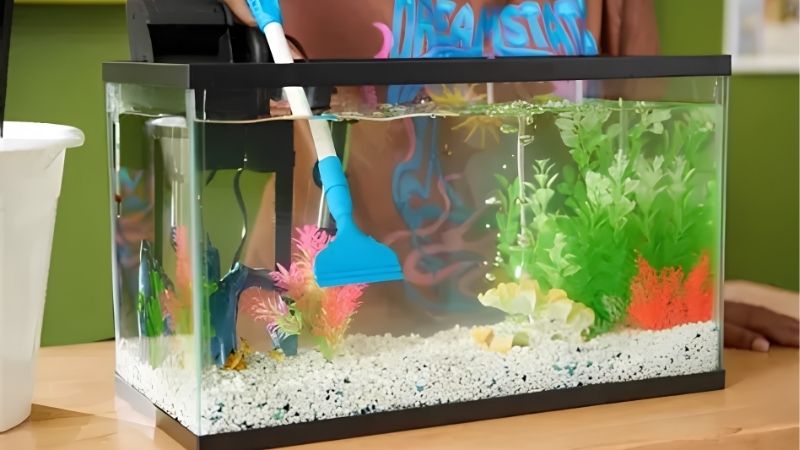
Scrape the viewing glass before siphoning so the debris leaves with the water. Work the scraper away from the substrate line to avoid dragging grit across the glass, which is how acrylic tanks pick up their permanent scratches.
Step two: siphon and vacuum around the fish
Working with fish in the tank changes the pace rather than the technique. Everything is done more slowly and more deliberately, which costs a few extra minutes and removes essentially all of the risk.
Vacuum roughly a third of the substrate, pushing the tube in until the gravel lifts and tumbles. Move deliberately rather than quickly, and let curious fish investigate the tube rather than herding them away from the area you are working on.
Keep decor in place. Removing ornaments to scrub them disturbs far more than it cleans, and anything genuinely coated in algae can be lifted out, rinsed in the bucket of removed tank water and returned within the same session.
Step three: refill gently and restart
Pour the new water against the glass or onto a plate rather than directly onto the substrate or onto a fish. Measure the gap behind the tank before buying a hose, since a kinked line makes controlled refilling almost impossible.
Restart the heater and filter once the water covers both, then check the temperature again after twenty minutes. Feed lightly or skip the feeding for that day, since fish gain nothing from a full portion immediately after the disturbance.
How to Clean a Fish Tank Without Removing Fish Badly
Three actions turn an ordinary clean into a genuine risk for the fish, and all three of them come from treating thoroughness as the goal rather than stability.
Do not net the fish out
Catching, transporting and returning fish causes handling stress, damages the slime coat and exposes them to a second set of parameters in the holding container. The disturbance of cleaning a fish tank without removing fish is trivial by comparison.
Do not strip the tank in one session
The urge to do everything at once usually arrives after a tank has been left a while, and it is exactly the wrong response to that situation. Thoroughness in a single session is what causes the damage.
Removing all the decor, vacuuming the whole substrate and servicing the filter together strips bacteria from every surface at once. Spread those tasks across separate weeks so that the colony is never disturbed in more than one place at a time.
Do not use soap or household cleaners
Nothing that has met detergent goes near the tank, including buckets, scrapers and ornaments. Residues are difficult to rinse away completely and are harmful at concentrations well below the level that leaves a visible film.
How to Clean a Fish Tank Without Removing Fish Weekly
The reason this works is that each session is small. Cleaning a fish tank without removing fish stays safe precisely because nothing changes by more than the fish can comfortably absorb in a single afternoon.
The weekly routine
Keeping each session unremarkable is mostly a matter of doing it often enough that nothing accumulates between them. The routine below is the same one that governs any water change, with the scraping added at the front.
Change 20 to 30 percent weekly, vacuum a rotating third of the substrate, scrape the viewing glass and test the three readings before starting. Keep the filter service in a separate week entirely from any substrate work.
Feed what is eaten in one to two minutes. Feeding sets how much waste reaches the substrate, so portion control keeps sessions short more effectively than any improvement in vacuuming technique.
What makes sessions longer over time
A routine that took fifteen minutes in the first month can take twice that by the sixth, and the tank rarely announces why. Two causes account for nearly all of the drift in either direction.
Dense hardscape creates dead spots where waste settles out of the flow, and a filter slowed by clogging has the same effect across the tank. Both turn a fifteen minute job into a considerably longer one within a few months.
Equipment wears quietly. Siphons clog and lose suction, scrapers pick up grit that scratches, and a heater left unplugged after a session shows up as a temperature drop several hours later rather than straight away.
Early signs to act on
Most sessions pass without incident, and the two that do not tend to announce themselves within a day. Both have straightforward responses that do not involve adding anything to the water.
Any ammonia or nitrite reading after a session means too much was disturbed at once. Change 25 percent, feed lightly, and separate the filter and the substrate tasks into different weeks from then on.
Behaviour that persists once the water tests clean is a different question. Continued gasping, hiding or refusal to feed is the point to consult an aquatic vet or an experienced local fish shop rather than adding anything to the water.
Frequently Asked Questions
These come up the first time someone plans a proper clean of an established tank and assumes the fish need to be somewhere else entirely while it happens.
Is it safe to clean a fish tank without removing fish?
Yes, and it is safer than the alternative. Netting and holding fish causes handling stress and slime coat damage, while a 20 to 30 percent change with properly matched water barely registers as an event for them.
How much water can I take out with fish inside?
Keep single changes to 50 percent at most, and 20 to 30 percent for routine work. Leave enough depth for the fish to swim normally throughout, and never drain to the point where any fish is lying on its side.
How to clean a fish tank without removing fish, deeply?
Split it across several weeks rather than doing it all at once. Several 15 to 20 percent changes on consecutive days, with a third of the substrate each time, reach exactly the same result without swinging pH and hardness.
Can I clean the decorations while the fish are in?
Yes, one or two pieces at a time. Lift them out, rinse in the bucket of removed tank water, and return them in the same session, leaving the rest in place so that the colony and the layout are not disturbed all together.
See More:
Cleaning Around Them
How to clean a fish tank without removing fish comes down to keeping every session small: 20 to 30 percent of the water, one third of the substrate, matched refill water within 1 to 2 °F (about 1 °C), and the filter left for a different week.
How Are Giant Aquarium Tanks Emptied and Cleaned?

Aquarium Water Clarifier and Flocculant