Last Updated: October 21, 2026
- Why Stocking Limits Matter
- The Problem With the One-Inch Rule
- Stocking Guidelines by Tank Size
- Factors That Affect How Many Fish You Can Keep
- Let Your Water Tell You
- Signs You Have Too Many Fish
- Stocking Examples for Popular Tank Sizes
- The Importance of the Water Column
- Compatibility Beyond Numbers
- Top-Rated Picks
- Frequently Asked Questions
- Conclusion
- Related Articles
- Related Guides
⚡ Key Takeaways
As an Amazon Associate we earn from qualifying purchases at no extra cost to you.


Get instant results in seconds — no signup.
- Every fish you add increases the bioload, meaning the amount of waste your filter and water changes must process.
- The old guideline of one inch of fish per gallon ignores the realities of fish biology.
- A lightly stocked tank is more stable, more forgiving of mistakes, and far easier to keep healthy.
- A common pleco may be three inches at the store but can exceed a foot as an adult.
Figuring out how many fish in a tank you can safely keep is one of the trickiest balancing acts in the hobby. Overstocking is the most common beginner mistake, and it leads to poor water quality, stressed fish, aggression, and disease. Yet the popular advice you will hear, like the one-inch-per-gallon rule, is too simplistic to trust on its own. The real answer depends on tank size, filtration, the species you keep, their adult size, and their waste output. This guide gives you practical stocking tables and the reasoning behind them.
Related: best 5-gallon fish tank kits.
🛒 Best Price Today on Amazon
Prime members get fast, free shipping on everything above, plus member-only deals. New members get a 30-day free trial — cancel anytime.
Why Stocking Limits Matter
Every fish you add increases the bioload, meaning the amount of waste your filter and water changes must process. Push past your tank’s capacity and ammonia and nitrate climb faster than you can manage, oxygen levels drop, and territorial disputes flare up. Responsible stocking protects both water quality and the long-term health of your fish.
The Problem With the One-Inch Rule
The old guideline of one inch of fish per gallon ignores the realities of fish biology. A slender one-inch tetra and a chunky one-inch goldfish produce vastly different amounts of waste. Body mass, activity level, and territorial needs matter far more than length alone. Use the rule only as a rough starting point, then refine with the factors below.
Stocking Guidelines by Tank Size
| Tank Size | Small Fish (under 2″) | Medium Fish (2–4″) | Example Stocking |
|---|---|---|---|
| 10 gallons | 5–8 | Not recommended | A small school of nano fish |
| 20 gallons | 10–15 | 5–6 | A community of tetras and corys |
| 29 gallons | 15–20 | 8–10 | Tetras, rasboras, a centerpiece fish |
| 40 gallons | 20–25 | 10–12 | Larger community with dwarf cichlids |
| 55 gallons | 25–30 | 12–16 | Schooling fish plus a small showpiece |
These are conservative ranges that assume good filtration and weekly water changes. When in doubt, understock. A lightly stocked tank is more stable, more forgiving of mistakes, and far easier to keep healthy.
Factors That Affect How Many Fish You Can Keep
Adult Size, Not Store Size
Fish are usually sold as juveniles. A common pleco may be three inches at the store but can exceed a foot as an adult. Always research the full grown size before buying, not the size in the tank at the shop.
Waste Output
Some species, like goldfish and cichlids, are heavy waste producers and need far more room than their length suggests. A single fancy goldfish realistically needs 20 gallons or more despite its modest size.
Swimming Space and Territory
Active swimmers like danios and barbs need horizontal swimming room, while territorial species need defined boundaries. Overcrowding sparks aggression even when water quality is fine.
Filtration and Oxygen
Strong filtration and good surface agitation raise your effective capacity by processing waste and oxygenating the water. A wave maker or powerhead improves circulation and gas exchange, which becomes increasingly important in well-stocked tanks.
Let Your Water Tell You
The ultimate test of whether you are overstocked is your water chemistry. If nitrate climbs quickly between water changes, or you struggle to keep ammonia and nitrite at zero, you have too many fish for your maintenance routine. A reliable water test kit turns this from guesswork into a clear signal.
Schooling and Social Needs
- Many popular species, like tetras, rasboras, and corydoras, must be kept in groups of six or more to feel secure.
- Factor these minimum group sizes into your plan rather than mixing single specimens.
- Some species are territorial and need extra space per individual.
- Mixing aggressive and peaceful fish reduces the total number you can comfortably house.
Signs You Have Too Many Fish
- Nitrate rises rapidly despite regular water changes.
- Fish gasp at the surface, indicating low oxygen.
- Frequent disease outbreaks and persistent stress.
- Increased aggression and nipped fins.
- Cloudy water that keeps returning.
Stable temperature also affects oxygen capacity, since warm water holds less dissolved oxygen. Keeping an eye on a quality thermometer helps you avoid pushing a stocked tank into oxygen stress on hot days.
Stocking Examples for Popular Tank Sizes
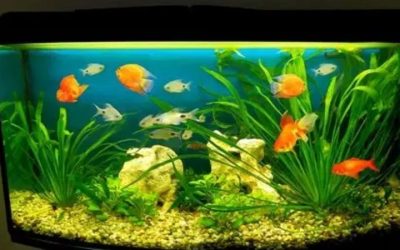
Concrete examples make stocking far easier to visualize. In a 20 gallon tank, a satisfying community might include a school of eight neon tetras, six corydoras catfish, and a single centerpiece like a dwarf gourami, with room to spare. This combination spreads fish across the top, middle, and bottom of the water column, creating visual interest without crowding.
A 29 gallon tank opens up more options, such as a school of ten harlequin rasboras, six panda corydoras, a small group of three honey gouramis, and a few nerite snails for algae control. Stepping up to a 55 gallon allows a more ambitious display, perhaps a large school of fifteen tetras, a group of eight corydoras, a pair of dwarf cichlids, and a bristlenose pleco. Notice how each plan favors schools over single fish and leaves margin rather than maxing out capacity.
The Importance of the Water Column
Smart stocking considers not just how many fish but where they swim. Fish occupy different zones: top-dwellers like hatchetfish and gouramis, mid-water schoolers like tetras and rasboras, and bottom-dwellers like corydoras and loaches. Distributing your stock across these zones makes a tank look fuller and more natural while reducing competition and territorial conflict.
Packing too many fish into the same zone, such as several bottom-dwelling species competing for the same floor space, creates stress even if your overall numbers look reasonable. Thinking in three dimensions rather than just counting heads leads to more harmonious, better-looking communities.
Compatibility Beyond Numbers
- Temperament: avoid mixing fin-nippers like tiger barbs with long-finned fish like bettas or angelfish.
- Adult size: never combine fish small enough to be eaten with much larger tank mates.
- Water needs: group fish with similar temperature and pH preferences.
- Activity level: pair calm species together and energetic species together to reduce stress.
- Territory: give cichlids and other territorial fish enough space to establish boundaries.
A tank that respects compatibility houses fewer conflicts and healthier fish than one stocked purely by the numbers. The best aquariums balance quantity, zone distribution, and temperament together.
Top-Rated Picks


| Product | Brand |
|---|---|
| Aqueon Shrimp Pellets Sinking Food for Tropical Fish,… | Aqueon |
| API BOTTOM FEEDER PELLETS WITH SQUID Fish Food 1.3-Ou… | API |
| Tetra ShrimpWafers Complete Diet for Catfish and Loac… | Tetra |
| Hikari Tropical Sinking Wafers for Catfish, Loaches a… | Hikari |
| Ultra Fresh Bottom Feeder Fish Food, Sword Prawns, Na… | UltraFresh-ShrimpDelight |
Frequently Asked Questions
Is the one-inch-per-gallon rule accurate?
Only loosely. It ignores body mass, waste output, and territory. Use it as a rough starting point, then adjust based on species and your test readings.
How many fish can a 10 gallon tank hold?
A 10 gallon tank suits roughly five to eight small nano fish, such as a single species school. It is too small for most medium or messy fish.
Can I overstock if I have a strong filter?
A powerful filter helps with waste, but it does not remove nitrate or create swimming space. Overstocking still causes stress and aggression regardless of filtration.
Do I count fry toward my stocking limit?
Once fry grow, yes. Plan ahead, because a tank that looks understocked with babies can quickly become crowded as they mature.
What is the safest approach for beginners?
Understock deliberately. Fewer fish mean more stable water, easier maintenance, and healthier animals, giving you room to grow into the hobby without disasters.
Does adding more plants let me keep more fish?
Live plants help by absorbing some nitrate and improving water quality, which gives you a little more margin. However, plants do not increase swimming space or reduce territorial conflict, so they are not a license to overstock.
How does filtration affect my stocking limit?
Strong biological and mechanical filtration processes waste faster and supports a slightly higher bioload, but no filter removes nitrate or creates room for fish to swim. Filtration raises your ceiling modestly, not dramatically.
Why do my fish fight even though water quality is good?
Aggression usually stems from crowding, lack of territory, or incompatible temperaments rather than water chemistry. Reducing stock, adding hiding spots, and choosing compatible species typically resolves it.
Conclusion
There is no single magic number for how many fish in a tank, because the right answer depends on size, species, filtration, and your maintenance habits. Use stocking tables as a guide, research adult sizes, and let your nitrate readings confirm whether your bioload is sustainable. When you respect these limits and lean toward understocking, you reward yourself with clearer water, calmer fish, and a far more enjoyable aquarium.
How to Choose Aquarium Tank Footprint in 2026: What Actually Matters

Aquarium Test Strips