Last Updated: October 21, 2026
- Top Pick: MICROBE-LIFT Nite-Out II Aquarium Bacteria for Start-up, Instantly Cycle Aquariums, Add Fish on Day 1, Rapid Ammonia and Nitrite Reducer for Freshwater & Saltwater Fish Tank, 8 Ounces (NITEH08)
- Best Value: API QUICK START Freshwater and Saltwater Aquarium Nitrifying Bacteria 4-Ounce Bottle
- Premium Choice: Brightwell Aquatics MicroBacter7 Biological Filter Bioculture Aid, 500 ml
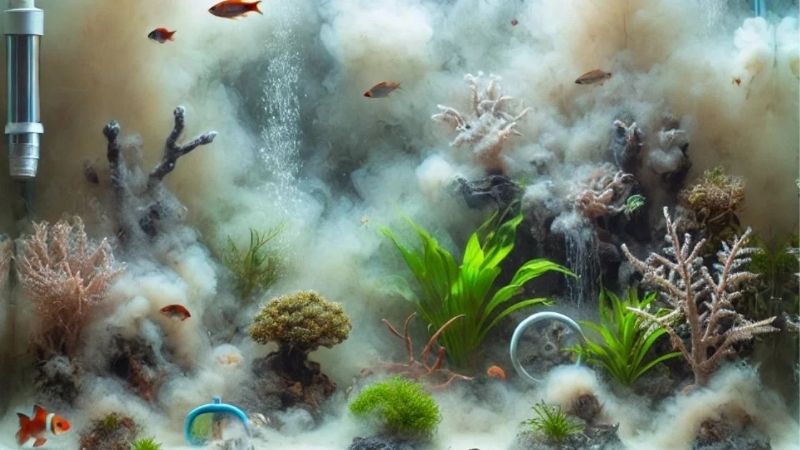
Fish tank bacteria bloom describes one specific event: heterotrophic bacteria multiplying fast enough in the water column to turn it visibly milky. These are not the nitrifying bacteria you are trying to grow, the event is not usually dangerous, and it clears in three to ten days without any help at all.
As an Amazon Associate we earn from qualifying purchases.
As an Amazon Associate we earn from qualifying purchases at no extra cost to you.




By David Nguyen
Two Kinds of Bacteria, One Cloudy Tank
Two completely different groups of bacteria live in an aquarium, and only one of them causes cloudiness. A fish tank bacteria bloom involves the fast-reproducing group that feeds on dissolved organic matter, while the slow-growing nitrifiers stay on surfaces where you cannot see them.
The Deciding Number Is Ammonia, Not the Cloudiness
Test ammonia, nitrite, nitrate and temperature with a liquid kit. Ammonia 0 ppm and nitrite 0 ppm alongside a milky tank means the bloom is harmless and needs nothing but time and reduced feeding for the next few days.
Ammonia above 0.25 ppm alongside the same appearance is a different situation entirely. That combination means the nitrifying colony is not keeping pace, and the correct response is a 25-50% water change today with temperature matched to within 1-2 °F (about 1 °C).
Note tank age as well. A bloom in a tank under three months old is a normal stage of maturation, while a bloom in an established tank means something specific happened in the preceding week, usually to the filter or the substrate.
The Biology: Why These Bacteria Multiply So Fast
Heterotrophic bacteria consume dissolved organic carbon, the compounds released by uneaten food, fish waste, decaying plants and disturbed detritus. They reproduce in a matter of hours rather than days, which is why a tank can go from clear to milky overnight.
Nitrifying bacteria work on an entirely different timescale, doubling in roughly fifteen to twenty-four hours under good conditions. This is why establishing a cycle takes three to eight weeks while a bloom appears in one, and why the two are never the same event.
The bloom ends when the food runs out. Once the pulse of dissolved organics is consumed, the population crashes back to what the remaining supply supports, and the water clears without intervention. Adding bottled bacteria does not shorten this because it is not a shortage of bacteria.
There is one genuine risk during a dense bloom, and it is oxygen. Bacteria in the water column consume it continuously, so a warm, heavily stocked tank can dip low overnight. Rapid gill movement before dawn is the signal to add an air stone immediately.
Normal Ranges Against Action Thresholds
The table pairs each version with its readings and the appropriate response. In three of the five rows the correct action is to do nothing beyond feeding less, which is genuinely the hardest instruction to follow.
| Situation | Readings | What it means | Action |
|---|---|---|---|
| Milky water, tank under 3 months | Ammonia and nitrite above 0 | Cycling bloom, normal stage | Change 25-50%, protect fish, wait |
| Milky water, tank under 3 months | Ammonia 0, nitrite 0 | Organic bloom, tank maturing | Feed less, wait 3-10 days |
| Milky water after filter cleaning | Ammonia above 0.25 ppm | Nitrifying colony disrupted | Change 50%, leave media alone |
| Milky water after substrate vacuuming | All four normal | Organics released from substrate | Nothing, clears in a few days |
| Recurring blooms in an old tank | Nitrate above 40 ppm | Organic load outgrowing the schedule | Larger changes, less food |
What This Means in a Real Tank
Every tank contains these bacteria continuously. What varies is whether they ever get a large enough pulse of food to become visible, and that depends on volume, stocking and how maintenance is actually carried out rather than on tank quality.
Tank Size, Placement and Fit
Volume determines concentration. A 5 gallon (19 L) tank concentrates released organics four times more than a 20 gallon (76 L) tank, so identical overfeeding produces a visible fish tank bacteria bloom in the nano setup and nothing at all in the larger one.
Real capacity is lower than the printed figure. A 20 gallon (76 L) tank holds roughly 17-18 gallons (64-68 L) after substrate and hardscape, which matters when you calculate the size of a corrective water change under pressure.
Filter capacity and placement decide how quickly it clears. Measure before you order: 4-6 in (10-15 cm) behind the tank for a hang-on-back filter, cabinet height for a canister housing plus the hose bend above it, and stand capacity against roughly 10 lb/gallon (about 1 kg/L) filled.
How This Differs Across 10, 20 and 55 Gallon Tanks
Small tanks bloom sooner and clear more slowly, because they have less water to dilute organics and less colonised surface area to consume them. Nano tanks are not simpler versions of large tanks, they are the same system with less margin for error.
Large tanks bloom less often but more dramatically. A deep substrate vacuum in a neglected 55 gallon (208 L) tank releases months of accumulated organics at once, and that single session can produce a week of cloudiness a smaller well-maintained tank would never generate.
Turnover shapes recovery. A baseline of 4-6 times tank volume per hour suits community stocking, with 8-10 times for goldfish and cichlids, and printed GPH drops 30-50% once media and hoses are loaded. Bacteria in the water column also consume oxygen, so flow matters during a bloom.
How Stocking, Feeding and Maintenance Change the Picture
Feeding is the single largest input. Food that is not eaten within one to two minutes reaches the substrate and decomposes there, releasing exactly the dissolved organics these bacteria use, and cutting feeding for three days does more than any product.
Maintenance technique matters more than frequency. Vacuuming the entire substrate and rinsing all filter media in the same session releases a large pulse of organics while reducing the colony that would consume it, which is the classic recipe for a bloom.
Power interruptions produce their own version. Storm season across much of North America runs roughly June to November, and a filter that sits still for hours goes anaerobic inside the housing, so restarting it pushes accumulated organics into the tank at once.
The remedy is straightforward once you know it. After any outage longer than a few hours, rinse the mechanical media in a bucket of tank water before restarting rather than letting stagnant housing water flow straight back into the display.
Common Mistakes and Myths to Retire
Three responses extend a fish tank bacteria bloom that would otherwise have cleared on its own. All three come from the reasonable instinct that visible cloudiness demands visible action.
Myth: A Bloom Means the Tank Is Dirty or Unsafe
Cloudiness and water quality are separate measurements. A tank can be milky with ammonia and nitrite both at 0 ppm, which describes clean water containing a temporary bacterial population, and fish are unaffected by it in that state.
The replacement test: judge by the four readings, not by clarity. The only version of a fish tank bacteria bloom that carries real risk is the one accompanied by an ammonia or nitrite reading, and that risk comes from the compound rather than the cloud.
Myth: Adding More Bottled Bacteria Will Clear It
A bloom is not a shortage of bacteria, it is a surplus of food. Adding more bacteria to water already supporting an explosive population changes nothing about the organic supply driving it, and in some cases the product itself adds organic matter.
Bottled nitrifying bacteria has a genuine use in seeding a new tank, where it can shorten cycling depending on storage and shelf age. That is a different job from clearing cloudiness, and no product produces an instant cycle regardless of the packaging.
Myth: Repeated Large Water Changes Will Speed It Up
Water changes remove some suspended bacteria, and the population rebuilds within hours as long as the food supply remains. Changing 50% daily on a tank with clean readings mostly stresses fish through repeated chemistry shifts while the bloom runs its course anyway.
The replacement approach: change 20-30% weekly as normal, stop feeding for a day then halve portions for a week, and leave the filter alone entirely. That combination removes the fuel, which is the only thing that actually shortens the event.
Preventing Blooms Long Term
A fish tank bacteria bloom is preventable in an established tank and largely unavoidable in a new one. The difference is whether the organic supply gets a sudden pulse, and nearly every pulse in a mature tank comes from something the owner did that week.
What to Do on a Schedule
Change 20-30% weekly adjusted by measured nitrate, and vacuum a third of the substrate at each session rather than all of it. Rotate sections so the whole bed is covered monthly without releasing everything in one go.
Keep substrate work and filter work on separate weeks. Neither job is urgent enough to justify doing both at once on a stocked tank, and separating them is the single habit that prevents most blooms in established setups.
Rinse mechanical media in a bucket of tank water monthly, never under the tap, and clean only one part of the filter at a time. Chlorine and chloramine kill nitrifying bacteria on contact, which is what turns a harmless haze into a genuine ammonia problem.
Gear That Degrades and How It Shows Up
Filters lose 30-50% of rated flow as media loads and impellers wear, and reduced flow means organics settle rather than reaching mechanical media. A hang-on-back unit that lost prime after a power cut may be moving very little water while sounding entirely normal.
Test reagents expire and read low with age, which is the worst failure mode here because the ammonia number is what separates the harmless bloom from the dangerous one. Strips drift quickly once opened in a humid room, so write the opening date on the box.
Heaters drift ±2-4 °F (±1-2 °C) on budget units, and warmer water speeds bacterial reproduction in both directions. Every powered device beside water belongs on a GFCI outlet with a drip loop and a UL or ETL mark.
The Twelve-Month Running Cost
The recurring items are dechlorinator, replacement mechanical media, test reagents, food and continuous power for filter and heater. Filters taking loose media let you replace only the floss while keeping colonised biological media, which is the single choice that most reduces recurrence.
Proprietary cartridge filters push the cost the other way. Discarding the whole cartridge monthly removes the nitrifying colony on a schedule, so the purchase cost and the frequency of blooms both climb together across a year of ownership.
Where a cartridge system is already in place, run the old and new cartridge together for two to four weeks so the colony transfers across. The same approach works when upgrading filters entirely, by moving seeded biological media into the new housing rather than starting it empty.
Frequently Asked Questions
These five come up most often on the second or third day of a milky tank, when patience starts to run out.
How long does a bacteria bloom last?
Typically three to ten days once the organic input drops. Blooms during cycling can recur several times over the three to eight week period as conditions shift. The duration depends on how much food was released, not on what you add to the tank.
Should I stop feeding completely?
Skip one day, then feed half portions for a week. Healthy adult fish handle several days without food without difficulty, and reducing the input is the only intervention that reliably shortens a fish tank bacteria bloom.
Is it safe to add fish during a bloom?
No. Wait until the water clears and ammonia and nitrite read 0 ppm for several consecutive days. Adding livestock during a bloom increases the organic load and adds bioload to a system that is already showing it is unsettled.
Will a UV steriliser clear it?
Partly, since suspended bacteria pass through the unit. It treats the symptom rather than the cause though, and the cloudiness returns when the organic supply persists. It is a reasonable purchase for green water and an expensive one for this.
Why does my established tank keep blooming?
Look for a repeating trigger: a monthly cartridge swap, a full substrate vacuum in one session, or overfeeding. Nitrate above 40 ppm between changes points to organic load outgrowing the schedule, which makes recurrence predictable rather than mysterious.
The Bottom Line on Bacterial Blooms
A fish tank bacteria bloom is a temporary population of organics-feeding bacteria, and the four readings tell you whether it matters. Ammonia and nitrite at 0 ppm means wait, feed less and leave the filter alone for three to ten days. Ammonia above 0.25 ppm means the nitrifying colony was disrupted, and that calls for a 25-50% change today. Adding bottled bacteria, clarifier or daily large water changes does not shorten it, because the bloom ends when its food runs out rather than when you intervene.

Aquarium Bioload Explained: How Waste Load Really Works

Aquarium Quick Disconnect Plumbing