Last Updated: October 4, 2026
Quick answer: Our top pick in 2026 is the Basic aquarium test strips — our #1 rated choice. See the full ranked comparison, alternatives and buying advice below.
The Short Answer
Yes—aquarium test strips are worth it if you use them for fast, routine screening and confirm unusual results with a liquid test kit. They are inexpensive, simple, and useful for spotting obvious changes in water quality. However, strips are not the best choice when you need maximum precision, are cycling a new aquarium, or are troubleshooting sick or dying fish.
For many freshwater aquariums, test strips are a practical first line of defense. They can tell you whether pH, hardness, alkalinity, nitrate, nitrite, chlorine, and other readings appear to be in a normal range. That information is much better than guessing based on clear-looking water. Clear water can still contain dangerous ammonia or nitrite.
As an Amazon Associate we earn from qualifying purchases at no extra cost to you.


The main catch is that strips are screening tools, not a complete diagnosis. A strip that shows an unexpected result should prompt a second test—not an immediate large chemical adjustment.
What You Actually Get
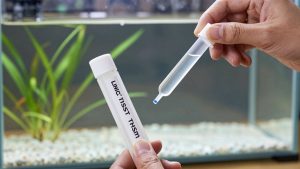
An aquarium test strip is a narrow paper or plastic strip with several chemically treated pads. You dip it into a water sample, remove it, wait for the time listed in the instructions, and compare the colors with a chart.
Most kits include between 50 and 150 strips. The number of tests can sound larger because one strip may test multiple water parameters at once. For example, an 8-in-1 kit may check pH, ammonia, alkalinity, hardness, chlorine, nitrite, nitrate, or related measures, depending on the manufacturer’s exact formula. A listed 150-strip, 11-in-1 kit may advertise up to 950 readings because each strip contains multiple test pads. Those are readings, not 950 separate water tests.
Prices are generally modest. A basic aquarium strip kit may cost about $8 to $15, while a larger multiparameter kit with 100 to 150 strips, ammonia pads, a thermometer, or an ebook may cost roughly $18 to $30. As reference points, the AAwipes 8-in-1 kit is listed for under $10, while an 11-in-1 kit with 150 strips and 50 ammonia strips is listed for under $30.
Using strips correctly matters more than many buyers realize. Take a sample from the aquarium rather than testing water directly under a running tap. Follow the specified dip and wait times, keep the strip flat, and read it under neutral, bright light. Do not compare colors after the recommended window has passed. Close the container immediately after removing a strip, because humidity can damage the unused pads.
Pros
- Fast results: Most tests take roughly 30 seconds to a few minutes, depending on the number of pads and the instructions.
- Low cost per check: A $10 kit with 50 strips works out to about 20 cents per strip, while a $23 kit with 150 strips costs about 15 cents per strip before considering shipping.
- Easy for beginners: There is no measuring powder, counting drops, or cleaning a test tube between samples.
- Broad coverage: One strip can screen several important parameters, including pH, nitrate, nitrite, hardness, alkalinity, and chlorine.
- Convenient for regular maintenance: Strips are useful after a water change, when adding new fish, or when checking whether readings are changing over time.
- Portable: A small container can be kept near a quarantine tank, carried to a fish store, or packed for travel without spilling liquid reagents.
- Less mess: There are no bottles to shake and fewer parts to misplace than with a liquid master test kit.
- Helpful for ponds and multiple tanks: A multiparameter strip kit can provide a quick overview across several aquariums without using a separate test for every parameter.
Cons
- Color matching is subjective: Two shades may look nearly identical, especially when a result falls between chart values.
- Lower precision: Strips usually provide ranges rather than highly specific measurements. That may be enough for routine monitoring but not for diagnosing a delicate situation.
- Ammonia coverage varies: Some kits do not test ammonia at all, while others include only a limited number of ammonia strips. Check the package contents instead of assuming an “8-in-1” or “11-in-1” label includes every essential parameter.
- Moisture ruins accuracy: Leaving the cap open, touching the pads, or storing the container in a humid fish-room cabinet can degrade the strips before the expiration date.
- Timing errors affect results: Reading too early or too late can produce a misleading color.
- Not ideal for emergency troubleshooting: If fish are gasping, lying on the bottom, or showing sudden distress, a more precise liquid test is usually the better tool.
- One bad strip can create confusion: A single unusual reading may be caused by contamination, an old strip, or poor lighting rather than a true aquarium problem.
Who Should Buy It
Test strips make sense for new fishkeepers who want a simple way to learn how their aquarium changes from week to week. They are also a good fit for established freshwater tanks with a stable biological filter, consistent stocking, and no current health problems.
Buy them if you want to check water before and after routine maintenance, monitor a community tank, or keep an inexpensive backup kit on hand. They are especially useful when the alternative is testing nothing at all. A quick test every week or two can reveal a trend before fish show symptoms.
They can also be practical for owners of several aquariums. A kit with 100 to 150 strips may provide enough checks for months, depending on whether you test one tank weekly or monitor multiple tanks several times per week.
Who Should Skip It
Skip strips as your only testing method if you are cycling a new aquarium, adding fish to a recently disturbed tank, or dealing with unexplained illness or deaths. During cycling, ammonia and nitrite can rise quickly, and knowing whether a reading is close to zero is more important than receiving a broad color range.
They are also a poor sole choice for shrimp tanks, breeding projects, planted aquariums with demanding species, saltwater systems, or tanks requiring tightly controlled chemistry. These setups may need dedicated tests for parameters such as calcium, magnesium, phosphate, salinity, or copper—measurements that a general strip kit may not include.
If you dislike interpreting colors or have difficulty reading small charts, liquid tests or a digital meter may be easier to use consistently.
Cheaper Alternatives
| Option | Cost | Trade-off |
|---|---|---|
| Basic aquarium test strips | About $8–$15 | Lowest upfront cost and fastest checks, but broad color ranges and inconsistent ammonia coverage. |
| Large multiparameter strip kit | About $18–$30 | Lower cost per strip and more tests, but extra parameters may be unnecessary and results are still approximate. |
| Liquid freshwater master kit | About $25–$45 | More precise for ammonia, nitrite, nitrate, and pH, but slower, messier, and more expensive upfront. |
| Individual liquid tests | About $6–$15 per parameter | Good for confirming one problem without buying a full kit, but costs more if several parameters need testing. |
| Local fish-store water testing | Free to about $5 per sample | Can be economical for occasional checks, but results are inconvenient and may not be available during an emergency. |
The cheapest sensible strategy is often a combination: use strips for routine monitoring and keep a liquid test for ammonia, nitrite, and nitrate confirmation. That approach costs more than relying only on strips, but less than replacing fish after an undetected water-quality problem.
FAQ
Are aquarium test strips accurate enough for fish?
They can be accurate enough for routine screening when stored properly and used exactly as directed. Their limitation is usually precision, not total uselessness. If a strip shows a clearly elevated nitrate, nitrite, or ammonia result, treat it as a warning and confirm it with a liquid test before making major changes.
How often should I use aquarium test strips?
For a stable, established aquarium, testing once a week or every other week is a reasonable routine. Test more often after adding fish, cleaning filter media, changing a large amount of water, treating illness, or noticing unusual behavior. A new aquarium may need testing every day or every few days during cycling, which is when a liquid kit is generally preferable.
Do aquarium test strips test ammonia?
Some do, and some do not. Always check the individual parameter list. Even when ammonia is included, a kit may provide fewer ammonia strips than total strips. The 11-in-1 example listed above includes 50 ammonia strips, while a multiparameter kit with a similar-sounding name may use a different formula.
What is better: test strips or a liquid kit?
Neither is universally better. Strips are better for speed, convenience, and frequent broad checks. Liquid kits are better for precision, cycling a tank, and investigating a serious problem. For most hobbyists, owning strips for convenience and a liquid test kit for confirmation offers the best balance in 2026.
Ready to decide? Our #1 pick for 2026 is the Basic aquarium test strips.
Live price & availability on Amazon.
Related Reviews & Guides

Titanium Heater vs Glass Aquarium Heater: Which Is Right for Your Home (2026)
Koller Products vs Marineland Aquarium Kits: Compared Guide