Last Updated: October 9, 2026
- Read the centerpiece fish before filling the cast
- Audit candidates through six behavioral lenses
- Candidate profile: quiet lower-level communities
- Surface structure without creating a ceiling
- Combinations to avoid
- Run a feeding trial, not a feeding assumption
- Introduction and the ready-to-use exit plan
- Sources
- Related Guides
- Top Pick: Swimming Creatures™ 3 Dwarf Honey Yellow Gourmi (Trichogaster chuna) Freshwater Aquarium Fish (Approx. 0.5-1")
- Best Value: Swimming Creatures™ 5 Dwarf Honey Yellow Gourami (Trichogaster chuna) – Freshwater Aquarium Fish (Size Approx. 0.5"-1")
- Premium Choice: Gourami Dwarf Gourami Honey Gourami Aquarium Fish Tank Tank Top
Honey Gourami Tank Mates: Calm Community Choices
A honey gourami can be physically unharmed yet still fail in a community. This small labyrinth fish often loses when rapid tank mates turn every meal into a race, when surface cover is occupied by another territorial species, or when constant activity prevents it from leaving shelter. Suitable honey gourami tank mates create a low-pressure social landscape: compatible water, modest adult size, separate zones, restrained temperament and predictable food access.
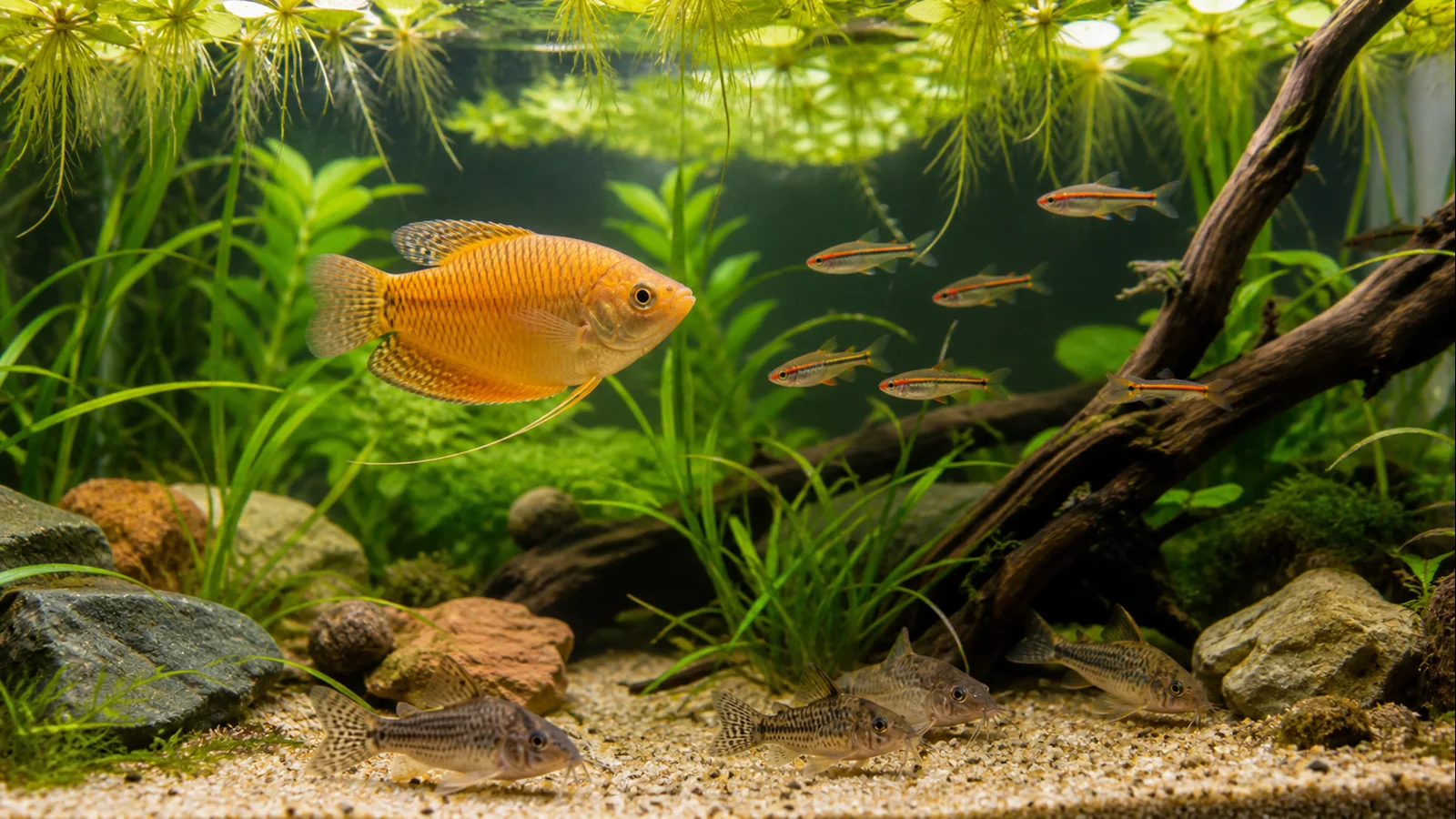
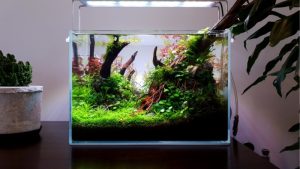
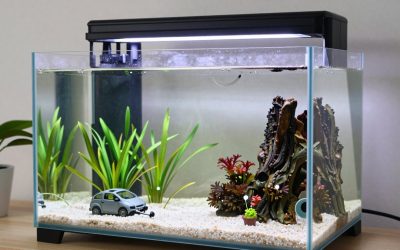
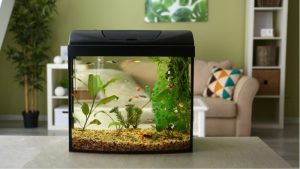
Editorial illustration; not evidence for species identification.
As an Amazon Associate we earn from qualifying purchases at no extra cost to you.


Read the centerpiece fish before filling the cast
The honey gourami is Trichogaster chuna. Shop labels sometimes confuse it with thicker-bodied color forms of other gouramis, so verify the scientific name. FishBase documents the species and reported environmental information, and GBIF supplies taxonomic and occurrence context. Natural vegetated habitats help explain its preference for cover; they do not prove that every wild measurement is an ideal captive target.
Honey gouramis occupy upper and middle water and breathe atmospheric air with a labyrinth organ. They must reach the surface freely. Many captive guides report workable temperatures broadly around 22–28°C/72–82°F and pH from mildly acidic to mildly alkaline, but stock history and stability matter. Establish the actual values selected in the honey gourami care guide, then screen companions against those values—not against a union of every range online.
Individuals vary. A male may become territorial, especially around bubble-nest activity; a shy fish may remain withdrawn among energetic neighbors. Compatibility therefore needs observation after introduction, not just research before it.
Audit candidates through six behavioral lenses
1. Thermal overlap
Choose a temperature comfortably inside both species’ captive ranges. A fish able to survive 28°C is not necessarily suited to years there. Reject narrow overlaps at opposing limits.
2. Adult body and mouth size
Tiny juvenile companions may become large enough to intimidate or eat a gourami. Conversely, adult shrimp and fry can be prey to the gourami. Research mature size and feeding ecology, not sales-tank dimensions.
3. Zone use
Surface space is premium territory. A second surface-oriented labyrinth fish can create conflict even in a generous volume. Bottom groups often reduce direct competition, provided their social and temperature needs are met.
4. Temperament and motion
Fast does not always mean aggressive, but relentless movement can suppress a honey gourami’s feeding and exploration. Avoid known fin nippers; the gourami’s feeler-like pelvic fins and slower pace make harassment costly.
5. Feeding access
Select fish that allow small floating or slowly sinking particles to remain available. A honey gourami that approaches, hesitates and retreats at every meal needs a changed method or changed companion.
6. Chemistry
Do not force a soft-water schooling fish and a hard-water livebearer into an averaged compromise merely because both are community species. Test hardness and alkalinity as well as pH.
Candidate profile: quiet lower-level communities
Small Corydoras suited to the chosen temperature
A social group of an appropriately warm-tolerant Corydoras species can use the lower level while the gourami explores plants above. Provide fine sand, bottom hides and dedicated sinking food. Species identification matters; not every Corydoras shares the same thermal preference. Leave open air access and avoid crowding the footprint with too many bottom groups.
Kuhli loaches in a mature, covered setup
Kuhli-type loaches are peaceful and bottom-oriented, but need their own group, secure crevices, soft substrate and a tightly covered aquarium. They often feed when light is low, so deliver food where it can be verified rather than assuming scraps reach them. Their secretive behavior makes body-condition checks essential.
Small, restrained rasboras
Calm rasboras can provide midwater movement without dominating the surface. Harlequin-type and smaller Trigonostigma choices may work where temperature, adult group size and chemistry overlap. A complete school needs horizontal room. Avoid stacking multiple schools into a short aquarium solely because each fish is small.
Peaceful small tetras, selected carefully
Some small tetras can coexist, but species reputation matters less than observed nipping and food speed. Choose a non-nipping group, keep enough conspecifics to support normal schooling, and create a broad feeding field. Serpae-type tetras and other persistent fin-focused fish are poor choices.
Surface structure without creating a ceiling
Floating plants help diffuse light and create broken sight lines. Use the options in the floating aquarium plant guide to make several loose patches rather than a continuous mat. Keep a clear feeding lane and multiple open breathing windows. Surface agitation should preserve gas exchange without turning the entire upper level into turbulent water.
Filter choice affects social success. Strong output can force the gourami into one quiet corner, concentrating all fish around it. Baffle or redirect flow while maintaining oxygenation and biological capacity; the aquarium filter selection guide explains the trade-offs. A weak, dirty filter is not an acceptable way to obtain gentle flow.
Use stems, wood and broad leaves to make visual partitions. The gourami should be able to approach the surface, retreat, and feed without crossing a companion’s defended route. Count usable pathways, not decorative density.
Combinations to avoid
- Bettas and other gouramis: similar zone use and body signals can trigger conflict; even apparently calm individuals may change at maturity.
- Tiger barbs and habitual fin nippers: repeated sampling of fins or feelers creates injury and chronic avoidance.
- Large cichlids or predatory fish: adult mouth size makes “peaceful” irrelevant.
- Very active danios in limited space: speed, cooler preferences in some setups and feeding dominance make the match unreliable.
- Hard-water livebearers when chemistry does not overlap: behavior alone cannot solve mineral mismatch.
- Coldwater species: a compromise temperature may leave one partner chronically warm or the other chronically cool.
- A second male honey gourami in a small footprint: same-species competition can be stronger than community conflict.
Mixed-sex honey gouramis also require caution. A female cannot be used as a permanent object for a male’s courtship. Provide dense retreats and be prepared to separate. No ratio guarantees peace.
Run a feeding trial, not a feeding assumption
Offer an appropriately sized, varied staple and safe frozen or live foods as suitable. At the first community meals, place a small portion near the gourami’s cover, then distribute the rest across the school’s route. Watch swallowing, not merely approach. A fish that mouths and spits particles may need smaller food or may be stressed.
Feed bottom dwellers with suitable sinking items, preferably when midwater fish are less active, and confirm the food is eaten. Increasing total food to help one excluded animal often degrades water before solving access. If targeted placement fails, separation may be kinder than continued competition.
Introduction and the ready-to-use exit plan
Quarantine each new group in a mature, species-appropriate enclosure. Introduce the gourami into a finished, planted layout rather than repeatedly changing its cover as more purchases arrive. If adding a territorial centerpiece to existing fish, adjust sight lines beforehand and observe for a full activity cycle, including meals and lights-out transitions.
Keep a cycled spare tank or a safe temporary divider plus independent long-term housing. The spare needs heat, cover and biological filtration; an empty glass box assembled during a crisis is not a plan. Separate if the gourami stops feeding, remains behind equipment, is repeatedly chased from the surface, shows torn fins, or breathes rapidly after water-quality problems have been excluded. Also separate an aggressor that patrols beyond a small nest area.
The OATA fish-keeper resources provide a practical welfare baseline but come from a trade-body perspective. For lesions, swelling, loss of balance, persistent respiratory change or unexplained decline, contact a qualified aquatic veterinarian. Check ammonia, nitrite, temperature and equipment immediately, but avoid unsupported salt, medication or dosing. A knowledgeable aquatic professional can assess layout and stocking; a veterinarian should diagnose and direct treatment.
Sources
- FishBase honey gourami summary — taxonomy, size and environmental records.
- GBIF search for Trichogaster chuna — accepted-name and distribution context.
- Seriously Fish knowledge base — species profiles and candidate comparison.
- OATA useful information — practical fish-welfare and water-quality guidance.
Related Reviews & Guides


5 Best Cheap Aquarium Filters Under $20 in 2026
Best Fish Tank for a Dorm Room: Top Compared Compact Picks