Last Updated: October 9, 2026
- Set the micro-community budget
- Measure candidates with the mouth-first rule
- Best-fit candidate: one restrained microfish school
- Bottom-level possibilities
- Shrimp: coexistence is not offspring safety
- Do not combine with ember tetras
- Engineer food delivery at ember scale
- Stability rules for the small aquarium
- A separation plan sized for microfish
- Sources
- Related Guides
- Top Pick: Ember Tetra – Pack of 15 | Freshwater Tropical Aquarium Live Fish
- Best Value: Swimming Creatures™ 12 Ember Tetra (Hyphessobrycon amandae) – Freshwater Aquarium Live Fish (Approx. 1.5 cm)
- Premium Choice: Swimming Creatures™ 15 Ember Tetra (Hyphessobrycon amandae) – Freshwater Aquarium Live Fish (Approx. 1.5 cm)
Ember Tetra Tank Mates for a Peaceful Nano Community
An ember tetra’s greatest compatibility problem is scale. At roughly a few centimeters as an adult, Hyphessobrycon amandae can be swallowed by fish that are routinely described as peaceful, outcompeted by equally harmless but faster feeders, or destabilized by a tank whose tiny water volume leaves no margin for an extra group. Choosing ember tetra tank mates therefore begins with mouth size and feeding mechanics, then expands to temperature, chemistry, zone and temperament.
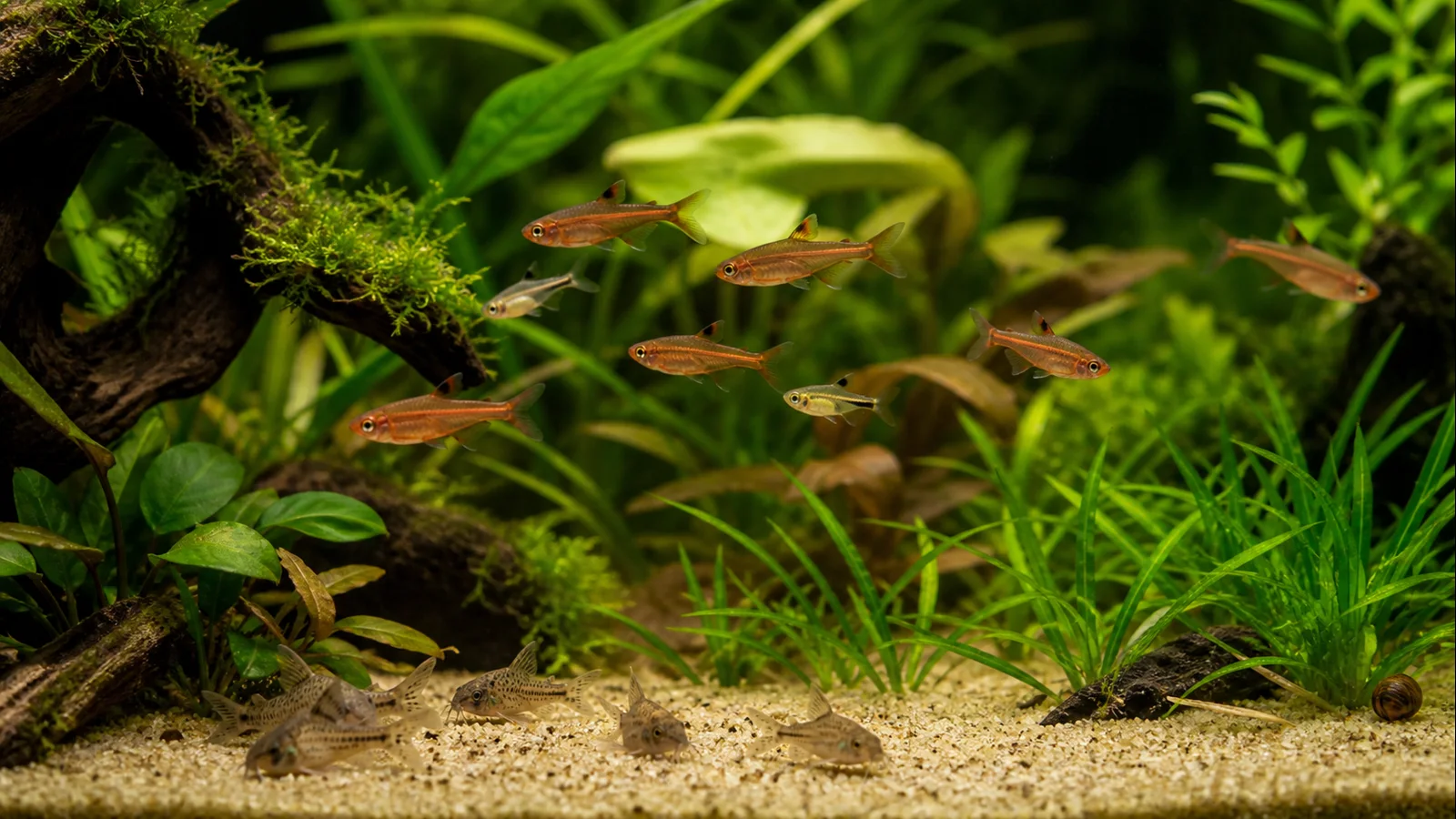
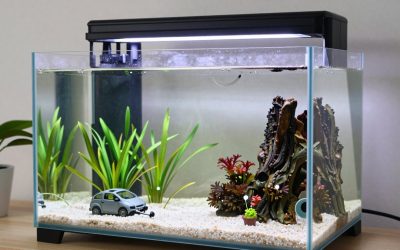
Editorial illustration; not evidence for species identification.
As an Amazon Associate we earn from qualifying purchases at no extra cost to you.




Set the micro-community budget
FishBase provides identity, size and reported environmental information for ember tetras, while GBIF supplies taxonomic and occurrence context. Sources commonly describe warm water around 24–28°C/75–82°F and a preference for calmer, planted conditions. Treat wild-habitat values as ecological context rather than a demand for extreme captive chemistry.
Reserve capacity for a proper ember school before considering another species. A larger group can display more confidence and natural movement than a handful kept only to make room for novelty. Establish the school’s needs using our ember tetra care guide. Calculate usable water after substrate and decor, then judge filtration, surface area and weekly waste trend. “Nano” describes size, not immunity to ammonia or oxygen limitation.
Complete a fishless cycle and prove that the filter processes expected waste before stocking. A mature aquarium with biofilm and stable tests is safer for microfish than a newly filled box with an impressive product label.
Measure candidates with the mouth-first rule
Research adult standard length and, crucially, gape. A deep-bodied fish of moderate length may have a mouth capable of taking a slender ember. Predation can occur after months of apparent peace as the companion matures. If the candidate naturally eats small fish or large insect prey, do not gamble on temperament.
Then check five more dimensions:
- Temperature: select a setting comfortably supported for both species, not a one-degree overlap at their limits.
- Swimming zone: ember tetras use midwater; another school there needs additional horizontal room.
- Temperament: exclude persistent chasers, territorial cave defenders in tight quarters and fin nippers.
- Feeding access: candidates must allow fine particles to remain available long enough for ember-sized mouths.
- Chemistry: compare general hardness, carbonate hardness and pH, using breeder water as well as referenced profiles.
Compatibility is not transitive. If species A works with embers and species B works with A, that gives no evidence that B works with embers.
Best-fit candidate: one restrained microfish school
Tiny Boraras rasboras can match the scale and calm-water aesthetic, provided their warm, soft-water needs overlap. They need their own adequate group and may share the same feeding zone, so this is suitable only in a footprint large enough for two real schools. Use distinct food placement and observe both. In limited tanks, increasing the ember group is usually better welfare than adding a second species for visual variety.
Green neon tetras and other very small characins sometimes fit by size, but separate species do not merge into one functional school. Verify temperature and source-water chemistry, quarantine them independently, and avoid a collection of undersized groups. Similar appearance does not guarantee identical disease sensitivity or feeding behavior.
Bottom-level possibilities
Pygmy Corydoras
Pygmy Corydoras can use lower and middle levels, which means more overlap than larger bottom-bound Corydoras. They require a social group, smooth substrate and deliberate sinking or slow-falling food. Choose an exact species and check temperature. Their presence raises the total number of social fish quickly, so allow a longer aquarium and robust biological capacity.
Small kuhli-type loaches
Most kuhli loaches require more footprint, group space and food than a very small nano tank provides. In a mature, larger planted community they may coexist peacefully, but their secretive habits make feeding verification hard. Do not add one as a solitary cleanup animal.
Snails
Small snails avoid predation on embers and can use surfaces, yet they add waste and may multiply with excess food. Very soft water can affect shells. Feed according to species instead of relying on incidental algae, and never release unwanted snails outdoors.
Shrimp: coexistence is not offspring safety
Adult dwarf shrimp may live alongside ember tetras in dense planting. Shrimplets are bite-sized prey, and freshly molted adults are vulnerable. If breeding shrimp is the priority, a fish-free tank gives predictable survival. If the goal is a mixed display, provide mosses and fine cover from the nano low-light plant guide and accept that reproduction may be limited.
Larger Amano-type shrimp reduce the mouth-size risk but still need compatible temperature, minerals and a secure acclimation process. Copper-containing treatments and some medications can harm invertebrates; consult a veterinarian and product label rather than dosing the community by guesswork.
Do not combine with ember tetras
- Angelfish, medium cichlids and other large-gaped fish: a calm adult can treat embers as prey.
- Fast danios or vigorous barbs in a small footprint: motion and food competition can suppress the school.
- Territorial bettas or gouramis in a nano tank: individual variation and shared upper-midwater space make outcomes unpredictable.
- Known fin nippers: tiny fish cannot tolerate repeated pursuit or injury.
- Hard-water livebearers when mineral needs diverge: a friendly platy does not make soft water suitable for itself.
- Cool-water species: temperature compromise can keep both groups outside comfortable long-term conditions.
- Any unidentified juvenile: unknown mature mouth size ends the assessment.
Engineer food delivery at ember scale
Use a varied, nutritionally complete food in particles small enough to swallow. Crushing a flake produces mixed sizes; watch whether embers actually ingest rather than repeatedly spit the pieces. Fine frozen or cultured live foods can add variety when safely sourced. Avoid collecting food from waterways with unknown pollution or parasites.
Create a gentle circulation path that carries particles through the school without immediately pulling them into the filter. Feed tiny portions in two or three positions. Bottom residents should receive their own suitable food after the embers have engaged elsewhere. Remove visible excess, and adjust the next ration instead of allowing a permanent debris bank.
Stability rules for the small aquarium
Small water volume changes quickly. Check temperature during hot and cold parts of the day, mark an evaporation line, and top off with suitable water without confusing topping off with a water change. Test ammonia and nitrite after adding companions, while tracking nitrate and maintenance frequency. Never replace all filter media together.
Plant density improves refuge but consumes swimming volume and can reduce nighttime oxygen. Prune enough to maintain open midwater and surface exchange. If fish cluster at the surface or breathe rapidly, test water and inspect circulation immediately; do not assume they are merely hungry.
A separation plan sized for microfish
Prepare a cycled spare aquarium with guarded intake, stable heat and small-fish-safe cover. Standard dividers may have gaps embers can cross, and shared water will not isolate pathogens. Identify triggers before introduction: a fish disappears from the school, stops feeding, becomes pale outside normal lighting changes, is chased into a corner, or shows damaged fins. Predatory stalking requires immediate separation even before injury.
The RSPCA fish-care guidance provides a welfare baseline for environment and stocking. Persistent rapid respiration, lesions, swelling, abnormal swimming or unexplained losses require a qualified aquatic veterinarian. An experienced aquatic professional can review filter flow and stocking, but should not be substituted for diagnosis. Do not use unsupported medication, salt or dosing in a mixed fish-and-invertebrate tank.
Sources
- FishBase ember tetra summary — species identity, adult size and environmental records.
- GBIF Hyphessobrycon amandae search — taxonomy and occurrence context.
- Seriously Fish knowledge base — referenced captive profiles for candidate comparisons.
- RSPCA advice on keeping fish — welfare and environment baseline.
Related Reviews & Guides

6 Best Water Air Pumps For Aquarium 2026
Best Aquarium Heater for 20 Gallon Shrimp Tank in 2026: Compared and Ranked