Last Updated: October 9, 2026
- Top Pick: Cardinal Tetra Live Freshwater Aquarium Fish – 5 +2 Free Count – Paracheirodon innesi, 1–2 cm Small Tropical Community Fish – Colorful Schooling Fish for Planted Tanks & Community Aquariums
- Best Value: Cardinal Tetra Live Freshwater Aquarium Fish – 10 +4 Free Count – Paracheirodon innesi, 1–2 cm Small Tropical Community Fish – Colorful Schooling Fish for Planted Tanks & Community Aquariums (10)
- Premium Choice: Cardinal Tetra Live Freshwater Aquarium Fish 50 + 10 Free Count – Paracheirodon innesi, 1–2 cm Small Tropical Community Fish – Colorful Schooling Fish for Planted Tanks & Community Aquariums (50)
Cardinal Tetra Tank Mates: A Compatibility Checklist
The best cardinal tetra tank mates share more than a reputation for being peaceful. They must remain comfortable in warm water, avoid swallowing a slender tetra, leave the school enough midwater room, reach food without creating a frenzy, and tolerate the same chemistry. Compatibility is conditional: individual behavior, tank dimensions and group sizes can overturn any species-level prediction. Use the checklist below to design a community and keep a separation option ready.
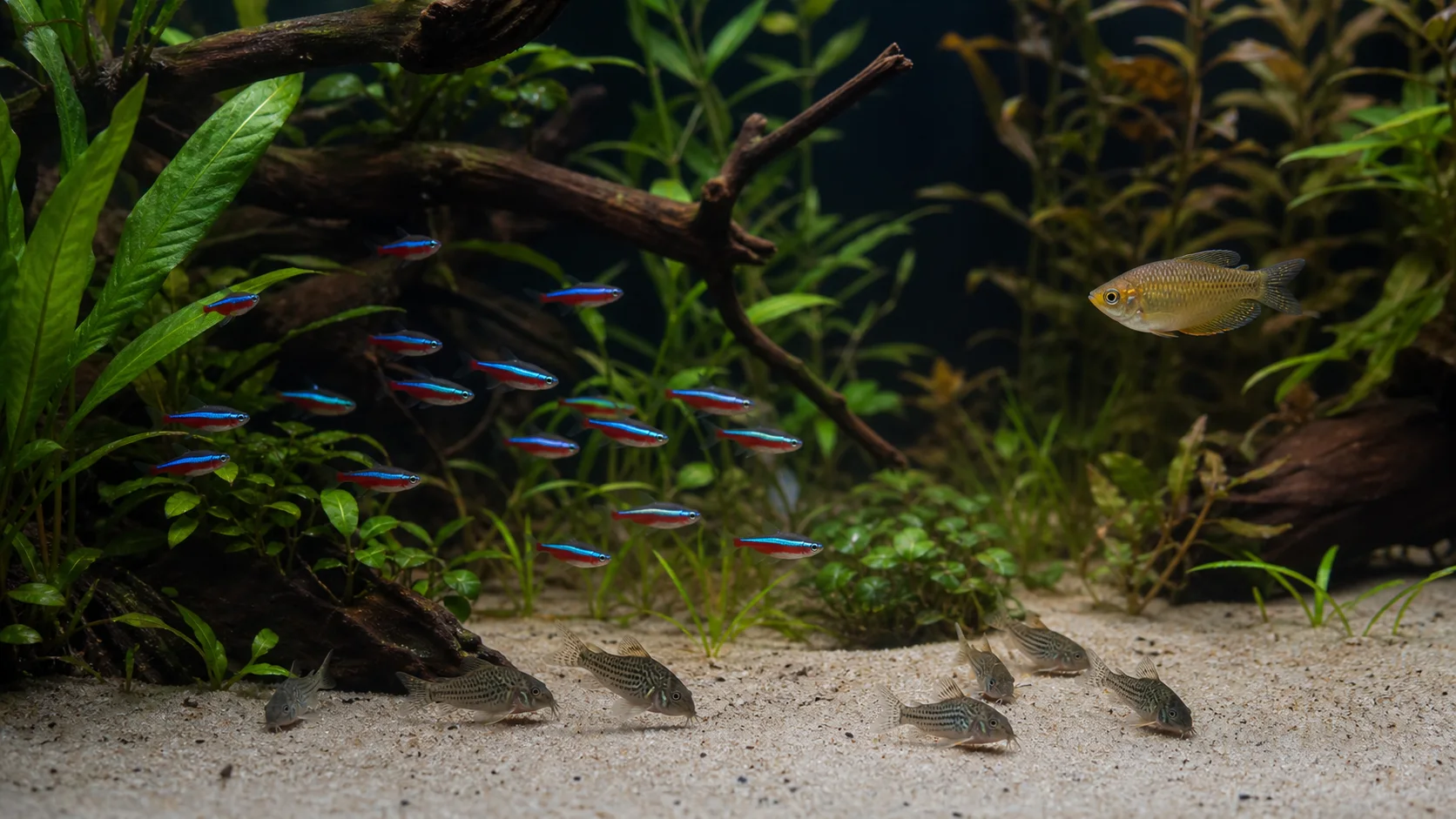
Editorial illustration; not evidence for species identification.
As an Amazon Associate we earn from qualifying purchases at no extra cost to you.


Establish the cardinal side of the match
Cardinals, Paracheirodon axelrodi, are small schooling characins associated with warm, often soft and acidic South American waters. FishBase records environmental and size information, while GBIF provides taxonomy and occurrence context. Wild records describe habitat, not a command to reproduce an extreme blackwater value in captivity. Captive-bred fish may be accustomed to different water, but they still need stable, clean conditions and careful acclimation.
Plan the cardinal school first. A larger, coherent group generally behaves more naturally and confidently than a token trio, and it creates a clear visual unit rather than scattered targets. The tank needs horizontal midwater space after wood and plants are installed. Read the species-specific cardinal tetra care guide before allocating remaining capacity to companions.
For compatibility screening, use the actual temperature at which the cardinals will live—often roughly 24–28°C/75–82°F depending on stock and source—rather than the widest published tolerance. Confirm pH, general hardness and carbonate hardness with tests. Ammonia and nitrite should remain undetectable; adding a companion never fixes poor water or nervous behavior caused by an immature aquarium.
The six-filter compatibility test
Score every candidate against all six factors. One failure can outweigh five matches.
| Filter | Question to answer before purchase | Red flag |
|---|---|---|
| Temperature | Is there a comfortable long-term overlap, not just an emergency tolerance? | Candidate needs cool water or sustained heat beyond its normal care |
| Adult size | Could its adult mouth engulf a cardinal? | “Peaceful” fish with a large gape |
| Swimming zone | Does the tank provide separate usable space? | Another dense midwater school in a short tank |
| Temperament | Does it chase, nip or ambush? | Territorial defense across the whole footprint |
| Feeding access | Can cardinals obtain small food calmly? | Fast surface feeders consume every portion |
| Chemistry | Do hardness, pH and stability needs overlap? | Hard-water livebearer paired only because it is friendly |
This is stricter than comparing care-sheet endpoints. If species A is listed at 23–28°C and species B at 27–31°C, 27–28°C is not automatically a good long-term compromise; it may put both near a boundary. Prefer overlap near the middle of each fish’s well-supported captive range.
Strong candidate groups, with conditions
Warm-water Corydoras chosen by species
Some Corydoras species can suit a warm cardinal aquarium and occupy the bottom, reducing zone conflict. Choose by scientific name because temperature needs vary. Maintain their own social group, use smooth sand, and provide oxygenated water and feeding points at the substrate. “Bottom feeder” does not mean it survives on tetra leftovers. Very warm conditions that suit some headline communities may be inappropriate for cooler-water Corydoras.
Small warm-tolerant rasboras
Calm rasboras of modest adult size can work when their temperature and chemistry genuinely overlap. They create another midwater group, so this option needs more length and open space than a cardinal-only display. Observe feeding speed: distribute fine food over a broad area so both schools eat. Avoid buying an unidentified “rasbora” because adult size differs widely.
Peaceful dwarf cichlids in a structured tank
A correctly identified, suitably warm dwarf cichlid may use lower territories while cardinals remain above. This is an advanced match, not a default recommendation. Breeding cichlids can attack fish near caves, and cardinals may consume fry. Use wood and plants to break sight lines, allow a generous footprint, and be ready to remove the cichlid or school.
Small loricariid catfish
A modest, identified suckermouth catfish can occupy surfaces and lower levels if temperature, oxygen and adult size fit. Supply its actual diet, wood or hides where required, and account for waste. It is not a cleanup device. Large plecos are unsuitable simply because juveniles look small in shops.
Matches that need special scrutiny
Discus are often pictured with cardinals, and the geographic story seems appealing. Yet discus require careful decisions about high temperature, feeding, body size, health screening and tank volume. A discus can potentially eat small fish, and warm conditions narrow filtration and oxygen margins. Consult the discus care guide and build around discus first; never add them as decorative companions to a tetra-scale aquarium.
Neon tetras resemble cardinals, but similarity does not create a reason to mix schools. Neons often suit slightly cooler management, and the two species may not form one secure group. Compare the neon tetra care profile and select one species in a limited footprint. If keeping both, provide full groups and enough midwater length for each.
Shrimp may coexist with adults in dense planting, but cardinal tetras can eat shrimplets and freshly molted individuals. Snails can be compatible when water is not so soft that shell condition deteriorates. Neither is guaranteed safe, and both add feeding and waste considerations.
Do not combine these categories
- Large predatory or large-gaped fish: calm behavior does not prevent opportunistic swallowing.
- Persistent fin nippers or hyperactive chasers: cardinals should not spend the day compressed behind decor.
- Cool-water specialists: raising their temperature merely to meet cardinals can shorten the safety margin.
- Hard, alkaline-water specialists: averaging incompatible chemistry serves neither animal.
- Territorial fish that claim the full tank: a community needs an escape route outside the defended area.
- Unidentified juveniles: an unknown adult size makes predation and bioload impossible to assess.
Avoid overstocking with several “nano” species. Small body size does not eliminate oxygen demand, social-group needs or competition. The RSPCA’s fish welfare advice emphasizes an appropriate environment and responsible stocking rather than collecting one of everything.
Build feeding access into the layout
Cardinals have small mouths and usually take fine foods in midwater. Offer a varied, nutritionally complete diet in particles they can swallow. Spread modest portions along the school’s route rather than dropping a clump beside a dominant companion. Use sinking foods for bottom residents at their active time, then verify consumption; feeding after lights dim can help some catfish, but leftovers must not accumulate unseen.
During the first two weeks after adding a species, watch an entire meal. Note which fish arrive first, which retreat and where particles travel in the current. Weight loss with apparently generous feeding often means access failure, not insufficient total food. Adjust placement or remove the competitor rather than endlessly increasing the ration.
Introduction sequence and separation plan
Quarantine new fish in a cycled, appropriately heated setup. Confirm normal respiration, feeding and body condition before introduction. Add cardinals as a complete school where practical, then introduce compatible residents without repeatedly destabilizing the community. Rearrange selected sight breaks before adding a territorial fish, not after a victim is trapped.
Prepare an exit tank with mature filtration, heater as required, lid and hides. A secure divider can buy time, but tiny cardinals may pass through gaps and waterborne disease still crosses it. Define triggers in advance: repeated chasing that prevents feeding, torn fins, a fish pinned in a corner, predatory stalking, persistent rapid breathing, or chemistry that cannot satisfy both species. When one appears, separate promptly and reassess rather than waiting for a guarantee to become true.
Illness, injury, unexplained color loss or ongoing respiratory distress requires a qualified aquatic veterinarian. Test temperature, ammonia and nitrite immediately, but do not medicate a mixed community based on guesswork. An experienced aquatic professional can evaluate stocking and filtration; diagnosis and treatment decisions belong with a veterinarian.
Sources
- FishBase cardinal tetra summary — identity, size and environmental records.
- GBIF search for Paracheirodon axelrodi — taxonomy and occurrence context.
- Seriously Fish knowledge base — referenced captive-care profiles for cardinals and candidates.
- RSPCA keeping fish advice — environment, stocking and welfare baseline.
Ready to decide? Our #1 pick for 2026 is the Temperature.
Live price & availability on Amazon.
Related Reviews & Guides


How to Choose Aquarium Substrate Grain Size in 2026: What Actually Matters
Aquarium Filter Dimensions for Standard Tanks Size Guide With Measurements (2026)