Last Updated: October 9, 2026
- Top Pick: CARDINAL TETRA CARE AND OWNERSHIP: The Complete Guide to Cardinal Tetra Care, Breeding, Feeding, Nutrition, Habitat, Diet, Interaction, Cost, … Aquarium Mastery for Beginners and Experts
- Best Value: Cardinal Tetra Live Freshwater Aquarium Fish – 10 +4 Free Count – Paracheirodon innesi, 1–2 cm Small Tropical Community Fish – Colorful Schooling Fish for Planted Tanks & Community Aquariums (10)
- Premium Choice: Cardinal Tetra Live Freshwater Aquarium Fish – 5 +2 Free Count – Paracheirodon innesi, 1–2 cm Small Tropical Community Fish – Colorful Schooling Fish for Planted Tanks & Community Aquariums
Cardinal Tetra Care: Water, School Size and Feeding
A cardinal tetra does not need an aquarium that imitates a flooded Amazon forest down to the last leaf. It needs something more achievable: clean water whose chemistry does not swing, enough companions to make schooling feel safe, shaded retreats, and food small enough to eat. That distinction matters because the species’ wild history is often turned into rigid captive-care rules. A responsibly bred fish accustomed to local tap water may struggle more with an abrupt attempt at extreme softness than with a moderate, steady setup.
Paracheirodon axelrodi is the accepted scientific name listed by FishBase and GBIF. Its blue stripe runs most of the body, while the red usually extends from head region to tail; a true neon tetra generally shows less red. If identification is uncertain, compare the fish with our neon tetra care guide before setting temperature expectations.
As an Amazon Associate we earn from qualifying purchases at no extra cost to you.


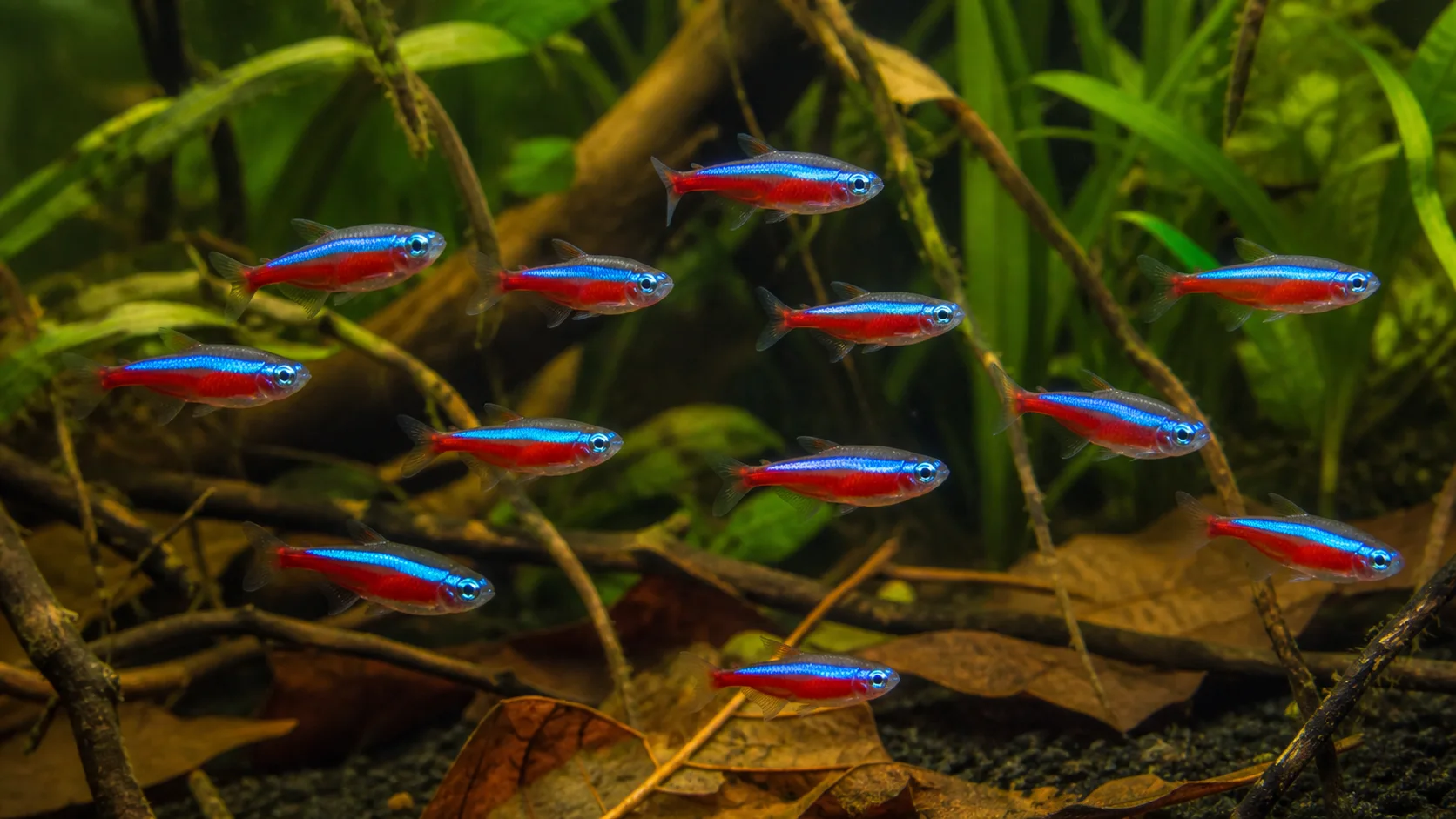
Editorial illustration; not evidence for species identification.
Start with a mature, horizontally useful tank
Cardinals are small, but a dozen moving together use more horizontal room than their individual length suggests. A long aquarium around 75 litres/20 US gallons is a practical starting point for a proper school and a modest community. Dimensions matter more than a nominal gallon label: uninterrupted front-to-back swimming space is useful, while a tall narrow vessel adds little. Larger volumes also dilute waste and change temperature more slowly.
Cycle the biological filter before buying fish. In normal operation, ammonia and nitrite should remain undetectable on a suitable aquarium test, with nitrate managed through feeding, plants, maintenance and water changes. Our fishless cycling walkthrough explains how to establish that bacterial capacity without exposing animals to toxins. The RSPCA fish guidance likewise emphasizes preparing and cycling the environment before stocking.
Use a gentle-to-moderate filter that circulates the whole tank without pinning the fish in place. Put the heater near flow, protect its guard if necessary, and use a separate thermometer. Leave an open lane for schooling, then frame it with rooted plants, wood and floating shade. Dark substrate and a background can make the fish feel less exposed. Botanicals may tint the water, but they are optional; never treat unknown collected leaves or wood as automatically aquarium-safe.
Choose a stable water window
Published sources describe cardinal tetras from warm, often acidic and very soft waters. Seriously Fish synthesizes habitat and aquarium observations, while FishBase reports environmental information rather than a universal captive prescription. For a typical community, about 24–27°C/75–81°F and mildly acidic to near-neutral pH are defensible working targets when they match the fish’s source. Exact hardness deserves discussion with the breeder or retailer because captive-bred stock may have been raised in more mineralized water.
Do not chase a chosen pH with repeated chemical additions. Measure source water, tank water and hardness, then favor a range you can reproduce at every water change. Temperature, dissolved waste and pH all interact with acclimation. A result outside a popular internet number is not automatically dangerous; a rapid shift toward that number can be.
Wild-caught cardinals warrant extra caution. Their collection origin, transport duration and holding water may differ sharply from a local captive-bred line. Ask the seller what they know, quarantine separately, and adjust gradually under observation. The site’s quarantine guide provides a process for equipment separation and monitoring. Quarantine is observation and biosecurity, not permission to medicate healthy fish without a diagnosis.
Build a school, not a decorative handful
Six is often repeated as a minimum for schooling fish, but it should be treated as a floor rather than a target. Ten to twelve cardinals create a more coherent group and distribute vigilance and minor jostling. If filtration and tank space permit, a larger single-species school is usually more convincing than several undersized tetra groups.
Watch how the group uses the aquarium. Loose exploration during calm periods can be normal; a tight cluster can reflect novelty, a nearby threat or sudden disturbance. Persistent hiding, clamped fins, surface gasping, isolation or failure to feed demands investigation. Check temperature, ammonia, nitrite, filter operation and recent changes before assuming a social cause.
Tank mates should overlap in temperature and chemistry, lack a tetra-sized mouth, and not dominate every feeding. Peaceful bottom dwellers can work in sufficient space, as can calm warm-water community species. Avoid large predatory fish, relentless fin nippers and cool-water animals forced into an unhealthy compromise. The word “peaceful” on a shop label is not a compatibility test.
Feed small portions across the water column
Cardinal tetras have small mouths and feed readily in midwater. Use a good-quality fine granule or crushed flake as a staple, rotating appropriately sized frozen or live foods such as small daphnia, cyclops or brine shrimp where reliable. Variety supplies different textures and encourages natural searching; it does not justify oversized pieces.
Offer an amount the school can finish promptly, once or twice daily according to age, stocking and the tank’s maintenance capacity. Observe every individual rather than timing by habit. Food that reaches the substrate untouched increases organic load, while dominant community fish may consume everything before shy cardinals approach. Distribute a pinch across more than one location or feed competing species strategically.
Thin fish are not necessarily underfed, and extra food is not a safe treatment for weight loss. Parasites, infection, bullying and poor water can produce similar signs. Record appetite, feces, breathing and body condition, then consult an aquatic veterinarian or qualified fish-health professional when deterioration persists. Avoid unsupported medication or dosing advice from anonymous posts.
A maintenance rhythm cardinals can tolerate
Perform regular partial water changes sized to measured nitrate, stocking and feeding, often weekly in a normal community. Match replacement water temperature closely and condition municipal water for chlorine or chloramine as appropriate. Vacuum accessible debris without stripping every surface clean; biological filter media should be gently rinsed in removed aquarium water when flow declines, not sterilized on a schedule.
Daily, count the fish and notice respiration, color, posture and feeding response. Weekly, verify temperature and test core nitrogen parameters, especially after adding livestock or changing the filter. Monthly, inspect hoses, intake guards, heater condition and hidden waste behind hardscape. Trends are more informative than a single isolated test.
Cardinals may appear paler at night, after transport or under intense lighting. Color alone is not a water test. Pair appearance with behavior and measured conditions. If several fish suddenly lose color, breathe rapidly or crowd the surface, treat it as an urgent environmental warning: confirm oxygenation and toxins and seek professional help if correcting an identified husbandry problem does not produce prompt improvement.
A sensible first-week sequence
On arrival, dim the light and compare bag temperature and seller water with the prepared quarantine tank. Use an acclimation method suited to the measured difference and transport condition; prolonged exposure to opened shipping water can have its own risks, so “slower” is not universally safer. Transfer fish with minimal store water, then leave them quiet.
During the next days, offer tiny familiar foods, remove leftovers and log results. Do not add more fish merely because the cardinals hide initially. Once the observation period is completed and the school is feeding normally with no concerning signs, move it to the display with another careful temperature and chemistry match.
Successful cardinal tetra care is therefore a stability project rather than a quest for blackwater perfection. Give one adequately sized school a mature tank, repeatable warm-water conditions, fine varied food and quiet cover. Then let measurements and the fishes’ behavior guide adjustments. When symptoms suggest disease rather than a correctable setup issue, the responsible endpoint of a home guide is referral to an aquatic veterinarian, not improvised treatment.
Related Reviews & Guides


5 Best Aquascapings for Beginners (2026)
Celestial Pearl Danio Care: A Planted Nano Plan