Last Updated: October 17, 2026
Platies are the best fit for small tanks of about 15 to 20 gallons, swordtails suit long tanks of 29 gallons or more, and mollies sit in between but are safest in 29 to 30 gallons or more with hard, alkaline water; salt is optional, not required. All three are hardy livebearers from the same family (Poeciliidae), and all three give birth to live young, but they differ in adult size, swimming needs, water chemistry and temperament. This comparison covers each point so the right fish can be matched to a specific tank.
Quick Comparison
| Feature | Platy | Molly | Swordtail |
|---|---|---|---|
| Scientific name | Xiphophorus maculatus (also hybrids with X. variatus) | Poecilia sphenops, P. latipinna, P. velifera | Xiphophorus hellerii |
| Adult size | about 2 in (5 cm) | About 3 in for short-finned mollies; sailfins reach about 5 in | 4 to 6 in, not counting male sword |
| Minimum tank | About 14 to 20 gallons (Seriously Fish: base 24 by 12 in) | Seriously Fish: about 21 gallons (36 by 12 in) short-finned, about 23 gallons (30 by 15 in) sailfin; many care sheets say 29 to 30 or more | Seriously Fish: base 48 by 12 in, longer than a standard 29-gallon tank; other care sheets say 20 to 30 gallons |
| Temperature | 68 to 79°F | Roughly 70 to 82°F (Seriously Fish: 70 to 79°F for sailfins) | Roughly 61 to 82°F |
| pH | 7.0 to 8.2 | 7.0 to 8.5 | 7.0 to 8.0 |
| Hardness | 10 to 30 dGH | 15 to 35 dGH, harder is better | 10 to 25 dGH |
| Salt tolerance | Low to moderate; not needed | High; wild sailfins live in brackish water, but salt is not required in the aquarium | Low; not needed |
| Temperament | Peaceful | Generally peaceful; males can harass females | Active; males can be pushy |
| Diet | Omnivore | Omnivore with strong algae and plant component | Omnivore |
| Lifespan | About 3 to 5 years; sources vary | About 3 to 5 years | About 3 to 5 years |
| Care level | Easy | Easy to moderate | Easy |
Size, tank, temperature, pH and hardness figures come from Seriously Fish profiles for all three groups. Lifespans come from several aquarium care sheets, which commonly say three to five years, and salinity guidance for mollies varies between sources. When sources disagree the table gives a range and the roomier tank size is the safer choice.
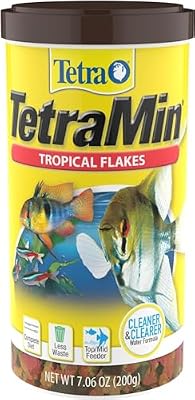
TetraMin Tropical Flakes Fish Food, 7.06 oz | Complete Daily Diet For Top-And-Mid Feeding Tropical Fish, Protein For Growth & Prebiotics for Digestion, Clear Water Formula
Included for 'Platy vs Molly vs Swordtail: Which Livebearer Fits Your Tank' because the listing specifies 7.06 oz and Complete Daily Diet For Top-And-Mid Feeding Tropical Fish, details this guide uses to compare options.
View on Amazon
TetraColor Tropical Flakes Color Boosting Fish Food, 7.06 oz | For Mid & Bottom-Feeding Tropical Fish, Supports Immune System & Reduces Stress, Clean & Clear Water Formula, Feed Daily
Included for 'Platy vs Molly vs Swordtail: Which Livebearer Fits Your Tank' because the listing specifies 7.06 oz and For Mid & Bottom-Feeding Tropical Fish, details this guide uses to compare options.
View on Amazon
API TROPICAL FLAKES Fish Food 5.7-Ounce Container
Included for 'Platy vs Molly vs Swordtail: Which Livebearer Fits Your Tank' as a relevant option in this category; details come from the product listing.
View on Amazon
API TROPICAL FLAKES Fish Food 1.1-Ounce Container
Included for 'Platy vs Molly vs Swordtail: Which Livebearer Fits Your Tank' as a relevant option in this category; details come from the product listing.
View on AmazonSize and Tank Space
The most important difference is how much room each fish needs. Platies stay near 2 inches and are comfortable in a 15 to 20 gallon tank. Swordtails are active mid-water cruisers that reach 4 to 5 inches, and they appreciate a long tank because they swim constantly. Seriously Fish lists a tank base of 48 by 12 inches as the minimum, which is longer than a standard 29-gallon tank. Mollies fall in between: short-finned mollies reach about 3 inches, but sailfin types reach about 5 inches, and Seriously Fish lists minimum bases equal to roughly 21 and 23 gallons respectively, so 29 to 30 gallons or more is a safer starting point than the 10-gallon tanks often sold alongside them.
Why Footprint Matters More Than Gallons
A tall 29-gallon tank and a long 29-gallon tank are not equivalent. Livebearers swim horizontally and use the middle and upper water. A base that is 30 inches long or longer gives each fish a straight run, spreads waste over a larger surface and lets a male retreat from another male. A 15-gallon tank that is 24 inches long is adequate for a small platy group but cramped for even two swordtails.
Stocking Calculation
Instead of inches per gallon, count adult fish by footprint and sex ratio. Livebearers breed constantly, and males chase females nearly all day. A ratio of at least two or three females per male spreads the attention and prevents exhaustion and injury.
| Tank | Reasonable platy stocking | Reasonable swordtail stocking | Reasonable molly stocking |
|---|---|---|---|
| 10 gallons (20 by 10 in) | Below the roughly 14-gallon minimum; not recommended | Not suitable | Not suitable |
| 20 gallons long (30 by 12 in) | 6 to 8 platies (1 male, 5 to 6 females) | Not suitable long-term | Marginal; a few short-finned mollies at most, sailfins unsuitable |
| 29 gallons (30 by 12 in) | 8 to 10 platies | 1 male with 3 to 4 females | 1 male with 3 to 4 females |
| 40 gallons breeder (36 by 18 in) | 10 to 12 platies | 2 males with 5 to 6 females | 2 males with 5 to 6 females, or a mixed group |
| 55 gallons (48 by 13 in) | Overkill unless mixed with other fish | A group of 8 to 10 | A group of 6 to 8 |
These are practical estimates based on adult size and activity, not hard numbers. The swordtail figures for a 29-gallon tank assume a longer-than-standard base; in a 30-inch tank keep the group at the low end or choose another species. Add fry to the count: a single female can drop a brood every four weeks or so, and an unplanned population doubles quickly in a small tank.
Water Chemistry and Salt Tolerance
All three do best in hard, alkaline water. Soft, acidic water causes problems such as fin damage and weak immunity, and keepers who use reverse osmosis or soft tap water often need to add mineral supplements or crushed coral. A comfortable zone that overlaps the Seriously Fish ranges for all three is roughly pH 7.2 to 8.0 and 15 to 25 dGH.
Mollies and Salt
Mollies are the most salt-tolerant of the three. Wild sailfin mollies live from freshwater into brackish and even near-marine lagoons. Seriously Fish states that salt is not required for either short-finned or sailfin mollies, only hard minerals. In a home aquarium many keepers add a small amount of aquarium salt, often cited as about a tablespoon per 5 gallons, but others find it unnecessary or even irritating in hard freshwater. Salt does not replace good filtration. It also affects other tank mates: corydoras, many tetras and live plants tolerate it poorly. In a mixed community, skip salt and instead supply the hardness and pH mollies need. Dedicated molly tanks can run a mild brackish setup, but recommended specific gravity values vary widely between sources (commonly about 1.002 to 1.010), so any change should be gradual and measured with a hydrometer.
Platies and Swordtails
Neither needs salt. A small dose is sometimes used to treat parasites, but regular dosing is unnecessary and may harm other species.
Temperament and Behaviour
Platies are the calmest: busy but non-aggressive, they accept nearly any peaceful tank mate. Mollies are also generally friendly, though males constantly pursue females, and a few individuals nip fins. Swordtails are the most assertive. Males establish a hierarchy, and a dominant male can bully others, especially in a short tank with few females. Swordtails also jump, so a tight lid is essential. Keepers report that adding extra females and plants as visual barriers reduces most of this.
Breeding Rate
All three are livebearers. Females store sperm and can give birth repeatedly after one mating. Gestation runs about four to six weeks depending on temperature. Platies and swordtails typically produce broods of 20 to 80 fry, and mollies can produce even larger broods in a mature female. Adults eat fry readily; dense plants such as java moss or floating cover improve survival, while a breeder box can stress the mother. Population control options include keeping a single sex, adding a predatory but compatible fish, or rehoming extra fry. Never release unwanted livebearers into local waterways, since several species are invasive in warm regions.
| Feature | Platy | Molly | Swordtail |
|---|---|---|---|
| Brood size | Typically 20 to 50 | Often 20 to 100 in larger females | Often 20 to 80 |
| Gestation | About 4 weeks | About 4 to 6 weeks | About 4 weeks |
| Fry difficulty | Easy | Easy | Easy |
| Hybridisation | Platies and swordtails can hybridise | Mollies hybridise with other mollies, not platies | Crosses with platies |
Platies and swordtails are closely related and can produce hybrids, and the resulting fish are fertile. If keeping the lines pure matters, house only one of them or accept mixed fry.
Compatibility With Other Fish
| Rating | Tank mates | Why |
|---|---|---|
| Good | Corydoras, harlequin rasboras, zebra danios (in larger tanks), other livebearers, bristlenose pleco, nerite snails | Similar temperature and water preferences, peaceful |
| Risky | Tiger barbs, fancy male guppies with pushy swordtail males, dwarf shrimp | Fin nipping, size gaps or fry-and-shrimp predation |
| Avoid | Bettas with mollies or swordtails in small tanks, large cichlids, goldfish, soft-water species like discus | Aggression, temperature or water mismatch |
Neon tetras and other soft-water species tolerate livebearer water poorly in the long run, even if they survive. Matching water chemistry first and appearance second prevents slow health problems.
Which to Pick: Decision Table
| Pick this if | Choose |
|---|---|
| Your tank is 15 to 20 gallons | Platy |
| You want the calmest community fish | Platy |
| You have a long tank of 29 gallons or more and want an active fish | Swordtail |
| Your tap water is very hard and alkaline | Any, with molly favoured for the highest hardness |
| You want to run a slightly brackish tank | Molly (sailfin or common) |
| You want algae grazing help | Molly |
| You have a tank of 10 gallons or less | None of the three; consider guppies or Endler’s livebearers |
| You can only supply soft, acidic water | None of the three; choose tetras or rasboras |
Feeding
All three eat flake, small pellets and frozen or live foods such as brine shrimp and daphnia. Mollies in particular need plant matter such as blanched spinach, spirulina flakes or algae wafers, and they will graze algae. Feed small amounts twice a day. Overfeeding fouls the water quickly in a small tank.
Weekly Maintenance Schedule
| Task | Frequency |
|---|---|
| Change 25 to 30 percent of the water | Weekly; mollies and swordtails produce heavy waste |
| Test ammonia, nitrite and nitrate | Weekly in new tanks, then every two weeks |
| Check pH and hardness | Monthly; livebearers fail in soft, acidic water |
| Rinse filter sponge in old tank water | Monthly |
| Count fish and fry | Weekly, to catch overstocking early |
Common Health Problems
| Symptom | Likely cause | Fix |
|---|---|---|
| Clamped fins, shimmying in place | Poor water quality, soft water or cold temperature (called “molly shimmies”) | Test water, raise hardness, keep temperature near 76 to 80°F |
| White spots | Ich | Gradual warming and a labelled treatment |
| Ragged fins | Fin nipping or bacterial infection | Separate aggressors, improve water changes |
| Hollow belly | Poor diet or parasites | Varied food; consult a species-appropriate treatment |
| Fish dying in a new tank | Uncycled filter, ammonia | Cycle the tank before stocking |
Mistakes to Avoid
- Buying a trio of mollies for a 10-gallon tank.
- Keeping one male with one female, which exhausts the female.
- Housing livebearers in soft water without any mineral support.
- Adding salt to a tank with corydoras or live plants without checking tolerance.
- Ignoring fry production until the tank is overrun.
Frequently Asked Questions
Which is easiest for a beginner, platy, molly or swordtail?
The platy is generally considered the easiest because it is small, peaceful and happy in a modest tank. Swordtails are also hardy but need more room, and mollies are stricter about water hardness and, for some types, salinity. All three need a cycled filter.
Can platies, mollies and swordtails live together?
Yes, in a long tank of about 29 gallons or more with hard, alkaline water. They share similar temperature and diet needs. Keep more females than males of each, and expect platies and swordtails to hybridise.
Do mollies need salt?
No. Seriously Fish states that salt is not required and that hard minerals matter instead, though many keepers add a small amount. Mollies tolerate salt much better than most fish and can live in brackish conditions. In a mixed community, avoid salt unless every species can handle it.
How big of a tank do swordtails need?
Seriously Fish gives a minimum base of 48 by 12 inches, which is longer than a standard 29-gallon tank, while other care sheets cite 20 to 30 gallons. More length is better because they swim constantly. A group with several males needs a larger tank than a single male with females.
How many babies do these fish have?
Typical broods run from about 20 to 80 fry, with large female mollies sometimes producing more. A female can give birth every month or so. Adults eat fry, so plan for cover or separate rearing.
How long do platies, mollies and swordtails live?
Sources commonly give about three to five years for platies, swordtails and mollies in good conditions, with some listing platies nearer two to three. Clean water, correct hardness and a stable temperature extend lifespan. Mass-bred fish from crowded farms can be shorter lived.
Related Reviews & Guides
6 Best Fish Tanks On Stand 2026
Aragonite Sand vs Crushed Coral Substrate: Which Is Right for Your Home (2026)