Last Updated: September 25, 2026
- How Much Power Does an Aquarium Actually Draw?
- What Kind of Power Strip for a 95 Gallon Fish Tank?
- Surge Protector vs Power Strip vs GFCI — They Are Not the Same Thing
- GFCI Protection Is Not Optional
- How to Make a Proper Drip Loop
- Timers and Smart Plugs: Mind the Load Rating
- The Rules That Are Not Negotiable
- Power Outages: What Actually Matters
- Troubleshooting
- Frequently Asked Questions
For a single freshwater tank up to about 75 gallons, a 6–8 outlet surge protector rated for 15 amps with at least 1,000 joules is plenty — the whole tank usually pulls under 400 watts, or about 3.3 amps. What actually keeps you safe is GFCI protection, a drip loop on every cord, and mounting the strip above the water line.
Aquarists make two opposite mistakes: overestimating how much power a tank draws, and underestimating how dangerous a wet outlet is. Mains electricity and water are a lethal combination, and the cheapest item here — a GFCI — is the one that saves lives.
As an Amazon Associate we earn from qualifying purchases at no extra cost to you. Prices and availability are accurate as of the date shown and are subject to change.

8 Outlet Heavy Duty Power Strip with 8 Individual Switches 1200J Black 6FT
Selected for "Aquarium Power Strips and Electrical Safety: Sizing, Drip Lo": this listing is aquarium equipment (8 Outlet Heavy Duty Power Strip with 8 Individual Switches 1200J Black), matching the equipment this article covers.
View on Amazon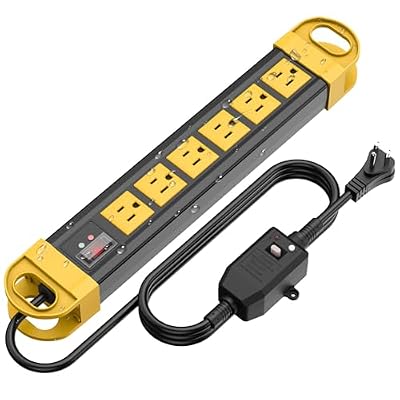
HHSOET GFCI Outdoor Power Strip Weatherproof IPX6 Waterproof, Yellow 6FT
Selected for "Aquarium Power Strips and Electrical Safety: Sizing, Drip Lo": this listing is aquarium equipment (HHSOET GFCI Outdoor Power Strip Weatherproof IPX6 Waterproof, Yellow 6), matching the equipment this article covers.
View on Amazon
KeBen Heavy Duty Power Strip Surge Protector,Individual Switches,6FT/15A
Selected for "Aquarium Power Strips and Electrical Safety: Sizing, Drip Lo": this listing is aquarium equipment (KeBen Heavy Duty Power Strip Surge Protector,Individual Switches,6FT/1), matching the equipment this article covers.
View on Amazon
CRST 8-Outlet Metal Power Strip with Individual Switches, 15A/1875W, 6FT
Selected for "Aquarium Power Strips and Electrical Safety: Sizing, Drip Lo": this listing is aquarium equipment (CRST 8-Outlet Metal Power Strip with Individual Switches, 15A/1875W, 6), matching the equipment this article covers.
View on AmazonHow Much Power Does an Aquarium Actually Draw?
Add up the nameplate wattage of everything that will sit on the strip. Almost all of it is the heater; filter, light, air pump and powerhead are rounding error by comparison. The one exception is a chiller.
| Equipment | Typical wattage | Amps at 120V | Notes |
|---|---|---|---|
| Heater, 10–20 gal | 50–100 W | 0.4–0.8 A | Roughly 3–5 W per gallon in a heated room |
| Heater, 40–55 gal | 200–300 W | 1.7–2.5 A | Cycles on/off; not a constant draw |
| Heater, 75–125 gal | 300–600 W | 2.5–5.0 A | Often two units split across the tank |
| Hang-on-back filter | 4–20 W | <0.2 A | Runs 24/7 |
| Canister filter | 15–45 W | 0.1–0.4 A | Larger models near the top of the range |
| LED light (freshwater) | 15–60 W | 0.1–0.5 A | On a timer, typically 8 hours |
| LED light (reef) | 60–200 W | 0.5–1.7 A | Ramps; peak draw only at midday |
| Air pump | 2–10 W | <0.1 A | Negligible load |
| Powerhead / wavemaker | 5–35 W | <0.3 A | Per unit; reefs often run two |
| UV sterilizer | 9–36 W | 0.1–0.3 A | Bulb wattage plus a small pump |
| Return pump (sump) | 20–80 W | 0.2–0.7 A | DC pumps draw less than AC |
| Chiller, 1/10 to 1/4 HP | 300–1,000 W | 2.5–8.3 A | Plus a large startup surge |
Nameplate wattage is peak draw, not average: a correctly sized heater pulls current maybe 10–25% of the time in a heated room. But when sizing a circuit, assume everything runs at once — on a cold morning it will.
What Kind of Power Strip for a 95 Gallon Fish Tank?
Total the tank, divide watts by 120 to get amps, and compare with the circuit. A standard US circuit is 15 amps (1,800 watts), and 80% of that — 12 amps, or 1,440 watts — is the safe continuous limit.
| Tank | Typical equipment | Total watts | Amps | % of a 15A circuit |
|---|---|---|---|---|
| 10 gallon | 50W heater, HOB filter, light, air pump | ~75 W | 0.6 A | 4% |
| 20 gallon | 100W heater, HOB filter, LED, air pump | ~130 W | 1.1 A | 7% |
| 40 gallon | 200W heater, canister, LED, powerhead | ~255 W | 2.1 A | 14% |
| 55 gallon | 250W heater, canister, LED, powerhead, UV | ~325 W | 2.7 A | 18% |
| 75 gallon | 300W heater, canister, LED, powerhead, UV | ~400 W | 3.3 A | 22% |
| 95 gallon | 2× 200W heaters, canister, LED, 2 powerheads, UV | ~540 W | 4.5 A | 30% |
| 125 gallon reef | 2× 300W heaters, return pump, reef LEDs, skimmer, 2 powerheads | ~850 W | 7.1 A | 47% |
| 125 gallon reef + chiller | as above plus 1/4 HP chiller | ~1,600 W | 13.3 A | 89% — too close |
So the honest answer for a 95 gallon tank: any quality 15A-rated surge protector with enough outlets handles it with room to spare. You are at roughly a third of the circuit. Buy for outlet count, cord length and build quality, not for amperage headroom you will never use.
The only setup that genuinely strains a 15A circuit is a large reef with a chiller. Compressor motors also draw a brief inrush current several times their running wattage at startup — that is what trips a breaker which seemed fine all week. Chillers belong on their own circuit.
Running Two Tanks on One Circuit
Adding a 20 gallon tank to an existing circuit is almost always fine — about 1.1 amps. Two 55s and a 20 together are still only around 6.5 amps. The risk is not the tanks, it is what shares the breaker: a space heater (1,500 W, 12.5 A), window AC or vacuum pushes you over instantly. Check what else is on that circuit first, and never share one with a space heater.
Surge Protector vs Power Strip vs GFCI — They Are Not the Same Thing
A power strip is just an extension cord with several sockets and, usually, a resettable circuit breaker. A surge protector is a power strip that also contains metal oxide varistors that clamp voltage spikes. Neither of them protects you — only a GFCI does that.
| Device | Protects against | Protects the fish? | Protects you? |
|---|---|---|---|
| Basic power strip | Overload (breaker trips) | Somewhat | No |
| Surge protector | Voltage spikes, lightning, grid switching | Yes — saves controllers and LED drivers | No |
| GFCI outlet or GFCI strip | Current leaking to ground through water — or you | Indirectly | Yes |
Joule rating is the total energy a surge protector can absorb before its protection is spent. Under 500 joules is entry level; 1,000–2,000 suits most tanks; 2,500 or more is worth it for controllers, dosers or reef LEDs. Joules are consumed — a unit that has eaten several surges can look fine while protecting nothing, so buy one with a “protected” indicator and replace it after a major surge.
GFCI Protection Is Not Optional
A ground fault circuit interrupter compares the current going out with the current coming back. If even about 5 milliamps goes missing — because it found a path to ground through spilled water, a cracked heater, or your arm while you were doing a water change — it cuts power in a fraction of a second. That is far below the current that stops a heart.
Get it one of three ways: a GFCI receptacle at the wall, a GFCI breaker in the panel, or a portable GFCI adapter or GFCI-equipped strip. Test it monthly — a GFCI that does not trip when tested is dead and must be replaced.
One honest trade-off: GFCIs nuisance-trip, and a leaky old heater can cut your filter while you are at work. The fix is to find and replace the failing device, never to remove the GFCI. If you are unsure whether an outlet is grounded or wired correctly, or a breaker trips for no clear reason, call a licensed electrician. This is not a DIY judgement call.
How to Make a Proper Drip Loop
Water runs downhill along a cord. A drip loop gives it somewhere to fall that is not your outlet. Every cord leaving the tank needs one — heater, filter, light, powerhead, air pump, the lot.
- Mount the strip above the water line, on the wall or the outside back of the stand — never on the floor, and never inside the stand where a leak pools.
- Let each cord hang below the outlet before it rises to plug in. The lowest point of the cord must be lower than the plug by several inches.
- Do not tape the loop flat or zip-tie cords into a tight bundle — that gives water a continuous path.
- Check the loop sits below the outlet, not merely curved. A cord that rises straight from tank to plug has no loop at all, however neatly routed.
Air pumps get one extra rule: fit a check valve and keep the pump above the water line. Without it, a power cut siphons water backwards down the tubing into the pump, then onto the floor.
Timers and Smart Plugs: Mind the Load Rating
Timers are perfect for lighting schedules, and smart plugs add remote control plus, on some models, energy monitoring. Check the printed rating: many cheap smart plugs are rated 10 amps, and far lower for inductive motor loads than resistive ones.
Never put a heater on a timer — it must cycle whenever the thermostat calls for heat. Lights and sometimes a UV sterilizer are good candidates. Do not chain a smart plug into a timer into a strip; each link is another failure point.
The Rules That Are Not Negotiable
- Never daisy-chain power strips. Plugging one strip into another defeats the overload protection of both and is a recognised fire cause. Need more outlets? Buy a strip with more sockets.
- Never plug a strip into an extension cord for permanent use, and never run a cord under a rug.
- Unplug everything before a water change that exposes the heater or means reaching into the tank. A heater run dry cracks, and a cracked heater is an energised element.
- Wall-mount, never floor-mount. Most aquarium electrical failures start with a small leak reaching a strip on the carpet.
Power Outages: What Actually Matters
Fish tolerate a temperature drop far better than a lack of oxygen, and biological filtration starts dying once flow stops. The best cheap insurance is a battery-powered air pump; many switch on automatically when mains power fails. Insulate the tank with blankets, stop feeding, and see our guide to keeping fish alive during a power outage.
When power returns, check the heater restarted and that your canister filter re-primed rather than running dry. A canister stagnant for hours can dump foul water back into the tank.
Troubleshooting
The GFCI keeps tripping
Unplug everything, reset, then reconnect devices one at a time. The heater is the usual culprit, followed by an old powerhead with a perished seal. Replace the faulty device; never bypass the GFCI.
The power strip’s breaker trips but the wall breaker does not
You are over the strip’s rating, not the circuit’s — usually a chiller or a second tank on the same strip. Move high-draw items to their own outlet.
You feel a tingle touching the water
Do not touch the tank again. Cut power at the breaker, then find the leaking device. A tingle means current is flowing through you, and the only reason it is not worse is usually your footwear. This is exactly what a GFCI prevents.
Outlet or plug feels warm
Stop using it. Warmth means resistance, and resistance means heat where there should be none — a failing outlet, a plug corroded by salt creep, or an overloaded strip.
Frequently Asked Questions
What kind of power strip do I need for a 95 gallon fish tank?
A 15-amp rated surge protector with 6 to 8 outlets and at least 1,000 joules covers a 95 gallon tank comfortably. Typical total draw is around 540 watts, or 4.5 amps, which is roughly 30% of a standard circuit. Prioritise a long cord, widely spaced outlets for chunky transformers, and a protection indicator light over raw amperage.
Can I run a 20 gallon aquarium on the same circuit as my other tank?
Almost certainly yes. A 20 gallon setup draws about 130 watts, or 1.1 amps, so even three or four modest tanks together stay well under the 12-amp continuous limit of a 15-amp circuit. The real question is what else shares that breaker — a space heater, window air conditioner or vacuum will overload it long before your aquariums do.
Is a GFCI really necessary for a fish tank?
Yes, without exception. A GFCI cuts power within milliseconds when roughly 5 milliamps leaks to ground, which is well below the level that can stop a heart. Water changes, cracked heaters and salt creep all create leakage paths, and no power strip, surge protector or fuse protects a person. Fit a GFCI outlet, breaker or adapter and test it monthly.
What joule rating should an aquarium surge protector have?
Aim for 1,000 to 2,000 joules for a standard freshwater tank, and 2,500 or more if you run reef LEDs, controllers or dosing pumps worth protecting. Joules are a consumable budget rather than a permanent rating: each surge absorbed uses some up, so choose a model with a protection indicator and replace it after any major electrical event.
Where should I mount the power strip relative to the tank?
Above the water line, fixed to a wall or the outside back of the stand, with every cord forming a drip loop that hangs below the plug before rising to it. Never place the strip on the floor, inside a cabinet where a leak would pool, or directly behind the tank where condensation and salt spray reach it.
Buy Tank on Amazon: 6 Picks Worth Ordering (2026)

Common Mistakes When Buying an Aquarium Overflow Box Guide