Last Updated: September 25, 2026
Best aquarium air pump choices rest on three figures: output in litres per minute, the depth the pump can push against, and noise in decibels. The third decides whether the pump stays in the room or ends up hidden in a cupboard with the airline run under a door. Outlet count and a check valve settle most of the rest of the decision.
As an Amazon Associate we earn from qualifying purchases.
As an Amazon Associate we earn from qualifying purchases at no extra cost to you. Prices and availability are accurate as of the date shown and are subject to change.
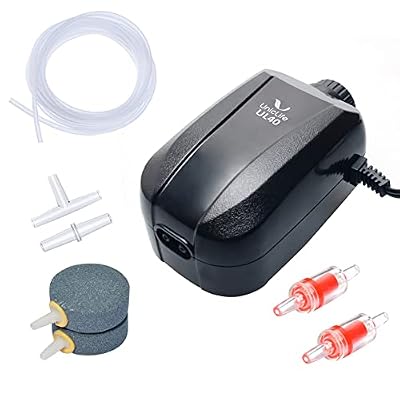
Uniclife 64 GPH Aquarium Air Pump with Dual Outlets Adjustable Quiet Fish Tank Air Pump with Air Stone Airline Tubing Check Valve and Connector Accessories for 10-100 Gallon Fish Tank
Selected for "Best Aquarium Air Pump: Output, Noise and Depth Ratings": this listing is pumps (Uniclife 64 GPH Aquarium Air Pump with Dual Outlets Adjustable Quiet F), matching the equipment this article covers.
View on Amazon
Pawfly Aquarium Air Pump 50 GPH Fish Tank Oxygen Pump for 10-60 Gallon Fish Tanks Buckets Dual Outlet Adjustable Ultra Quiet Aerator Pump with Airline Tubing Air Stones Connectors and Check Valves
Selected for "Best Aquarium Air Pump: Output, Noise and Depth Ratings": this listing is pumps (Pawfly Aquarium Air Pump 50 GPH Fish Tank Oxygen Pump for 10-60 Gallon), matching the equipment this article covers.
View on Amazon
AQQA Aquarium Air Pump, 3W Powerful Dual Outlet Adjustable Oxygen Aerator
Selected for "Best Aquarium Air Pump: Output, Noise and Depth Ratings": this listing is pumps (AQQA Aquarium Air Pump, 3W Powerful Dual Outlet Adjustable Oxygen Aera), matching the equipment this article covers.
View on Amazon
AQUANEAT Aquarium Air Pump, 100gal Fish Tank Air Bubbler, Adjustable Dual-Outlet Hydroponic Oxygen Aerator with Stones, Airline Tubing, Check Valves
Selected for "Best Aquarium Air Pump: Output, Noise and Depth Ratings": this listing is pumps (AQUANEAT Aquarium Air Pump, 100gal Fish Tank Air Bubbler, Adjustable D), matching the equipment this article covers.
View on AmazonBy David Nguyen
Sizing to the Device, Not the Tank
Picking the best aquarium air pump means matching output to what the air is driving rather than to tank volume. A sponge filter, an air stone and a protein skimmer all take different amounts, and depth rating caps what any of them can do.
The Deciding Numbers: Output, Depth Rating and Outlets
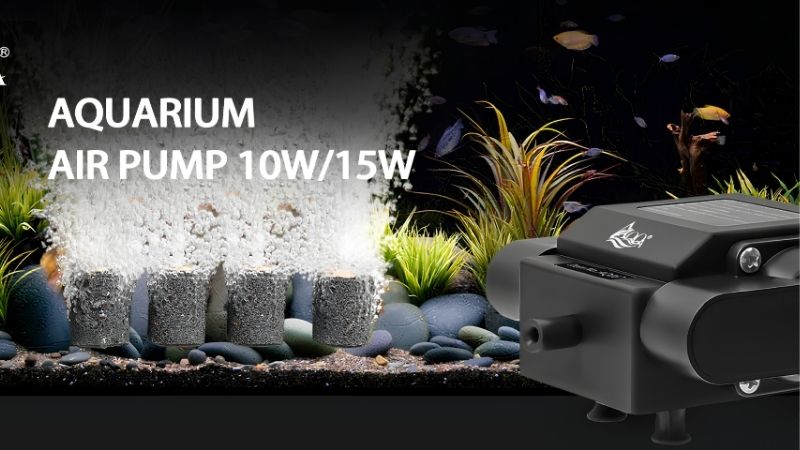
Output is quoted in litres per minute, commonly 1-2 LPM for a nano pump and 4-8 LPM for a dual-outlet model. A single sponge filter needs relatively little, while a long air bar or a deep tank needs considerably more to work properly.
Depth rating is the figure that catches people out. Most small pumps are rated to push against 3-6 ft (0.9-1.8 m) of water, and running one deeper than that produces weak bubbles regardless of how the output is described on the box.
Outlet count decides flexibility. A dual-outlet pump with independent control valves runs a sponge filter and an air stone at different rates from one unit, which is usually better value than two single pumps at similar total output.
Two More Criteria With Numbers Attached
Noise is the criterion that determines long-term use. Diaphragm pumps typically sit around 35-50 dB, and much of what reaches the room is vibration transmitted through whatever the pump is standing on rather than the motor itself.
Serviceability matters because diaphragms are consumables. A pump with a replaceable diaphragm kit lasts many years; one sealed against repair is disposable, and diaphragms stiffen within roughly one to two years of continuous running.
Tank Size, Placement and Fit
Measure the height of the pump position relative to the tank water line before ordering, since a pump sitting below that line will back-siphon water into itself when the power fails unless a check valve is fitted.
Place the pump on a soft surface rather than a hard shelf. A foam pad or a folded cloth under the feet removes a surprising amount of transmitted noise, often more than choosing a quieter pump would have done.
The Options by What the Air Is Driving
Four classes cover essentially every use. Each is matched below to a job, because the best aquarium air pump depends on how many devices it drives and how deep the water above them actually is.
Single-Outlet Diaphragm Pump: For One Sponge Filter
Main numbers: roughly 1-2 LPM, rated to around 3 ft (0.9 m) of depth, drawing very little power. This is the correct match for a single sponge filter in a tank up to about 20 gallons (76 L).
It suits shrimp tanks, quarantine tanks and grow-out setups. It does not suit deep tanks or multiple devices, since splitting a small pump between two outlets leaves both running weakly rather than one running properly.
Dual-Outlet Pump With Control Valves: The General-Purpose Choice
Main numbers: 3-8 LPM total across two independently adjustable outlets, rated to 4-6 ft (1.2-1.8 m). Being able to throttle one line without affecting the other is what makes this class the default for most keepers.
It suits anyone running a sponge filter plus an air stone, or two tanks from one pump. It does not suit very quiet rooms unless mounted on foam, and it does not suit a single small device, where the excess air is wasted.
Linear Piston Pump: For Multiple Tanks
Main numbers: 10 LPM and upward, rated to considerable depth, designed to run continuously for years driving a manifold of gang valves. Fish rooms and multi-tank setups are the reason this class exists.
It suits three or more tanks fed from one manifold, or a deep display where smaller pumps struggle. It does not suit a single tank, where the output is far beyond what any one device uses and the running cost is unnecessary.
Battery Backup Pump: For Power Cuts
Main numbers: modest output, running from batteries for hours rather than days, usually with a mains sensor that starts it automatically when power drops. Output is enough to keep one sponge filter or air stone moving.
It suits anyone in an area with regular outages, and it belongs in every marine or heavily stocked freshwater setup. It does not suit continuous use, and battery chemistry degrades, so test it twice a year rather than assuming it works.
| Option | Output | Depth rating | Outlets | Best for |
|---|---|---|---|---|
| Single-outlet diaphragm | 1-2 LPM | Around 3 ft (0.9 m) | One | One sponge filter, small tanks |
| Dual-outlet with valves | 3-8 LPM | 4-6 ft (1.2-1.8 m) | Two, adjustable | Most single-tank setups |
| Linear piston pump | 10 LPM and up | Deep, model dependent | Manifold | Fish rooms, three or more tanks |
| Battery backup pump | Modest, hours of runtime | Shallow to moderate | One or two | Power cuts, emergency aeration |
| Undersized pump, split | Below device needs | Not applicable | Two, both weak | Avoid, buy one class up instead |
Head to Head, and When Not to Buy
Two classes get compared constantly, and there is a common case where a new pump solves nothing. The best aquarium air pump is frequently the one already owned, with a fresh diaphragm and a clean air stone.
Single Versus Dual Outlet
The single-outlet pump wins on cost and on being quieter at the same build quality, since there is less mechanism moving. For one sponge filter in a small tank it is entirely adequate and nothing more is gained by upsizing.
The dual-outlet pump wins as soon as there is a second device or a second tank, because independent valves let each line run at its own rate. It also gives redundancy of a sort, since one outlet failing rarely takes both.
When a New Pump Is the Wrong Fix
Weak bubbles are usually a clogged air stone or a stiffened diaphragm rather than a failing pump. Replace the stone, which costs very little, and check whether the diaphragm kit is available before assuming the unit needs replacing.
Noise that has increased over time is often the pump walking on a hard shelf rather than the motor wearing. Put it on foam and check the feet are intact, since both cost nothing and resolve a large share of complaints.
The Cheaper Route That Works
A diaphragm rebuild kit costs a fraction of a new pump and restores full output on most models. Keeping one on the shelf turns a failing pump into a ten-minute job rather than a week of weak aeration while a replacement ships.
Air stones are consumables and should be treated as such. A stone that has been running six months produces larger, sparser bubbles, and replacing it often restores what looked like a pump problem for the price of a coffee.
Running It and the 12-Month Cost
The best aquarium air pump runs continuously and fails gradually, which makes its decline easy to miss. This section covers the maintenance that keeps output steady, what fails, and the safety points that apply to every model.
What Fails and How Fast
Diaphragms stiffen within roughly one to two years of continuous running, reducing output steadily rather than stopping suddenly. Air stones clog on a similar or faster timescale, and the two together explain most gradual aeration loss.
Feet perish and fall off, which is when a quiet pump becomes an audible one. Airline tubing yellows and hardens over years, and a hardened line at a fitting is where leaks develop, usually unnoticed behind the tank.
Gang valves also wear at the seals, letting air escape rather than reaching the device. A pump that seems weak on one line and strong on another is often a valve problem rather than anything to do with output.
Check Valves and Back-Siphon
A check valve in the airline is essential whenever the pump sits below the tank water line. Without one, a power cut lets water siphon down the airline into the pump, which destroys it and can empty a surprising amount of the tank.
Fit the valve close to the pump rather than at the tank end, and check its direction, since fitting one backwards blocks the air entirely. Replace it every couple of years, because the internal flap perishes like any other rubber part.
Safety, Placement and Timing
Every pump should carry a recognised certification such as UL or ETL, sit on a GFCI outlet and have a drip loop formed in its cable. Keep the pump above the water line where possible, with a check valve regardless.
On timing, air pumps, stones and tubing see their deepest discounts in late June and again in late November, which suits stocking spares. A sale changes nothing about sizing, and prices move constantly, so check at the moment of purchase.
Best Aquarium Air Pump Questions
These arrive once a sponge filter or air stone is planned. Every answer about the best aquarium air pump stays with output, depth and noise, since those three settle almost every case that comes up in practice.
What size pump do I need?
Size by what the air drives rather than by tank volume. A single sponge filter in a tank up to 20 gallons (76 L) runs on 1-2 LPM; two devices or a deeper tank wants a dual-outlet pump at 3-8 LPM.
Do I need a check valve?
Yes whenever the pump sits below the tank water line, and it is cheap enough to fit regardless. Without one, a power cut siphons water down the airline into the pump and ruins it, often overnight.
Why is my pump so loud?
Usually vibration transmitted into a hard surface rather than the motor. Put it on foam or a folded cloth, check the rubber feet are present, and make sure the airline is not pulling the body against the wall.
How long do diaphragms last?
Roughly one to two years of continuous running before output falls noticeably. Buy a pump with an available rebuild kit and keep one on the shelf, since replacing the diaphragm costs a fraction of replacing the pump.
See More:
Conclusion
The best aquarium air pump for most single-tank setups is a dual-outlet diaphragm model at 3-8 LPM with independent control valves, rated to at least the depth of your tank and mounted on foam to control transmitted noise.
One sponge filter in a small tank needs only 1-2 LPM, and three or more tanks are better served by a linear piston pump on a manifold. Fit a check valve, keep a diaphragm kit and spare air stones, and add a battery backup unit where outages are common.

Best Aquarium Air Stone for Fine Bubbles: Buyer’s Guide
Best Backup Battery for Wavemakers During Outages: Compared