Last Updated: September 25, 2026
Best return pump for aquarium sump selection is decided by delivered flow rather than rated flow. Head loss takes 25-40% of the box figure in a typical cabinet, and the target is 5-10 times display volume per hour actually arriving in the tank rather than leaving the pump. Plan the plumbing before choosing the model.
As an Amazon Associate we earn from qualifying purchases.
As an Amazon Associate we earn from qualifying purchases at no extra cost to you. Prices and availability are accurate as of the date shown and are subject to change.

JEREPOND 660GPH Aquarium Return pump with LCD display controller, DC 24V 25W aquarium pump for saltwater freshwater aquarium,fish tank,sump,20 speeds ECO Quiet Submersible and inline pump
Selected for "Best Return Pump for Aquarium Sump: Compared by Numbers": this listing is pumps (JEREPOND 660GPH Aquarium Return pump with LCD display controller, DC 2), matching the equipment this article covers.
View on Amazon
Orlushy DC-5000 Silent Swirl Controllable DC aquarium Pump 40W 1320GPH-marine wavemaker return pump with sine wave Controller for salt/Freshwater coral reef fish tank sump Circulation
Selected for "Best Return Pump for Aquarium Sump: Compared by Numbers": this listing is pumps (Orlushy DC-5000 Silent Swirl Controllable DC aquarium Pump 40W 1320GPH), matching the equipment this article covers.
View on Amazon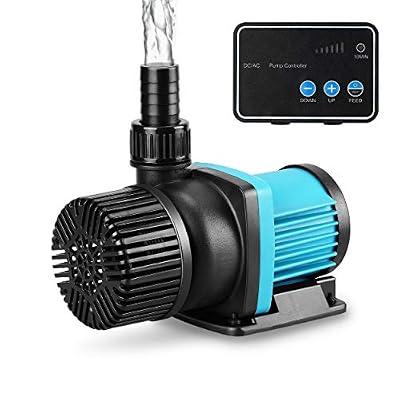
JEREPET 1850GPH 55W16FT Aquarium 24V DC Water Pump with Controller, Submersible and Inline Return Pump for Fish Tank,Aquariums,Fountains,Sump,Hydroponic,Pond,Freshwater and Marine Water Use
Selected for "Best Return Pump for Aquarium Sump: Compared by Numbers": this listing is pumps (JEREPET 1850GPH 55W16FT Aquarium 24V DC Water Pump with Controller, Su), matching the equipment this article covers.
View on Amazon
JEREPET 520GPH 20W 9FT Aquarium 24V DC Water Pump with Controller, Submersible and Inline Return Pump for Fish Tank,Aquariums,Fountains,Sump,Hydroponic,Pond,Freshwater and Marine Water Use
Selected for "Best Return Pump for Aquarium Sump: Compared by Numbers": this listing is pumps (JEREPET 520GPH 20W 9FT Aquarium 24V DC Water Pump with Controller, Sub), matching the equipment this article covers.
View on AmazonBy David Nguyen
Reading the Pump Curve, Not the Rating
Choosing the best return pump for aquarium sump duty is a matter of reading the pump curve rather than the headline rating. Four figures settle it, and two of them depend on how your plumbing is routed rather than on the pump itself.
The Deciding Number: Delivered Flow After Head Loss
Start from the target. A 75 gallon (284 L) display wants 375-750 GPH (1420-2839 LPH) through the sump, and a pump rated 900 GPH (3407 LPH) at zero head commonly delivers 550-650 GPH (2082-2460 LPH) at 4 ft (1.2 m) of lift.
Every fitting costs more. Elbows, valves and narrow tubing each add resistance, so a run with four elbows behind the cabinet delivers noticeably less than the same height with two. Plan the plumbing before choosing the pump rather than afterwards.
Two More Criteria With Numbers Attached
Power draw and heat go together. A submersible pump transfers essentially all of its wattage into the water as heat, so a 60 W pump in a small system raises temperature measurably while a 25 W DC pump moving similar water does not.
Noise matters in a living room. Submersible pumps are generally quieter than external ones because the water damps them, but a submersible with a worn impeller develops a hum that carries through the cabinet and is hard to isolate.
Mounting affects it as much as the pump does. A unit sitting directly on the sump base transmits vibration into the glass, so a small foam pad underneath removes a surprising amount of the noise reaching the room.
Tank Size, Placement and Fit
Measure the return chamber footprint and the height from the sump water line to the display rim before ordering, since the second figure is the head your pump has to overcome and it is usually taller than people estimate.
Leave clearance around the pump for servicing. A unit wedged into a corner behind a baffle gets stripped and cleaned rarely, and calcium deposits on the impeller reduce delivered flow steadily without any change in sound.
The Options by System Size and Control Needs
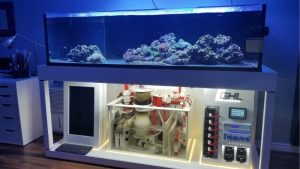
Four classes cover essentially every sump. Each is matched below to a system, since the best return pump for aquarium sump use depends on display size, cabinet height and whether adjustable flow is worth paying for.
Controllable DC Pump: The General-Purpose Default
Main numbers: adjustable typically from 20-100% of rated output, with power draw of roughly 20-60 W across the common sizes. Being able to tune flow after commissioning is the practical reason this class dominates modern builds.
It suits most reef and freshwater sumps from 40 gallons (151 L) upward, particularly where overflow noise needs trimming. It does not suit a minimal budget, and the controller is a failure point, so choose a model that defaults to running if it drops out.
Fixed-Speed AC Pump: The Reliable Baseline
Main numbers: a single output on the pump curve, higher power draw than a DC equivalent at similar flow, and no electronics beyond the motor. Reliability is the argument, since there is very little to fail apart from the impeller.
It suits keepers who want simplicity and have matched the pump to the plumbing accurately. It does not suit builds where flow needs trimming later, since the only adjustment available is a valve on the output, which wastes energy as heat.
External Pump: For Larger Systems
Main numbers: higher flow at height than submersible equivalents, and heat dissipated into the room rather than the water. On a 180 gallon (681 L) system that difference in heat transfer alone can be worth a chiller.
It suits systems above roughly 125 gallons (473 L) with the plumbing to support them. It does not suit small builds, since external pumps are louder in the room, need priming and introduce two more joints that can leak into a cabinet.
Nano Return Pump: For All-in-One and Small Sumps
Main numbers: 100-300 GPH (379-1136 LPH) rated, drawing 3-10 W, sized for a rear chamber or a 10 gallon (38 L) sump. Flow at this scale needs care, since too much pushes bubbles through a short chamber run.
It suits nano systems and all-in-one tanks. It does not suit anything above 40 gallons (151 L), and the small impellers block with detritus sooner than larger pumps, which makes monthly cleaning less optional than it sounds.
| Option | Typical delivered flow | Power draw | Heat into water | Best for |
|---|---|---|---|---|
| Controllable DC | 300-1500 GPH (1136-5678 LPH) | 20-60 W | Moderate, adjustable | Most sumps from 40 gallons up |
| Fixed-speed AC | 300-1200 GPH (1136-4542 LPH) | 40-100 W | Higher | Simple, reliable builds |
| External pump | 800-3000 GPH (3028-11356 LPH) | 60-200 W | Low, dissipated to room | Systems above 125 gallons |
| Nano return | 80-250 GPH (303-946 LPH) | 3-10 W | Low | All-in-one and small sumps |
| Oversized pump, valved down | Whatever the valve allows | Full draw regardless | Highest | Avoid where a smaller pump fits |
Head to Head, and When Not to Buy
Two of these get compared constantly, and there is a common case where a new pump is the wrong purchase entirely. The best return pump for aquarium sump use is often the one already fitted, stripped down and properly cleaned.
DC Versus AC
DC wins on adjustability, on power draw at a given flow and therefore on heat added to the water. Being able to dial output down by 20% to quieten an overflow, without wasting energy through a valve, is a real advantage.
AC wins on simplicity and price. There is no controller to fail and no firmware to misbehave, and for a build where the flow figure was calculated correctly at the start, that reliability is worth more than adjustment nobody will use.
When a New Pump Is the Wrong Fix
Declining flow is usually calcium deposits on the impeller or detritus in the intake, not a failing motor. Strip the pump, soak the impeller in a dilute vinegar solution, rinse thoroughly and re-measure before spending anything.
Micro-bubbles in the display are a baffle problem rather than a pump problem in most cases, though excessive return flow contributes. Check the bubble trap spacing and reduce flow toward the lower end of the target before replacing hardware.
The Cheaper Route That Works
Reducing plumbing restriction costs almost nothing and recovers real flow. Replacing two tight elbows with wider sweeps, or moving up one tubing size, can return 10-15% of delivered output without touching the pump at all.
A spare impeller is the other worthwhile purchase. It costs a fraction of a new pump, and having one on the shelf means a worn impeller is a ten-minute job rather than a week of reduced flow while a replacement ships.
Running It and the 12-Month Cost
The best return pump for aquarium sump duty runs continuously for years and fails gradually rather than suddenly. This section covers what degrades, the maintenance that holds flow steady, and the safety points that apply to every option above.
What Fails and How Fast
Impellers wear at the shaft and accumulate deposits, particularly in saltwater where calcium builds quickly. Flow falls steadily across a year with no change in noise, which reads as a filtration problem rather than a pump one.
Ceramic shafts crack if a pump runs dry even briefly, which is the usual consequence of a sump level dropping below the intake. Bearings and rubber mounts also harden with age, and a pump that has become audible is usually near replacement.
Maintenance That Holds Flow Steady
Strip and clean the pump every one to three months depending on water type, soaking the impeller in dilute vinegar where deposits have formed and rinsing thoroughly before reassembly. Clear the intake cage at the same time.
Re-measure delivered flow annually by timing the output into a container of known volume. Comparing that against the figure recorded at commissioning is the only reliable way to notice a decline before it affects the tank.
Safety, Power and Timing
Every pump should carry a recognised certification such as UL or ETL, sit on a GFCI outlet and have a drip loop formed in its cable. A pump is the one device in a sump that will empty water onto the floor if a fitting fails.
On timing, return pumps see their deepest discounts in late June and again in late November, which suits a planned replacement. A sale changes nothing about sizing, and prices move constantly, so check at the moment of purchase.
Best Return Pump for Aquarium Sump Questions
These arrive once the sump is planned but before the order. Every answer on the best return pump for aquarium sump question stays with delivered flow and head, since those two settle almost every case that comes up.
How do I calculate head loss?
Measure the vertical height from sump water line to the return outlet, then add roughly one foot of equivalent head per elbow. Read the pump curve at that total figure rather than trusting the headline rating on the box.
Can a return pump be too strong?
Yes. Above roughly 10 times display volume it pushes water through the sump faster than a skimmer can process, drives bubbles past the baffles and raises overflow noise. Valving down an oversized pump wastes power as heat.
Does the pump heat the water?
A submersible one does, transferring nearly all its wattage into the tank. That is helpful in a cool room and a problem in a warm one, which is part of why external pumps suit larger systems where the heat load is significant.
Should I run it through a valve?
Only on the output side, never the intake, and only as fine adjustment. Restricting the intake of a pump risks cavitation and premature wear, while a modest output restriction is acceptable although less efficient than a DC pump dialled down.
See More:
Conclusion
The best return pump for aquarium sump use is a controllable DC unit sized so that delivered flow, after a 25-40% head loss allowance, lands at 5-10 times display volume per hour with the pump running below full output.
On a simpler build, a correctly sized fixed-speed AC pump is reliable and cheaper. Above 125 gallons (473 L), consider an external pump to keep motor heat out of the water. Measure delivered flow at commissioning and re-check it annually.
What to Look for in Canister Filters in 2026: What Actually Matters
Best Aquarium Filter