Last Updated: October 21, 2026
If your water is cloudy, smells, or your fish are gasping after two weeks, it’s usually the filter, not the fish. Most beginners buy too little filtration or the wrong type for their tank shape and stocking. I have run all four main types on freshwater tanks from 5 to 75 gallons, and the right choice comes down to tank size, bioload, and how much maintenance you will actually do.
Short version: for most 10 to 40 gallon community tanks, a simple hang-on-back is enough and easiest to live with. For messy fish, planted tanks over 40 gallons, or if you want quiet and clear water, step up to a canister. For shrimp, fry, and bettas, a sponge filter driven by air is often better than anything expensive.
What to buy for common setups
10-gallon betta or shrimp tank: air-driven sponge filter. It cannot suck up babies, it won’t create a current that pins a betta in the corner, and if the power blips it restarts by itself. Pair it with a small air pump and a check valve. That is the whole system.
20 to 40 gallon community tank: a single hang on back aquarium filter rated for 30 to 50 gallons. Most people should buy one size larger than the box suggests, then turn the flow down if needed. The cheaper option is absolutely fine here – you are paying for a plastic box, a pump, and room for sponge and ceramic media.
55 to 75 gallon, cichlids, goldfish, or turtle tank: a canister aquarium filter rated for at least 1.5x your tank volume. These tanks produce more waste than a hang-on-back can process without weekly pad changes, and canisters hold three to four times more biological media.
The four types compared
| Type | Best for | Upkeep | Main downside |
|---|---|---|---|
| Hang-on-back (HOB) | 10-40 gal community tanks | Rinse sponge every 2-3 weeks, replace floss as needed | Noisy waterfall if water drops, limited media space |
| Canister | 40+ gal, messy fish, planted tanks | Clean every 6-12 weeks | Leaks at seals, heavy to carry to sink, higher price |
| Sponge filter | Shrimp, fry, betta, quarantine | Squeeze in old tank water monthly | Takes up tank space, weak mechanical filtration |
| Internal power filter | Small tanks, dorms, temporary setups | Rinse every 1-2 weeks | Occupies space, cord in tank, clogs fast |
Hang-on-back filters: best for most people
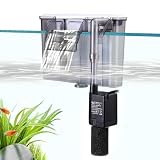
A hang-on-back hangs on the rim, pulls water up through an intake tube, and spills it back over a lip. That spill adds oxygen, which helps in warm tanks and crowded tanks. Media is usually a coarse sponge plus a bag of ceramic rings or a disposable cartridge. Throw the disposable cartridge away in concept – cut a coarse sponge to fit and add your own biomedia. It lasts for years and costs less.
Trade-offs are real. If you let evaporation drop the water level an inch, you get a constant trickling noise and salt creep on a brackish tank. The intake will also suck up shrimplets and long-finned bettas if you don’t add a prefilter sponge. And most HOBs lose prime after a power outage if the water level is low – they will buzz dry until you pour tank water into the box to restart the siphon.
Who it suits: anyone with a standard rectangular tank who wants to see the filter working and clean it in five minutes in the sink. If you hate plumbing, hoses, and buckets, start here.
Canister filters: when you need capacity and quiet
A canister sits in the cabinet, with intake and output hoses going up to the tank. Water passes through stacked trays you fill yourself: coarse foam, fine foam, ceramic or sintered glass media. Because the volume is so much larger, beneficial bacteria survive a missed cleaning, and water stays polished for weeks.
The failure mode is different from a HOB. Canisters rarely just stop – they leak. O-rings dry out, a hose clamp loosens, or you pinch the main gasket after cleaning and get a slow drip overnight. I keep the canister in a shallow plastic tote for the first 24 hours after maintenance for exactly this reason. They are also annoying to clean: disconnect, carry 15 pounds of water to the tub, open four latches, rinse trays, reassemble without kinking hoses.
Who it suits: tanks over 40 gallons, goldfish or African cichlids that shred pads in days, and living rooms where pump hum matters. A good canister filter for 75 gallon fish tank will run nearly silent if the cabinet door is closed. If you have a 20-gallon with six tetras, a canister is overkill and you will dread cleaning it.
Sponge, internal, and undergravel: niche but useful
Sponge filters look crude – a sponge on a weighted base bubbling away – but for shrimp, fry, and hospital tanks they are the safest option. There is almost nothing to break. The air pump is the only moving part and it lives outside the tank. The downside is mechanical filtration: they trap debris in the sponge but do not polish water like floss does, and they take up visual space in a display tank.
Internal power filters stick to the glass with suction cups. They are cheap, self-priming, and good for a 5-gallon desk tank where a HOB will not fit under a lid. They clog fast because the sponge is small, and fish like to hide behind them and get stuck as they grow. Check behind them during water changes.
Undergravel filters still have fans for heavily stocked African cichlid tanks, but I would skip them for most beginners. Debris collects under the plate where you cannot vacuum it without tearing down the tank, and plant roots tangle in the uplift tubes.
Sizing and maintenance that actually keeps fish alive
Ignore the “up to 70 gallons” on the box for HOBs and internals. That rating assumes two small fish and perfect maintenance. For a normally stocked tank, buy filtration rated for 1.5 to 2 times your tank volume per hour in turnover. A 20-gallon community does well with 150 to 200 gallons per hour of real flow. For canisters, which hold more media, 1.5x tank volume rating is usually enough.
Do not replace all media at once. That crashes your cycle and causes the ammonia spike people blame on “new tank syndrome” in an old tank. Rinse sponges and ceramic in a bucket of siphoned tank water, never hot tap water – chlorine kills the bacteria you are trying to keep. Replace fine floss when it falls apart, keep coarse sponge until it crumbles.
If flow drops by half, check the impeller first. Hair, plant leaves, and snail shells jam the magnet. Unplug, pull the impeller, wipe the shaft with a cotton swab, and it usually restarts. If a HOB rattles after cleaning, there is often air trapped under the impeller cover – tilt the box forward slightly until the bubbles escape.
FAQ
How long should I run my aquarium filter?
24 hours a day. Turning it off at night starves beneficial bacteria of oxygen and lets ammonia rise by morning. If noise is the issue, lower the water fall distance or switch to a sponge filter with a quiet air pump rather than using a timer.
Do I need a different filter for a betta or shrimp?
Yes, go gentler. Bettas struggle in strong current and shrimp babies get pulled into standard intakes. A sponge filter or a HOB with a prefilter sponge over the intake and flow turned down works best. Strong filtration is less important than stable, low-flow water for these animals.
Can I use two smaller filters instead of one big one?
Often that is better. Two small HOBs or a HOB plus a aquarium sponge filter gives you backup if one clogs or stops after a power outage, and you can clean them on alternate weeks without losing all your bacteria.
When should I upgrade from a hang-on-back to a canister?
When you are rinsing pads every week to keep flow up, when the tank is over 40 gallons with messy eaters like goldfish or cichlids, or when pump noise bothers you. If a larger HOB cleaned every two weeks keeps nitrates under 40 ppm before your water change, save your money.
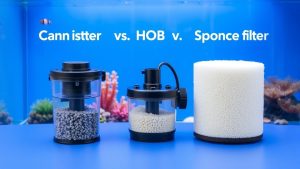
Canister vs HOB vs Sponge Filter: Which Aquarium Filter Should You Choose?
What to Look for in Aquarium Heaters in 2026: What Actually Matters