Last Updated: October 21, 2026
Best filter for 10 gallon tank setups is a narrower question than it looks, because a 10 gallon (38 L) tank holds closer to 8-9 gallons (30-34 L) once substrate is in. Size for that real figure, allow for flow loss once media is in, and check the outflow is not too strong for whatever you plan to keep.
As an Amazon Associate we earn from qualifying purchases.

Tetra LED 10 Gallon Complete Fish Tank Kit | Aquarium Kit Includes White LED Light, 10 Gallon Glass Tank With Hinged Hood, Filter, Filter Cartridge, For Freshwater Fish
Included for 'Best Filter for 10 Gallon Tank Setups: Sized by Turnover' as a representative aquarium product in this roundup; selection reflects the product set returned for this topic.
View on Amazon
Tetra Whisper EX 20 Aquarium Filter | For Fish Tanks 10-20 Gallons, Whisper Quiet Fish Tank Filter, Multi-Stage Filtration, Fast Set-Up - No Priming
Included for 'Best Filter for 10 Gallon Tank Setups: Sized by Turnover' as a representative aquarium product in this roundup; selection reflects the product set returned for this topic.
View on Amazon
BlueYu Aquarium Filter, Fish Tank Filter 4-in-1 for 10-30 Gallon Tanks, Submersible Internal Filter with Wave-Maker, Oxygenation & Adjustable Air Flow for Freshwater/Saltwater/Turtle Tanks (8W)
Included for 'Best Filter for 10 Gallon Tank Setups: Sized by Turnover' as a representative aquarium product in this roundup; selection reflects the product set returned for this topic.
View on Amazon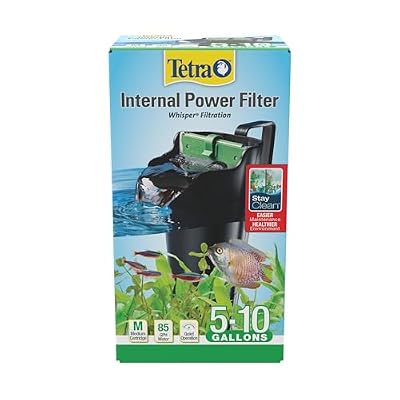
Tetra Whisper 85 GPH Internal Power Filter For Aquariums
Included for 'Best Filter for 10 Gallon Tank Setups: Sized by Turnover' as a representative aquarium product in this roundup; selection reflects the product set returned for this topic.
View on Amazon
Tetra Whisper IQ Power Filter 10 Gallons, 105 GPH, with Stay Clean Technology
Included for 'Best Filter for 10 Gallon Tank Setups: Sized by Turnover' as a representative aquarium product in this roundup; selection reflects the product set returned for this topic.
View on Amazon
DaToo Aquarium Power Filter In-Tank Ultra Silent Small Fish Tank Filter 3W For Aquarium 1 to 10 Gallon Tank, 1 Yr Warranty
Included for 'Best Filter for 10 Gallon Tank Setups: Sized by Turnover' as a representative aquarium product in this roundup; selection reflects the product set returned for this topic.
View on Amazon
hygger Hang-On-Back Aquarium Canister Filter, with 4-Stage Filtration
Included for 'Best Filter for 10 Gallon Tank Setups: Sized by Turnover' as a representative aquarium product in this roundup; selection reflects the product set returned for this topic.
View on AmazonBy David Nguyen
Sizing for Eight or Nine Gallons of Actual Water
Small tanks punish both undersizing and oversizing, which is what makes the best filter for 10 gallon tank question narrower than it first appears. The best filter for 10 gallon tank use has to move enough water to keep ammonia at zero without turning the tank into a current a betta cannot swim against.
The Deciding Numbers: Real Volume, Turnover and Loaded Flow
Start with real volume. A 10 gallon (38 L) tank holds roughly 8-9 gallons (30-34 L) after substrate, hardscape and the surface gap, so every calculation should use the lower figure rather than the number on the box.
Turnover for community stocking is 4-6 times per hour, which puts a 10 gallon tank at roughly 40-55 GPH (151-208 LPH) of actual flow. Goldfish do not belong in this volume at all, so the higher 8-10 times bracket rarely applies.
Then add headroom for loading. Printed GPH is measured with an empty housing, and real flow drops 30-50% once media and tubing are in place, so a unit rated 80-100 GPH (303-379 LPH) delivers roughly the right amount in service.
The Other Criteria: Flow Strength, Noise and Media System
Flow strength matters more here than in any larger tank, because the same GPH is concentrated in a much smaller space. Bettas, fancy guppies and fry all struggle in a 10 gallon tank with an unbaffled outflow.
Media system decides the running cost. A filter taking loose media lets you replace floss while keeping colonised biological media, while a cartridge system discards the colony monthly, which matters more in a small tank where the colony is small to begin with.
Noise is the third criterion and a genuine one, because 10 gallon tanks often sit in bedrooms, dorm rooms and offices. Air pumps buzz against hard surfaces, and hang-on-back units splash increasingly as the water level drops between top-offs.
Tank Size, Placement and Fit
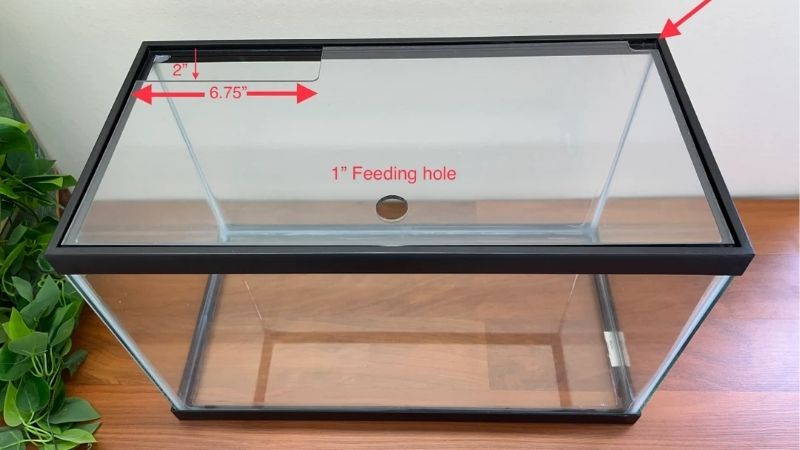
A standard 10 gallon tank measures about 20 x 10 x 12 in (51 x 25 x 30 cm), so any hang-on-back unit has to fit across a 10 in (25 cm) depth and clear the rim brace. Rear clearance of 4-6 in (10-15 cm) is still required.
Measure before you order: rear clearance against the unit depth, internal footprint if you are considering an internal filter, and stand capacity against roughly 10 lb/gallon (about 1 kg/L). A filled 10 gallon tank runs around 100 lb (45 kg) with substrate.
The Options by Need
These five cover what genuinely works as a best filter for 10 gallon tank choice. Each is grouped by the tank it suits rather than ranked, since the best filter for 10 gallon tank use depends on what is living in it.
For Bettas and Shrimp: Sponge Filter
An air-driven sponge filter delivers biological filtration with almost no current, which is the combination bettas and shrimp need. The sponge is the biological media, so nothing is discarded on a schedule and the running cost is close to nothing.
Who it suits: betta tanks, shrimp colonies, fry grow-out and quarantine. Who it does not: anyone wanting clear polished water, since mechanical filtration is limited, and anyone in a bedroom, since the air pump hums continuously and needs isolating from hard surfaces.
For Standard Community Stocking: Small Hang-on-Back With Loose Media
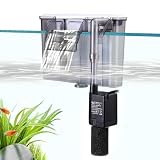
A hang-on-back unit rated around 80-100 GPH (303-379 LPH) with a media basket is the most versatile option for a 10 gallon community tank. It handles mechanical and biological filtration, and you choose what goes inside it.
Who it suits: small tetras, rasboras, corydoras and similar stocking with rear clearance available. Who it does not: bettas without a baffle, and tanks pushed flat against a wall, since these units need space behind the glass and lose prime if the water level drops.
Check the media basket specifically before buying. Several models look like loose-media units and only accept the manufacturer’s own inserts, which puts you back on a monthly purchase without realising it until the first replacement is due.
For Tanks Against a Wall: Internal Power Filter
An internal filter sits submerged inside the tank, removing the rear clearance requirement and the risk of losing prime entirely. Most small models are adjustable and suit tanks up to 20 gallons (76 L) comfortably.
Who it suits: tanks in tight spaces, hooded tanks and anyone who has had a hang-on-back unit run dry. Who it does not: aquascapers, since the unit occupies visible volume inside a tank that only has 8-9 gallons (30-34 L) of it.
For Lowest Running Cost: Corner or Box Filter
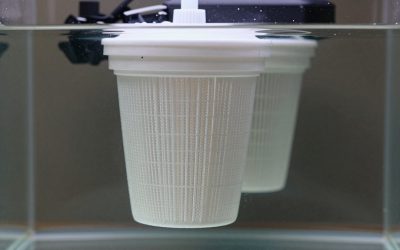
An air-driven box filter holds loose media in a submerged chamber, giving you sponge-filter economics with the ability to choose and layer media. Flow is gentle and adjustable through the air pump.
Who it suits: breeders, fry tanks and anyone who wants loose media at minimal cost. Who it does not: anyone prioritising appearance, since the box is visible inside the tank, and anyone unwilling to run an air pump.
For Kit Buyers: The Filter That Came With It
Most 10 gallon kits include a small hang-on-back or internal filter sized to the printed volume. It generally works out of the box, and it is generally cartridge-based, so the recurring cost starts in the first month.
Who it suits: someone who wants the tank running this weekend. Who it does not: anyone planning to keep the tank for years, since kit filters are sized to the minimum and most kits also omit a heater and a liquid test kit entirely.
| Option | Flow needed | Suits | Recurring cost | Who it suits |
|---|---|---|---|---|
| Sponge filter | Gentle, air-driven | 8-9 gallons (30-34 L) real volume | Air stone yearly | Bettas, shrimp, fry |
| HOB, loose media | 80-100 GPH (303-379 LPH) rated | Community stocking | Floss only | Tetras, rasboras, corydoras |
| Internal power filter | 80-100 GPH (303-379 LPH) rated | Tanks against a wall | Sponge and floss | Tight spaces, hooded tanks |
| Box or corner filter | Gentle, air-driven | Breeding and fry tanks | Air stone, floss | Lowest running cost |
| Kit filter | Sized to 10 gallons | As supplied | Usually cartridges | Immediate setup |
Direct Comparisons and Who Should Not Buy
Two of these are confused constantly, one common purchase is a mistake, and the cheapest best filter for 10 gallon tank option suits many setups better than anything powered.
Sponge Filter Versus Small Hang-on-Back
A sponge filter gives excellent biological filtration and minimal mechanical filtration, so the water stays chemically clean while fine particles stay suspended. A hang-on-back does both, at the cost of stronger flow and a continuing floss requirement.
The decision usually comes down to livestock. A betta or a shrimp colony is better served by the sponge, while a shoal of small tetras in a planted tank benefits from the polishing a hang-on-back provides.
Who Should Not Buy a Filter Rated for 30 Gallons
Overbuying is common advice and a poor fit at this size. A unit rated 200 GPH (757 LPH) in a tank holding 8-9 gallons (30-34 L) produces a current that pins small fish into corners and makes a betta’s life genuinely difficult.
It also does nothing extra biologically, since the bacterial colony sizes itself to the waste available rather than to the housing. Buy for turnover, then baffle if needed, instead of assuming that a larger unit is a safer choice.
The Cheaper Approach Worth Considering
An air pump with a sponge filter costs a fraction of a powered unit and runs for years with only an air stone to replace. For a betta, a shrimp colony or a small shoal in a planted 10 gallon tank, it is genuinely sufficient rather than a compromise.
Seeded media beats every hardware decision here. A handful of media from an established tank shortens the three to eight week cycle considerably, and it costs nothing if someone nearby has a running tank.
Plants do real work at this scale as well. A 10 gallon tank with fast-growing stems and floating species takes up ammonium directly, which supports the filter rather than replacing it and costs less than any upgrade on the shelf.
Living With It: Failures and Twelve-Month Costs
A 10 gallon tank leaves little margin, so how the best filter for 10 gallon tank use fails matters faster here than in a larger volume. These are the specific ways each option gives up.
Where Each Type Typically Fails
Hang-on-back units lose prime after a power interruption and can run dry with no change in sound. Intake tubes fall short as the water level drops through evaporation, which happens quickly in a small tank, and impellers rattle as they wear.
Sponge filters clog gradually, producing larger bubbles and reduced circulation, and air pump diaphragms stiffen across a few years. Internal filters accumulate detritus in the housing and lose flow, which is easy to miss because the unit is underwater.
Evaporation is the underlying cause of several of these. Small tanks lose proportionally more water, and indoor heating through winter speeds that up, so a 10 gallon tank can drop below a hang-on-back intake within a fortnight of neglect.
What It Costs to Keep Running
The recurring items are floss or sponge, an occasional impeller or air stone, and continuous electricity. Cartridge systems add a fixed monthly purchase that none of the loose-media options require, which is the largest single difference across a year.
Prices move constantly, so check at the time of purchase. The figure worth comparing is the twelve-month running total, since a cheaper cartridge-based unit typically overtakes a loose-media one somewhere around month eight.
Warranty, Spares and Electrical Safety
Warranties usually separate the housing from moving parts, with impellers, gaskets and air stones treated as consumables. Check whether spare impellers and intake tubes are sold individually, because a unit you can repair outlasts one you cannot by years.
Anything running beside water should carry a UL or ETL mark, and every powered device belongs on a GFCI outlet with a drip loop in the cable. Air pumps in particular need a check valve if the pump sits below the waterline.
Nano tanks fill dorm rooms and first apartments through the late-summer back-to-college period, and many institutions cap tank volume in student accommodation, commonly somewhere around 10 gallons. Check the rules before buying anything, since a filter is easier to return than a tank.
Frequently Asked Questions
These four come up most often when someone is filtering a first 10 gallon tank and every option on the shelf looks similar.
What GPH do I actually need?
Around 40-55 GPH (151-208 LPH) of real flow for community stocking in the 8-9 gallons (30-34 L) a 10 gallon tank really holds. Buy a unit rated 80-100 GPH (303-379 LPH) to allow for the 30-50% loss once media is loaded.
Is the flow too strong for my betta?
Often, with a standard hang-on-back. Watch whether the fish holds position in a corner or struggles near the outflow. Baffle it with a sponge over the outlet, or use a sponge filter, rather than accepting a fish that cannot rest.
Can I run two filters on a 10 gallon tank?
Yes, and a sponge filter alongside a small hang-on-back is a common setup. It means a cleaning session or a failure never removes the entire colony, which is real insurance in a volume this small.
Do 10 gallon tanks need a filter at all?
With fish, yes. Heavily planted low-stock tanks can run with minimal filtration, and that is an advanced arrangement rather than a beginner shortcut. At this volume parameters move fast, and a filter is what keeps ammonia at 0 ppm.
See More:
The Bottom Line
For most stocking the best filter for 10 gallon tank use is a small hang-on-back with a loose media basket, rated 80-100 GPH (303-379 LPH) so real flow lands near the 40-55 GPH (151-208 LPH) that 8-9 gallons of water needs. Baffle the outflow if you keep a betta or long-finned fish. The lower-cost option is a sponge filter on an air pump, which suits bettas, shrimp and fry better than anything powered and costs almost nothing to run across a year.
Product links and buying checks
As an Amazon Associate, we earn from qualifying purchases.
- AquaClear 20 power filter on Amazon — This 5–20 gallon hang-on-back model is one example for the small-HOB category discussed above. Check flow strength for bettas or shrimp and protect the intake where necessary.
Prices, availability and included accessories can change. Review the current listing and the compatibility guidance above before purchasing.
Best Multi Stage Aquarium Filter for Beginners: Top Picks
6 Best Aquarium Sump Pumps 2026