Last Updated: October 21, 2026
For a large tank — think 75 gallons and up — filtration stops being an accessory and becomes life support. A filter that works fine on a 29-gallon will leave a 125-gallon cloudy, smelly, and unstable because there is more waste, more water to move, and dead spots where detritus settles. The right choice comes down to how much media it holds, how well it moves water across the whole tank, and how easy it is to clean without crashing your cycle.
Rule of thumb: aim for 4-6x turnover per hour for most community and planted tanks, 6-10x for messy fish like oscars, goldfish, or turtles. So a 100-gallon cichlid tank wants 600-1,000 gallons per hour of real, media-loaded flow — not the number on the box, which is measured empty. Media volume matters more than that headline GPH. More sponge, ceramic, and floss means more bacteria and longer time between cleanings.
What large tanks actually need
Small tanks can get away with a single Hang-On-Back because waste is low and you can reach everywhere with a siphon. Large tanks have three specific problems. First, distance: a single intake in the corner leaves the far end stagnant. Second, bioload spikes: one dead fish or overfeeding in a big predator tank creates a lot of ammonia fast. Third, maintenance fatigue: if cleaning takes 45 minutes and spills water, you will put it off.
That is why experienced keepers on big tanks usually run either one large canister, a sump, or two filters instead of one. Two filters — for example, a canister plus a large sponge, or two HOBs on opposite ends — is not overkill. It gives you backup if one clogs or stops after a power outage, and lets you clean one at a time without losing all your beneficial bacteria.
The main options compared
There are four practical choices for large tanks. Canisters are the default for most people. Sumps hold the most media and are best for 125+ gallons and messy stock. HOBs work but you usually need two. Internal power filters and sponge filters are supplements, not standalones for big tanks unless the stock is very light.
| Type | Best for | Media space | Downsides |
|---|---|---|---|
| Canister filter | 75-180 gal community, planted, cichlid | Large | Heavy to carry to sink, O-ring leaks if neglected, can lose prime |
| Sump | 125+ gal, predators, turtles, reef-ready freshwater | Very large | Needs drilled tank or overflow box, takes stand space, must tune for noise |
| Hang-On-Back (x2) | 55-90 gal, beginners, rentals | Small-medium | Cartridges clog fast, bypass around media, noisy waterfall if water drops |
| Sponge / internal (as helper) | Backup biofiltration, fry, shrimp | Small but efficient bio | Not enough mechanical filtration alone, takes up tank space |
Canister filters: the safest default
For most 75 to 150-gallon tanks, a large canister filter for large aquarium is the easiest way to get quiet, high-volume filtration without plumbing a sump. It sits in the cabinet, pulls water from one end and returns it to the other via a spray bar or jet nozzle, which helps eliminate dead spots. You get baskets you can pack with coarse sponge, fine floss, and a liter or two of ceramic rings or pumice.
Trade-offs are real. Canisters are a pain to open when full — you will drip water if you rush. The number one failure mode is a flattened or gritty O-ring that weeps slowly down the back of the cabinet. Clean the O-ring groove and lightly lubricate with silicone grease every 2-3 cleanings, and replace the ring every couple years. Second failure mode: air lock after cleaning. If it hums but does not pump, it is usually air trapped in the head or a kinked hose, not a dead motor. Fill it with tank water before sealing and rock it gently to burp air.
Who it suits: anyone with a living-room tank who wants quiet and clean lines. If you keep plants, a canister with a spray bar gives gentle, even flow without blasting CO2 off. For a 75-gallon community, one large canister rated for 100+ gallons is often enough. For a 125-gallon with mbuna or goldfish, plan on a large canister plus a second filter.
Sumps: best for very large or messy tanks
A sump is a second tank under your main tank that adds 20-40 gallons of water volume and room for filter socks, sponge blocks, a pile of bio media, a heater, and even plants or pothos to suck up nitrates. Nothing beats it for media capacity and oxygenation. If you run turtles, large plecos, oscars, or a heavily stocked 180-gallon, a sump stays stable longer between cleanings than any plug-and-play filter.
The catch is complexity. You need an overflow to get water down — either a drilled tank or a hang-on overflow box — and a return pump sized to match. The classic failure mode is flooding during a power outage: water siphons down until the overflow breaks suction, and if your sump is too full, it overflows onto the floor. Always leave 3-4 inches of freeboard in the sump and test by unplugging the pump. The other issue is noise. A poorly tuned drain gurgles. A standpipe or gate valve on the drain fixes most of it, but expect an afternoon of fiddling.
Who it suits: DIY-comfortable keepers with 125 gallons and up, or anyone keeping predators where you want to hide heaters and run massive biological filtration. If you are in an apartment and cannot risk a plumbing mistake, stick with canisters. Shoppers comparing kits can browse aquarium sump filter kits to see what chambers and socks are included, but measure your stand first — many sumps do not fit through stock cabinet doors.
When two HOBs or a sponge combo is fine
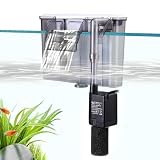
Do not dismiss Hang-On-Backs. Two large HOBs, one on each end of a 75 or 90-gallon, are cheap, simple to clean, and very hard to kill. There is no priming, no hoses, and parts are everywhere. The honest downside is media volume and bypass. Most HOBs push water around a thin cartridge once it starts to clog. Throw away the disposable cartridges and pack them with cut-to-fit sponge and a bag of ceramic media. Rinse the sponge in tank water every 2-3 weeks.
HOB failure mode on big tanks is siphon loss after a power cut. Some models self-prime, some do not and will run dry and burn out. If your area has flickery power, a canister that stays flooded or a sump with an auto-restart pump is safer than a non-self-priming HOB.
Sponge filters run on air and are excellent helpers. A couple of large sponge filters driven by a strong air pump add redundant biofiltration and are perfect for fry, shrimp, or quarantine corners in a big tank. As a sole filter for a stocked 100-gallon, they are not enough — they do almost no mechanical polishing, so water stays hazy. Used as a second filter alongside a canister or HOBs, though, they are cheap insurance. Check sizes for a large sponge filter for aquarium use and run it on the opposite end from your main intake.
Setup and maintenance that prevents crashes
Where you put intakes and outputs matters as much as brand. On a 6-foot tank, put intake and output at opposite ends to create a slow gyre, or use a spray bar along the back wall angled slightly down. You want surface ripple everywhere — that ripple is gas exchange. If food or dust sits motionless in one corner, add a small powerhead, not a bigger filter.
Clean on rotation. Never rinse all media in tap water at once; chlorine kills bacteria. Rinse half in old tank water, leave the rest dirty, and alternate next time. Replace fine floss when it mats down, but coarse sponge and ceramic last years until they physically crumble. Keep a spare impeller, O-ring, and a length of hose if you run a canister — those are the parts that fail on a Sunday night. And after any outage, check that every filter restarted. Large tanks can go a few hours without flow, but not a full day with a heavy bioload.
FAQ
Can I use one filter for a 125-gallon tank?
You can, but most keepers do better with two sources of filtration. One very large canister or sump can handle it if stocked lightly, but two filters give even flow and backup if one clogs.
How often should I clean a canister on a large tank?
Every 6-10 weeks for most stocked tanks, monthly for predators or turtles. If flow drops noticeably or you see bypass, clean sooner. Rinse in tank water, not tap water.
Is a sump overkill for freshwater?
Not for 150+ gallons or messy fish. It adds water volume, hides equipment, and holds far more media than a canister. For a quiet community 75-gallon, it is usually more work than you need.
Do I still need water changes with a big filter?
Yes. Filters convert ammonia to nitrate, but they do not remove nitrate. Expect 25-40% weekly on heavily stocked large tanks, less on lightly stocked planted tanks based on your test kit.
Common Mistakes When Buying an Aquarium Sump: Expert Guide

Best Rimless Aquarium With a Stand Included: Top-Rated