Last Updated: October 4, 2026
Getting the best rodi storage container and float valve combination right is mostly about flood protection. The container is cheap and the valve is cheaper, but a single failure can send a hundred gallons across a floor, so the second safety layer matters most.
As an Amazon Associate we earn from qualifying purchases.
As an Amazon Associate we earn from qualifying purchases at no extra cost to you. Prices and availability are accurate as of the date shown and are subject to change.
By David Nguyen
Quick answer: For most people in 2026, the best rodi storage container and float valve is the Rubbermaid BRUTE 32 (pair) — our #1 rated choice. See the full ranked comparison, alternatives and buying advice below.
How to Choose a Reservoir and Float Valve
Work through four things: how much water you actually need stored, whether the container suits long-term water storage, how the float valve mounts to that particular wall, and what backs it up when the valve eventually sticks. The last point is where most reef rooms get into trouble.
Size the Reservoir to Real Demand
Storage should cover your largest water change plus a buffer for top-off between production runs. Rubbermaid BRUTE cans come in 32 and 44 gallon sizes sold in retailer two-packs, while the Norwesco vertical tank holds 50 gallons in an 18 by 18 inch footprint. Two containers are the norm, since fresh top-off water and mixed saltwater need separate storage. A float valve keeps either container topped without supervision.
Usable volume runs below nominal, since the float mounts under the rim and few people draw a container completely dry. Plan around what you can practically draw rather than the figure printed on the side.
Check Container Material and Lid
Food-grade polyethylene with a proper lid is the baseline. BRUTE cans are widely used for this because lids are available, the plastic tolerates RO water, and the shape fits under most benches at 32 or 44 gallons. Avoid containers that previously held anything other than food or water, whatever the price. Lids also keep dust and stray salt out of stored water between changes.
The Norwesco tank stands 53 inches tall with a small 18 by 18 inch footprint, which suits tight fish rooms but demands headroom for filling. Confirm the floor can carry the load, since 50 gallons approaches 420 pounds once filled. Wall flex also affects how securely a float valve seats over time.
Match the Valve to the Wall
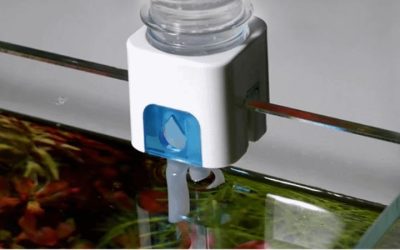
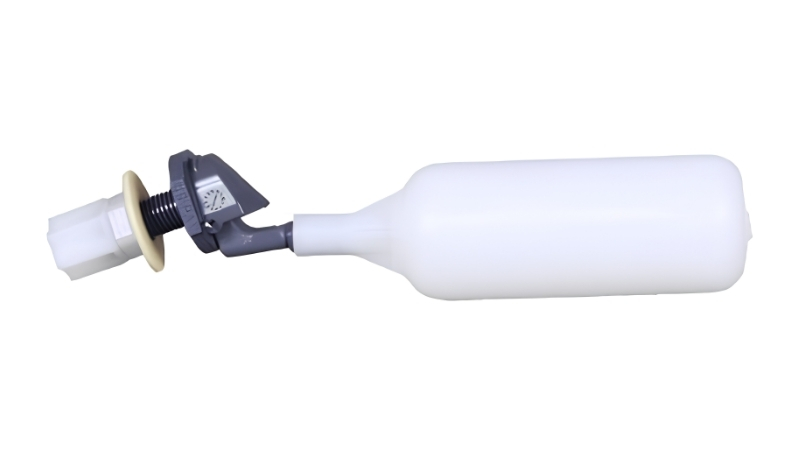
Float valve geometry is specific. The BRS adjustable float takes a 1/4 inch inlet, fits a maximum wall thickness of 1/4 inch, needs a 1/2 inch mounting hole, and is tested to 100 psi with a pass-through of 1.5 GPM at 40 psi. Adjustable arms help, since they let you fine-tune the shutoff height after installation.
That 1.5 GPM figure is valve capacity, not RO production, so it tells you nothing about fill speed from a 75 or 150 GPD system. Note also the difference between the 1/4 inch wall limit and the 1/2 inch hole you drill. Drill the hole where the wall is flattest rather than on a curve.
Add a Second Safety Layer
A float valve alone does not necessarily stop an RO/DI system, because water can continue to the drain even after the valve closes. A proper shutdown needs an automatic shutoff valve plus a check valve working together. Mechanical valves also stick over time as mineral deposits build on the seat. Pressure drops during household demand can also delay that closure.
The BRS automatic shutoff valve requires at least roughly 40 psi to operate, so low-pressure systems need that checked. For unattended filling, a controller with independent float switches adds a layer that does not depend on the mechanical valve at all. Redundancy costs far less than replacing flooring.
Top Picks
Three container options plus a controller upgrade cover most setups. Each entry lists real specifications, a relative price position as of 09/2026, and one genuine drawback. Container prices shift at retail, so confirm current figures before ordering a pair.
| Product | Best For | Key Spec | Watch Out For |
|---|---|---|---|
| Rubbermaid BRUTE 32 (pair) | Best value | 32 gal each; two cans with lids | Usable volume below nominal |
| Rubbermaid BRUTE 44 (pair) | Best all-round capacity | 44 gal each; two cans | Needs more floor space |
| Norwesco 50 vertical | Best small footprint | 50 gal; 18 x 18 in; 53 in tall | Height and filled weight |
| Tunze RO Water Controller | Best flood protection | 2 float switches; 12 or 24 h backup timer | Costs more than the reservoir |
Rubbermaid BRUTE 32 Pair: Best Value
A two-can package with lids runs roughly $80 as of 09/2026, and adding the BRS adjustable float near under $20 brings a complete fresh and salt setup to about $100. That covers most nano and mid-size reef schedules. Both cans are light enough to move empty and simple to clean.
Thirty-two gallons per can is modest once you account for the float mounting below the rim. If your weekly change approaches that figure, step up now rather than discovering the shortfall on a maintenance day. Lids matter more than people expect, since open reservoirs collect dust and evaporate steadily.
Rubbermaid BRUTE 44 Pair: Best All-Round Capacity
At around $108 as of 09/2026 for two cans, plus the float valve, a pair comes to roughly $125. The extra 12 gallons per can gives useful headroom for larger displays or for storing mixed saltwater between changes. Larger reservoirs also mean fewer fill cycles each week.
They occupy noticeably more floor area than the 32 gallon version, which matters in a cabinet or a small fish room. Measure the space including lid clearance before buying, since these are awkward to move once positioned. Casters make larger cans far easier to reposition when empty. A filled 44 gallon can weighs well over 350 pounds, so position it before filling.
Norwesco 50 Vertical Tank: Best Small Footprint
At roughly $225 as of 09/2026, about $250 with a float valve, the Norwesco holds 50 gallons in an 18 by 18 inch footprint standing 53 inches tall. That vertical shape suits fish rooms where floor space is the constraint. Polyethylene construction handles RO water without leaching.
Height creates its own problems: filling and cleaning are harder, and the filled weight concentrates on a small floor area. Confirm your floor structure and plan how you will access the top before committing to this shape. Vertical tanks also make it harder to see the water level at a glance.
Tunze RO Water Controller: Best Flood Protection
Near under $300 as of 09/2026 this controller uses two float switches plus a 12 or 24 hour backup timer, which stops filling even if a sensor misreads. For unattended overnight filling, that redundancy is the feature you are buying. Independent sensors mean a stuck float valve is no longer the only defence.
It costs more than any reservoir here, which feels backwards until you price water damage to a floor or ceiling. Treat it as insurance on the room rather than an accessory to the container. Backup timers are the feature that saves you when a switch sticks rather than fails outright. Pair it with a drip tray for a second physical barrier.
Frequently Asked Questions
Four questions come up repeatedly: where to mount the float, what size hole to drill, whether the valve stops waste water, and whether one float switch is enough for unattended filling.
Where should the float valve sit?
Roughly two inches below the rim is a practical starting point, leaving room for the shutoff to act before water reaches the top. The exact position depends on container shape and how fast your system fills. Faster systems need more margin below the rim.
Set it lower if your system produces quickly or if the container flexes when full. Test the shutoff deliberately with the system running before leaving it to fill unattended for the first time. Check the setting again after the first full cycle, since containers flex as they fill.
What size hole does the float need?
The BRS adjustable float needs a 1/2 inch mounting hole and fits walls up to 1/4 inch thick, which covers BRUTE cans and most polyethylene tanks. Both figures appear on the same specification sheet and are easy to mix up.
Do not confuse the two figures: the 1/4 inch limit is wall thickness and the 1/2 inch is the hole diameter. Drill slowly with a step bit so the plastic does not crack around the opening. A rubber washer on each side seals the opening properly.
Does the float valve stop waste water?
Not on its own. When the float closes, water can still pass to the drain unless an automatic shutoff valve and check valve are fitted to halt production properly. That distinction surprises most first-time reservoir builders.
The BRS automatic shutoff needs at least roughly 40 psi to close reliably, so verify your pressure. Without that pairing, a closed float can leave your system running quietly to drain for hours. Fit a check valve alongside it to stop backflow through the system.
Is one float switch enough?
For attended filling it usually is, but unattended overnight runs deserve redundancy. A single mechanical valve or one sensor represents a single point of failure directly above your floor. Reservoirs sit on floors that rarely tolerate a hundred gallons.
Two independent switches plus a backup timer, as in the Tunze controller, means one failure does not become a flood. Pair that with a drip tray or a floor drain wherever the reservoir sits. Reef hardware discounts around Prime Day and Black Friday, useful timing for a controller upgrade. Position the reservoir near a drain wherever the layout allows.
Final Thoughts
The best rodi storage container and float valve setup pairs enough usable volume with layered shutoff protection. A BRUTE pair with a BRS float near under $150 covers most reef schedules, while a controller with two switches is the upgrade that genuinely protects the room around it.
Ready to decide? Our #1 pick for 2026 is the Rubbermaid BRUTE 32 (pair).
Live price & availability on Amazon.
Related Reviews & Guides



Best Wave Maker for Reef Tank: Flow, Control and Placement

Aquarium Substrate for Marine Tanks: Aragonite vs. Live Sand