Last Updated: September 25, 2026
Trimming aquatic plants well is about matching blade shape to the job, not buying the longest tool. The best aquarium scissors for trimming plants pair the right geometry — curved, straight or wave — with enough reach for your tank, since length and cut quality are separate things.
As an Amazon Associate we earn from qualifying purchases.
By David Nguyen
Quick answer: For most people in 2026, the best aquarium scissors for trimming plants is the Fluval Curved — our #1 rated choice. See the full ranked comparison, alternatives and buying advice below.
How to Choose Aquarium Plant Scissors
Choosing plant scissors comes down to geometry, reach and care. Blade shape decides which plants you can trim cleanly, length decides whether you can reach them, and drying decides how long the tool lasts. None of those is the single spec.
Match Blade Shape to Plant
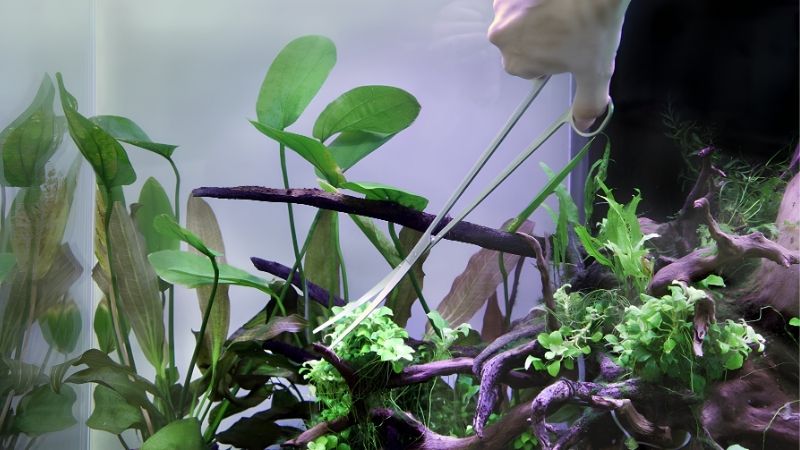
Blade shape drives the cut. Curved scissors like the Fluval 9.8-in reach over hardscape and trim stems at an angle, while straight blades suit broad, flat trims, and wave blades level carpets — each geometry changes the approach angle. Matching the geometry to your dominant plant type does more for a clean trim than paying up for a premium brand.
There is no single best shape; wave is not automatically better than straight. Pick the geometry for the plants you actually grow, since a curved tool that excels at stems is awkward on a flat carpet and vice versa. Most planted tanks do fine starting with one straight and one curved pair, adding wave only for a foreground carpet.
Choose Enough Reach
Reach must match tank depth. The UNS scissors run 10 in and the Fluval 9.8 in (25 cm), enough for most standard tanks, while the ADA at 160 mm (6.30 in) is a shorter detail tool for close work.
Longer is not a cleaner cut, just more reach. A 6-inch pair gives control for moss and foreground detail; a 10-inch pair reaches the substrate in a taller tank, so match length to depth rather than assuming long means better. A 25-cm pair reaches the substrate in most standard tanks, while a 30-cm tool suits deeper display tanks.
Straight for Broad Trims
Straight blades are the workhorse for broad trims. They cut flat across stem tops and dense growth quickly, which is why a straight pair like the UNS 10-in is a common first choice for general planted-tank maintenance.
For hardscape-heavy scapes, though, a curved blade reaches around rock better. Consider your layout: a straightforward stem tank favors straight scissors, while a rocky aquascape rewards the curved geometry despite the similar price band. Trimming a little and often keeps stems bushy, which beats one hard cut that can stall growth for a week.
Dry After Use
Scissors are a durability item in a wet hobby. Even stainless blades benefit from drying after use; the Fluval adds a carbonized coating for corrosion resistance, but standing water still invites spotting and dulling over time.
Wipe and air-dry the blades, and store them open. This small habit is cheaper than replacing a rusted pair, and it matters more than any brand claim, since a standardized sharpness or corrosion benchmark between these tools is not published. A drop of light oil on the pivot once a season keeps the action smooth on coated and stainless blades alike.
Top Picks
Four scissors cover the common trimming jobs, from a versatile curved pair to straight, wave and detail geometries. They differ mainly in shape and reach, not a measured cut quality. Prices are relative and shift over time.
| Product | Best For | Key Spec | Watch Out For |
|---|---|---|---|
| Fluval Curved | Best Overall | 9.8 in; stainless + carbonized coat; ~$17 | Curved less ideal on flat carpets |
| UNS Grey Straight | Best for broad stem trims | 10 in straight; ~$26 | ~56% above Fluval |
| UNS Grey Wave | Best for carpet leveling | 10 in wave; ~$28 | Niche shape for one job |
| ADA Pro-Scissors Spring | Best for moss and detail | 160 mm (6.30 in); ~$89 | ~436% above Fluval |
Fluval Curved
The Fluval Curved earns Best Overall on verified broad-use specs and the lowest price here — 9.8 in (25 cm), stainless with a carbonized coating, around $17 as of 09/2026 [Chewy, 2026]. The curved tips handle stems and reach over hardscape.
Curved blades are less ideal on a flat carpet than a straight or wave pair, so it is a generalist, not a specialist. As the value pick that still covers most trimming, though, it is the easiest single recommendation. At about $17 it also undercuts the UNS and ADA pairs, so it is the value entry as well as the all-rounder.
UNS Grey Straight
The UNS Grey Straight is the broad-trim specialist at 10 in, around $26 — about 56% above the Fluval [Buce Plant, 2026]. Its straight blade cuts flat across stem tops and dense growth efficiently.
The price premium buys geometry, not a measurably sharper edge, since blade quality is not benchmarked here. If your tank is stem-heavy and you want a dedicated straight pair, it is a clean fit; otherwise the Fluval covers similar ground. Rinsing and drying it after every trim matters more to its lifespan than the extra cost over the Fluval.
UNS Grey Wave
The UNS Grey Wave uses a wave geometry at 10 in, about $28 — roughly 69% above the Fluval [Buce Plant, 2026]. The wave blade is built to level carpet plants like a trimmed lawn.
That shape is niche: excellent on carpets, less useful elsewhere, so it is a second pair rather than a first. Wave is not inherently better than straight — it is specialized — so buy it only if you maintain a foreground carpet. Running it flat just above the carpet, like mowing, gives an even height that straight blades tend to scallop.
ADA Pro-Scissors Spring
The ADA Pro-Scissors Spring is the premium detail tool at 160 mm (6.30 in), about $89 — roughly 436% above the Fluval [ADA/AFA, 2026]. The spring action and short blades suit moss and fine foreground work.
Its short reach and high price make it a specialist, not an all-rounder. For delicate moss and tight detail it is precise, but the cost is hard to justify unless that fine work is a regular part of your scaping. The spring return also reduces hand fatigue during long detail sessions, which is its main draw beyond precision.
Frequently Asked Questions
Plant-scissor questions usually mix up shape, length and price. Each answer opens with the verdict, then the practical detail for your plants.
Curved better?
Not universally — curved is better for stems and hardscape, not for flat carpets. A curved pair like the Fluval reaches over rock and trims stems at an angle, while straight blades handle broad, flat cuts more cleanly.
Choose by your layout, not a blanket rule. A rocky, stem-heavy scape favors curved; a simple stem tank does fine with straight, so the shape follows the plants. If you buy only one pair, a curved tool covers both stems and light carpet work more flexibly than straight.
What length?
Enough to reach the substrate without straining — often 9 to 10 in for standard tanks, and around 6 in for detail work. The UNS and Fluval sit near 10 in, while the ADA is a shorter 6.30-in detail tool.
Longer is reach, not a cleaner cut. Match length to tank depth and the type of trimming, since a long pair adds nothing on shallow foreground work where control matters more. For nano foreground work, a 6-in pair gives far more control than a 10-in tool held at an angle.
What are wave scissors for?
Leveling carpet plants. The wave geometry, as on the UNS Wave, trims low foreground carpets evenly like mowing, which straight blades do less cleanly across a broad flat area.
For anything but carpets they are overkill, so most tanks do not need them. Add a wave pair only if you maintain a dense foreground; otherwise a straight or curved pair covers the work. A straight pair can rough-cut a carpet, but the finish is less even, which is why wave exists as a specialist.
Best for moss?
Short, precise scissors — the ADA Spring at 6.30 in is built for moss and fine detail. Its spring action and short blades give control that a long 10-in pair cannot on delicate growth.
A curved pair works in a pinch, but the short detail tool is cleaner on moss. If detailed foreground and moss work is frequent, the shorter geometry is worth the premium. Trimming moss above the waterline before it regrows also gives cleaner lines than snipping it submerged.
Final Thoughts
The best aquarium scissors for trimming plants come down to geometry and reach for your specific plants, not the biggest number: curved for stems and hardscape, straight for broad trims, wave for carpets, short for moss. The Fluval Curved leads as an affordable all-rounder, while the UNS and ADA pairs specialize — and since cut quality is not benchmarked, matching shape to the job beats chasing length or price.
As an Amazon Associate we earn from qualifying purchases at no extra cost to you. Prices and availability are accurate as of the date shown and are subject to change.
Ready to decide? Our #1 pick for 2026 is the Fluval Curved.
Live price & availability on Amazon.
Related Reviews & Guides



Live Moss Ball Marimo Aquarium

Quick Picks: Best LED Aquarium Lights for Planted Tanks