Last Updated: September 25, 2026
Every aquarium setup comes down to three things: tank footprint, water parameters and social needs. Footprint (length and width, not gallons) decides swimming room; temperature, pH and hardness decide whether the fish thrives or merely survives; and group size decides its stress level. Get those three right and the rest follows. Below is a species-by-species reference for ten popular fish.
One rule applies before any species on this list: the tank must be fully cycled first. A cycled tank has a bacterial colony that converts ammonia to nitrite and nitrite to nitrate, so both ammonia and nitrite read 0 ppm while nitrate climbs. Adding fish to a new, uncycled tank is the single most common cause of beginner losses. If you have not done this yet, start with the fishless nitrogen cycle and only then shop.
As an Amazon Associate we earn from qualifying purchases at no extra cost to you. Prices and availability are accurate as of the date shown and are subject to change.

Ultimate Aquarium Species Word Search: 100 Aquarium-Themed Word Search Puzzles with 1,000 Words to Find
Selected for "Aquarium Setup by Species: Tank, Water and Tankmates for 10 ": this listing is aquarium equipment (Ultimate Aquarium Species Word Search: 100 Aquarium-Themed Word Search), matching the equipment this article covers.
View on Amazon
Swimming Creatures™ Live Aquarium Plants (10 Species Bundle)
Selected for "Aquarium Setup by Species: Tank, Water and Tankmates for 10 ": this listing is aquarium equipment (Swimming Creatures™ Live Aquarium Plants (10 Species Bundle)), matching the equipment this article covers.
View on Amazon
Florida Species Live Aquarium Plants Bundle (4)
Selected for "Aquarium Setup by Species: Tank, Water and Tankmates for 10 ": this listing is aquarium equipment (Florida Species Live Aquarium Plants Bundle (4)), matching the equipment this article covers.
View on AmazonFlorida 10 Species Live Aquarium Plants Bundle
Selected for "Aquarium Setup by Species: Tank, Water and Tankmates for 10 ": this listing is aquarium equipment (Florida 10 Species Live Aquarium Plants Bundle), matching the equipment this article covers.
View on AmazonThe minimum tank sizes below are the smallest footprints in which these animals behave normally over a full lifespan — not the smallest box a shop will sell you them in. Parameter ranges are guidance, not law: local tap water varies enormously, and most of these species are now captive-bred generations removed from wild collection points, so a stable value inside the range beats chasing a “perfect” number.
Aquarium Setup by Species: The Master Comparison Table
| Species | Minimum tank | Temp | pH | Group size | Temperament | Difficulty |
|---|---|---|---|---|---|---|
| Harlequin rasbora | 20 gal long | 73–82°F | 6.0–7.5 | 8–10+ | Peaceful schooler | Easy |
| African dwarf frog | 10 gal (shallow) | 75–82°F | 6.5–7.8 | 2–3+ | Peaceful, near-blind | Moderate |
| Betta (male) | 5 gal | 78–80°F | 6.5–7.5 | 1 only | Territorial to own kind | Easy |
| Neon tetra | 20 gal long | 70–76°F | 5.5–7.0 | 10+ | Peaceful schooler | Easy–moderate |
| Corydoras (standard) | 20 gal long | 72–78°F | 6.0–7.5 | 6+ | Peaceful bottom shoaler | Easy |
| Guppy | 20 gal | 74–82°F | 7.0–8.0 | 3+ (1M:2–3F) | Active, peaceful | Easy |
| Cherry shrimp | 10 gal | 65–78°F | 6.5–8.0 | 10+ colony | Peaceful, prey | Easy |
| Kuhli loach | 20 gal long | 75–84°F | 5.5–7.5 | 5–6+ | Shy, nocturnal | Moderate |
| Bristlenose pleco | 29 gal | 73–81°F | 6.5–7.8 | 1 (males territorial) | Calm, food-territorial | Easy |
| Honey gourami | 15–20 gal | 72–82°F | 6.0–7.5 | 1, pair or trio | Shy, gentle | Easy |
Harlequin Rasbora
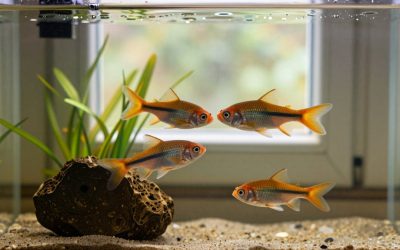
A 20-gallon long is the honest minimum: harlequins are cruisers that spend the day moving across the middle of the tank, and a short footprint compresses that behavior. Keep them at 73–82°F, pH 6.0–7.5, soft to moderately hard (roughly 2–12 dGH). Group of eight to ten minimum — a group of five will hide and lose color. They look their best over dark substrate with tannin-stained water, dense stem plants at the back and open lanes in front. Feed small floating flake and micropellets with frozen daphnia twice a week. Tankmates: corydoras, kuhli loaches, honey gourami, cherry shrimp.
African Dwarf Frog Habitat and Tank Setup
A 10-gallon suits two or three frogs, but depth matters more than volume: they are fully aquatic yet breathe air, so water shallower than about 16–18 inches lets them reach the surface without exhausting themselves. Keep 75–82°F, pH 6.5–7.8, gentle flow. A tight-fitting lid is non-negotiable — they jump and desiccate fast. Their eyesight is poor, so target-feed sinking frozen bloodworm or brine shrimp with tongs or a pipette; fast fish will strip food before a frog finds it. Avoid nippy barbs and anything small enough to swallow. Do not confuse them with African clawed frogs, which grow far larger and eat tankmates.
Betta
Five gallons is the real floor, not one. A betta in a heated, filtered 5–10 gallon with 78–80°F water, pH 6.5–7.5 and gentle flow behaves like a completely different animal from a bowl-kept fish. Use a sponge or baffled filter — heavy current exhausts long finnage. Add floating plants, a leaf hammock and smooth décor with no sharp edges, and always leave surface access for the labyrinth organ. One male per tank; never two. Skip fin-nippers and other long-finned, brightly colored fish. Full details are in our betta care guide.
Neon Tetra
Neons prefer it cooler than most community fish — 70–76°F — which is exactly why they often fail in tanks run at 80°F for bettas or gouramis. Soft, slightly acidic water (pH 5.5–7.0, 1–10 dGH) suits them; they are sensitive to swings, so stability beats precision. Keep ten or more in a 20-gallon long with planted edges and open swimming space. Feed crushed flake, micropellets and frozen daphnia. They are notoriously poor at handling brand-new tanks, so add them well after cycling completes, never as cycling fish.
Corydoras
Standard corydoras (bronze, peppered, panda, sterbai) need a 20-gallon long; pygmy species manage in 10. Temperature 72–78°F for most, with sterbai tolerating warmer and panda preferring cooler. pH 6.0–7.5. Sand or very smooth fine gravel is effectively mandatory — sharp substrate erodes their barbels and leads to infection. Keep six or more; a lone cory is a stressed cory. They are not cleanup crew: feed sinking wafers, frozen bloodworm and blackworm directly, after lights out if faster fish dominate. See our substrate selection guide before you buy gravel.
Guppy
Guppies want hard, alkaline water — pH 7.0–8.0 and GH 8–20 — which makes them a poor match for soft blackwater setups built around neons and rasboras. Run 74–82°F in a 20-gallon for a starter group. Keep one male to two or three females, or a single-sex group; a 1:1 ratio means females get harassed relentlessly. They breed constantly, so plan for fry or accept that tankmates will eat them. Feed varied flake with vegetable content and occasional frozen food. Modern fancy strains are less hardy than their reputation suggests — buy from a keeper with stable stock.
Cherry Shrimp
Neocaridina thrive in a 10-gallon colony tank at 65–78°F, pH 6.5–8.0, GH 6–12 and KH 2–8 — harder water than most fish here, because they need minerals to molt. Copper-based medications and some plant fertilizers are lethal; read every label. Start with ten or more and let the colony build. Mature biofilm, moss, cholla wood and leaf litter feed them better than any commercial food. Cover the filter intake with sponge. Any fish with a mouth will eat shrimplets, so choose a shrimp-first tank if you want a breeding colony — see our freshwater shrimp keeping guide.
Kuhli Loach
Kuhlis are social despite being nocturnal: keep five or six in a 20-gallon long or they will never come out. Water 75–84°F, pH 5.5–7.5, soft to moderate. Sand substrate lets them burrow naturally; sharp gravel injures them. Provide caves, driftwood tangles and leaf litter, and pre-filter every intake — they are professional escape artists and routinely get sucked into filters or squeeze out of open lids. Feed sinking pellets and frozen foods after dark. They are harmless to shrimp adults but will take stray shrimplets.
Bristlenose Pleco
Bristlenose (Ancistrus) top out around 4–6 inches and fit a 29-gallon — unlike common plecos, which reach 18 inches and need enormous tanks despite being sold at the same size. Keep 73–81°F, pH 6.5–7.8. Driftwood is a requirement, not decoration: they rasp on it for the fiber their digestion needs. Supplement with algae wafers, blanched zucchini and deshelled peas; an aquarium never grows enough algae to feed one. They produce heavy waste, so oversize filtration and keep up water changes — our filtration guide covers turnover rates. One male per tank.
Honey Gourami
Honey gourami (Trichogaster chuna) are the gentle alternative to dwarf gourami, which carry a well-documented iridovirus problem and far more aggression. One fits a 15-gallon; a pair or trio is better in 20 gallons. Keep 72–82°F, pH 6.0–7.5. They are timid, so calm surface water, floating plants and tall background planting make them bold. As labyrinth breathers they must reach the surface, and cold room air above the tank can chill that breath — keep a lid on. Feed small flake, micropellets and frozen brine shrimp.
Which of These Can Share a Tank?
| Combination | Works? | Why |
|---|---|---|
| Harlequin rasbora + corydoras + kuhli loach | Yes | Matching soft water, different levels, all peaceful |
| Harlequin rasbora + honey gourami | Yes | Rasboras give a shy gourami confidence |
| Neon tetra + corydoras | Yes | Both suit cooler, softer water |
| Neon tetra + guppy | Compromise | Water hardness preferences conflict; pick one |
| Betta + cherry shrimp | Risky | Depends entirely on the individual betta |
| Betta + guppy | No | Flowing fins trigger attacks in both directions |
| Betta + kuhli loach or cory | Usually yes | Bottom dwellers stay out of a betta’s zone |
| African dwarf frog + fast tetras | No | Frogs are outcompeted at feeding time |
| African dwarf frog + cory + honey gourami | Yes | Slow, calm feeders in warm shallow water |
| Cherry shrimp + any fish | Adults yes, babies no | Shrimplets are food; colony growth stalls |
| Bristlenose pleco + community | Yes | Ignores tankmates; just needs its own wafer |
Equipment That Covers Most of These Setups
Whichever species you pick, the hardware list is nearly identical: an adjustable heater sized to the tank, a filter you can throttle down, a test kit for ammonia, nitrite, nitrate and pH, a siphon for water changes, and a lid. Starter kits bundle most of this and are usually cheaper than buying piecemeal — just check the included filter can be baffled and the heater is adjustable rather than preset.
Two extras earn their place: a sponge pre-filter (protects shrimp, kuhlis and frogs) and a second heater or thermometer for verification, because a stuck heater is the fastest way to lose a tank. Pair the kit with the right water testing routine and a sensible beginner plant list and you are set.
Frequently Asked Questions
Do I really need a bigger tank than the shop recommends?
In most cases yes. Shop minimums reflect what an animal can physically survive in, not where it behaves normally. Schooling species like harlequin rasboras and neon tetras need horizontal swimming distance, and a longer footprint also buys parameter stability: more water dilutes ammonia spikes, temperature swings and dosing mistakes, which is exactly what a beginner needs most.
How long does cycling take before I can add any of these species?
A fishless cycle typically takes four to six weeks, sometimes faster with bottled bacteria or seeded media from an established filter. It is finished when you can dose ammonia to about 2 ppm and read 0 ppm ammonia and 0 ppm nitrite within 24 hours, with nitrate present. Neon tetras and African dwarf frogs are particularly intolerant of an unfinished cycle, so do not rush this step.
Can I keep a betta with cherry shrimp?
Sometimes, and it depends on the individual fish rather than the species. Some bettas ignore adult shrimp entirely; others hunt them systematically. If you try it, establish the shrimp colony first in a heavily planted tank with moss and hiding space, add the betta afterwards, and accept that shrimplets will be eaten, meaning the colony grows slowly or not at all.
Are the pH and hardness ranges here strict requirements?
No, they are guidance. Nearly all of these species are captive-bred and have adapted over generations to average tap water, so a stable value slightly outside the listed range usually beats chemically chasing an ideal number. The exceptions worth respecting are hardness for cherry shrimp, which need minerals to molt successfully, and temperature ranges, where neon tetras genuinely prefer cooler water.
Which species on this list is the best starting point for a first tank?
A 20-gallon long with a school of harlequin rasboras and a group of corydoras is the most forgiving combination here. Both are hardy, both tolerate a range of parameters, they occupy different levels so the tank looks full, and neither breeds fast enough to overwhelm you. Add a honey gourami later as a centerpiece once the tank is stable.
Male vs Female Angelfish: How to Tell Them Apart
5 Best Fish Disease Treatments and Medications: A Complete Buyer’s Guide