Last Updated: September 25, 2026
Best aquarium substrate selection turns on two questions before appearance: what grain size the livestock needs, and whether the bed should change your water chemistry or leave it alone. Everything else, from bed depth to how much you need to order, follows from those two answers rather than from how the bed looks.
As an Amazon Associate we earn from qualifying purchases.
As an Amazon Associate we earn from qualifying purchases at no extra cost to you. Prices and availability are accurate as of the date shown and are subject to change.

Aqua Natural Substrate, Sugar White Sand, 10lb
Selected for "Best Aquarium Substrate: Grain Size, Depth and Chemistry": this listing is substrate and hardscape (Aqua Natural Substrate, Sugar White Sand, 10lb), matching the equipment this article covers.
View on Amazon
Aqua Natural Aquarium Substrate, Diamond Black Fine Gravel, 10lb
Selected for "Best Aquarium Substrate: Grain Size, Depth and Chemistry": this listing is substrate and hardscape (Aqua Natural Aquarium Substrate, Diamond Black Fine Gravel, 10lb), matching the equipment this article covers.
View on Amazon
Aqueon Plant and Shrimp Aquarium Substrate, Aqua Soil for Fish Tanks, 5 Pounds
Selected for "Best Aquarium Substrate: Grain Size, Depth and Chemistry": this listing is tanks (Aqueon Plant and Shrimp Aquarium Substrate, Aqua Soil for Fish Tanks, ), matching the equipment this article covers.
View on Amazon
Aqua Natural Substrate, Galaxy Sand, 10lb
Selected for "Best Aquarium Substrate: Grain Size, Depth and Chemistry": this listing is substrate and hardscape (Aqua Natural Substrate, Galaxy Sand, 10lb), matching the equipment this article covers.
View on AmazonBy David Nguyen
Grain Size and Chemistry Come Before Looks
Choosing the best aquarium substrate means matching grain size to the animals and chemistry to the target parameters. Four figures settle it, and the chemistry one is the least reversible decision in a tank build.
The Deciding Numbers: Grain Size and Chemical Activity
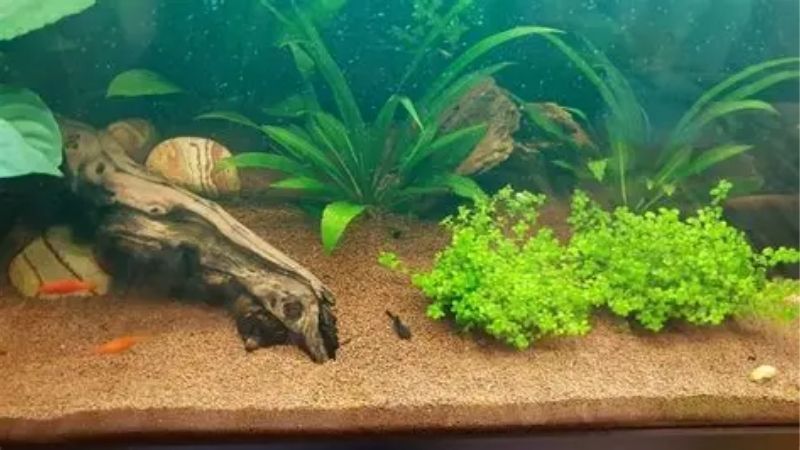
Grain size decides mechanics. Anything from 0.4-1 mm reads as sand and suits sifting species; 3-5 mm reads as gravel and keeps waste on the surface where a siphon reaches it; above 5 mm, food and detritus fall in and stay there.
Chemical activity decides your water. Inert quartz and gravel change nothing at all, aragonite and crushed coral raise KH and hold pH up, and nutrient soils strip KH and pull pH downward. Those three behaviours suit completely different sets of livestock.
That makes substrate the least reversible decision in a build, since changing it later means dismantling the aquascape and disturbing a large share of the bacterial population living within the bed itself.
Two More Criteria With Numbers Attached
Depth follows the plan. One to two inches (2.5-5 cm) suits an unplanted community, 2-3 in (5-7.6 cm) supports rooted plants, and Tanganyikan shell dwellers want 3-4 in (7.6-10 cm) to excavate properly.
Sloping the bed from front to back adds depth where plants root without raising the volume everywhere. It also looks deeper than it is, though substrate migrates forward over months and needs pushing back occasionally.
Weight decides how much to order and what the stand carries. Substrate runs roughly 1-1.5 lb per gallon per inch of depth (about 0.45-0.7 kg per 3.8 L per 2.5 cm), which adds up quickly on a large footprint.
Tank Size, Placement and Fit
Measure the footprint and multiply by your intended depth before ordering, since bag coverage charts are generous and running short means a second delivery and a partial redo of the aquascape you have already built.
Build hardscape on the bottom glass or on an eggcrate base rather than on the substrate. Rock resting on sand settles over months as fish dig beneath it, and a structure that shifts can crack glass or trap a fish.
The Options by What the Tank Holds
Four substrate types cover essentially every freshwater build. Each is matched below to a use, because the best aquarium substrate depends on livestock and target chemistry rather than on how the bed looks in a photograph.
Inert Gravel: The General-Purpose Community Choice
Main numbers: 3-5 mm grain, chemically inert, laid 1-2 in (2.5-5 cm) deep. Waste sits on the surface where a gravel vacuum lifts it, and the bed does not alter KH, GH or pH in either direction.
It suits community tanks without sifting species and anyone whose tap water already sits where they want it. It does not suit corydoras or loaches, whose barbels are damaged by sharp gravel, and it is a poor base for rooted plants.
Inert Sand: For Sifting Species and Bottom Dwellers
Main numbers: 0.4-1 mm grain, inert, laid 1-2 in (2.5-5 cm) deep. Detritus stays on the surface rather than falling in, which makes it easier to keep clean than gravel despite the common assumption to the contrary.
It suits corydoras, loaches, kuhli species and any fish that sifts substrate through its gills. It does not suit a vacuum used aggressively, since a wide tube pushed into sand simply removes the bed into the bucket.
Nutrient Soil: For Rooted Planted Tanks
Main numbers: 2-4 mm granules holding plant nutrients, laid 2-3 in (5-7.6 cm) deep, and chemically active in a way that lowers KH and pH over the first months. Root feeders establish far faster in it than in inert gravel.
It suits planted tanks and Caridina shrimp, which want the soft acidic water it produces. It does not suit Neocaridina or rift lake cichlids, and most soils leach ammonia for the first weeks, so the tank needs cycling with that in mind.
Carbonate Substrate: For Hard Alkaline Tanks
Main numbers: aragonite sand at 0.5-1.5 mm or crushed coral at 2-5 mm, dissolving slowly to hold KH in the 10-18 dKH band. It is the passive way to keep hard water hard without dosing anything weekly.
It suits African cichlids, livebearers on soft tap water and marine systems. It does not suit planted or soft-water tanks at all, and the buffering weakens over years as the bed dissolves and becomes buried under detritus.
| Option | Grain size | Chemistry | Bed depth | Best for |
|---|---|---|---|---|
| Inert gravel | 3-5 mm | None | 1-2 in (2.5-5 cm) | General community tanks |
| Inert sand | 0.4-1 mm | None | 1-2 in (2.5-5 cm) | Corydoras, loaches, sifters |
| Nutrient soil | 2-4 mm granules | Lowers KH and pH | 2-3 in (5-7.6 cm) | Rooted plants, Caridina shrimp |
| Aragonite or crushed coral | 0.5-5 mm | Raises and holds KH | 1-2 in (2.5-5 cm) | Rift lake cichlids, marine |
| Coarse gravel above 5 mm | 5 mm and up | None | Any | Traps waste, generally avoid |
Head to Head, and When Not to Buy
Two types get compared constantly, and there is a case where changing substrate solves nothing. The best aquarium substrate is frequently the one already in the tank, siphoned more thoroughly.
Sand Versus Gravel
Sand wins for bottom-dwelling fish, and it is easier to keep clean because waste stays visible on the surface. It loses on rooted plants, which struggle in a compacted fine bed without root tabs, and it needs a gentler vacuum technique.
Gravel wins for rooted plants without soil and for anyone who wants to push a vacuum tube fully into the bed. It loses on barbel damage to sifting species and on trapping food between grains where nothing reaches it.
When Changing Substrate Is the Wrong Fix
Rising nitrate is a feeding or stocking problem before it is a substrate one. Measure the portion against the two-minute rule and vacuum a third of the bed weekly for a month before concluding the substrate is the source.
Plants failing in inert gravel usually need root tabs and adequate light rather than a full substrate change. Tabs cost a fraction of a soil rebuild and can be tried without disturbing the tank or restarting a cycle.
The Cheaper Route That Works
Pool filter sand is chemically identical in function to branded aquarium sand at a small fraction of the price per pound, in the same 0.45-0.85 mm range. It needs thorough rinsing, and so does everything else.
Crushed coral in a filter bag raises KH without rebuilding a bed, which suits anyone whose only reason for changing substrate is water chemistry. It is also removable, which a buried carbonate bed is not.
Living With It and the 12-Month Cost
The best aquarium substrate is the one component you cannot service without dismantling the tank, so its long-term behaviour matters more than its appearance on day one. This section covers what changes and what it costs.
What Changes Over Time
Carbonate substrates dissolve as they buffer, so KH falls slowly across a year with an unchanged routine. That is the mechanism working correctly, and it means a top-up every two to three years rather than a fault.
Nutrient soils exhaust their nutrient load across roughly one to three years and gradually lose their buffering effect on KH. Root tabs extend that, and a full rebuild eventually becomes the honest answer for a heavily planted tank.
Setup, Rinsing and the First Weeks
Rinse inert sand and gravel in batches until the water runs clear, since unrinsed substrate clouds a tank for days and drives fine particles into filter impellers. Nutrient soils are the exception and should not be rinsed at all.
Fill the tank onto a plate or a bag laid over the bed rather than pouring straight in. Even rinsed substrate lifts if water hits it directly, and a planted layout can be undone in seconds by a careless first fill.
Expect ammonia from a new soil bed for the first few weeks, which is normal rather than a fault. Cycle the tank with that in mind and test before stocking, since the soil rather than the fish is producing it.
Recurring Cost and Timing
Inert substrates have no recurring cost at all. Carbonate beds need topping up every few years, and nutrient soils need root tabs and eventually replacement, which makes them the most expensive option across a decade.
On timing, substrate is heavy and shipping dominates its price, so bulk purchases in the late June and late November discount windows are worth planning. Prices move constantly, so check at the moment of purchase.
Best Aquarium Substrate Questions
These arrive at the planning stage, before the tank is filled. Every answer about the best aquarium substrate stays with grain size, depth and chemistry, since those three decide almost every case that comes up.
How deep should the bed be?
One to two inches (2.5-5 cm) for an unplanted community, 2-3 in (5-7.6 cm) for rooted plants, and 3-4 in (7.6-10 cm) for shell dwellers. Deeper beds in a rock-heavy tank create pockets without giving livestock anything they use.
Can I mix substrate types?
Yes, and layering soil beneath a capping sand or fine gravel is a common planted tank approach. Mixing carbonate into inert sand also works for buffering. What does not work is mixing types with very different grain sizes evenly.
Does sand cause dangerous gas pockets?
Rarely at 1-2 in (2.5-5 cm) with normal maintenance and any bottom-dwelling livestock stirring it. Very deep undisturbed beds are where the concern arises, and a shallow bed with weekly vacuuming does not develop them.
Can I change substrate with fish in the tank?
In sections over two or three weeks, replacing a third at a time, which limits the disturbance to the bacterial population. Doing it in one session risks an ammonia spike, so test daily for a week afterwards either way.
See More:
Conclusion
The best aquarium substrate for a general community is inert gravel at 3-5 mm laid 1-2 in (2.5-5 cm) deep, switching to inert sand at 0.4-1 mm wherever corydoras, loaches or other sifting species are kept.
Use nutrient soil at 2-3 in (5-7.6 cm) for rooted planted tanks and Caridina shrimp, and aragonite or crushed coral where hard alkaline water is the target. Calculate weight at 1-1.5 lb per gallon per inch before ordering.
Best Led Light for Low Tech Planted Aquarium in 2026: Compared and Ranked
Planted Aquarium for Beginners: Easy Plants and Setup Guide