Last Updated: October 21, 2026
Why is my aquarium water cloudy has four common answers, and the colour of the cloud tells you which one you are actually looking at. Before changing anything, test ammonia, nitrite, nitrate and temperature, because the most dangerous cause looks almost identical to the most harmless one in a glass box.
As an Amazon Associate we earn from qualifying purchases.
As an Amazon Associate we earn from qualifying purchases at no extra cost to you.





By David Nguyen
Four Numbers, Then Read the Colour
Cloudy water is a symptom with several unrelated causes, and treating the wrong one wastes days. Answering why is my aquarium water cloudy starts with readings and observations rather than with a bottle of clarifier, because two of the four causes are biological emergencies.
The Four Numbers to Test Before You Do Anything
Test ammonia, nitrite, nitrate and temperature, in that order, using a liquid kit rather than strips. Ammonia and nitrite should read 0 ppm, nitrate below 40 ppm, and temperature steady inside the range for your species. Write all four down before touching the tank.
Then record two more figures nobody thinks of as measurements: how many hours the light runs each day, and how much food goes in daily. Six to eight hours of light and food consumed within one to two minutes are the reference points that most cloudy tanks have drifted away from.
Note the tank’s age as well. A tank under three months old that clouds is behaving normally for its stage, while an established tank that clouds has had something done to it recently, and the two situations call for completely different responses.
The Decision Tree: Colour Points to Cause
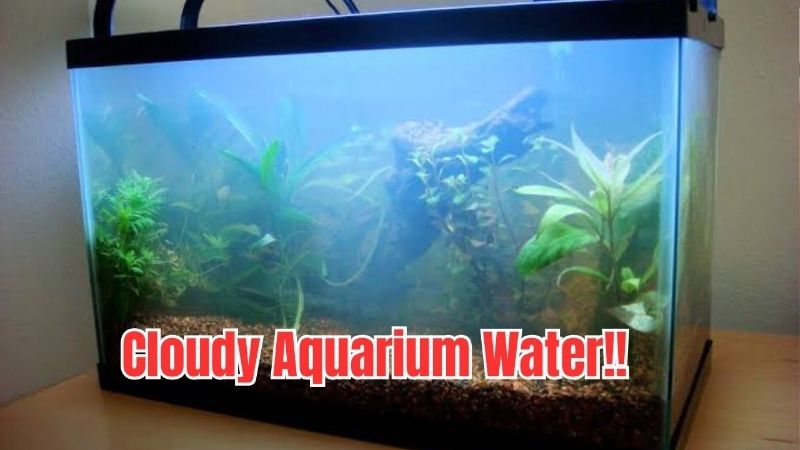
Milky white or grey haze that appeared over a day or two in a tank under three months old is almost always a bacterial bloom. Fine particulate that settles when the filter is off is substrate dust. Green tint is free-floating algae, and yellow-brown is usually tannins from wood.
Timing narrows it further. Cloudiness within hours of a water change points to disturbed substrate or microbubbles. Cloudiness that builds over a week alongside a rising nitrate reading points to overfeeding and organic load. The table below pairs each pattern with its first action.
| What you see | Readings that go with it | Most likely cause | First action |
|---|---|---|---|
| Milky white haze, tank under 3 months | Ammonia above 0, nitrite above 0 | Bacterial bloom during cycling | Change 25-50%, stop feeding one day |
| Milky haze in an established tank | Ammonia above 0 after filter cleaning | Biological filter disrupted | Change water, do not clean media again |
| Fine grit that settles overnight | All four readings normal | Substrate dust or new hardscape | Let the filter clear it, add floss |
| Green tint deepening over days | Nitrate above 40 ppm, light over 8 hours | Free-floating algae | Cut light hours, blackout the tank |
| Yellow-brown but clear | All four readings normal, wood present | Tannins leaching from driftwood | Harmless, dilute with water changes |
When It Is Not an Environmental Problem
Cloudy water on its own is not a diagnosis of illness. If all four numbers read clean, the light runs six to eight hours and feeding is controlled, the tank is usually clearing a mechanical or biological event that will resolve on its own timeline.
Fish behaviour is the separate signal. Rapid gill movement, hanging at the surface or refusing food alongside clean readings means something beyond water clarity is happening, and that is a conversation for an aquatic veterinarian or an experienced fish store rather than a dosing decision.
Clearing Cloudy Water Step by Step
Work through these in order and stop when the cause is addressed. The sequence matters because the first step protects fish while you diagnose, and the later steps only make sense once you know which of the four answers to why is my aquarium water cloudy applies.
Step 1: Water Change First, Diagnosis Second
If ammonia or nitrite reads above 0 ppm, change 25-50% immediately with temperature matched to within 1-2 °F (about 1 °C) and dechlorinated water. That single action reduces the toxin and thins the bloom, and it is safe regardless of which cause you eventually confirm.
Skip one feeding, then resume at half volume. Uneaten food is the fuel for a bacterial bloom, and cutting the input does more in three days than any product does in one. Retest ammonia and nitrite twelve hours after the change.
Step 2: Fix the Cause, Not the Appearance
For a bacterial bloom, the fix is time plus reduced input. Blooms are heterotrophic bacteria feeding on dissolved organics, and they clear in three to ten days once the food source drops. There is no way to shorten that reliably, and clarifiers only clump particles.
For substrate dust, add a fine floss or polishing pad to the filter and let mechanical filtration do the work over a day or two. For tannins, water changes dilute the colour gradually, and activated carbon removes it faster while it remains active.
Step 3: Improve Flow and Mechanical Filtration
Cloudiness persists in tanks where water is not actually reaching the filter. Check turnover against a baseline of 4-6 times tank volume per hour for community stocking, or 8-10 times for goldfish and cichlids, and remember printed GPH drops 30-50% once media and hoses are loaded.
Dead spots matter as much as total flow. Fine particles settle where circulation is weak and re-suspend every time you move a decoration, so repositioning the outflow often clears a tank faster than adding equipment to it.
Step 4: Tank Size, Placement and Fit
Small volumes cloud faster and clear slower. A 5 gallon (19 L) tank concentrates organics four times more than a 20 gallon (76 L) tank, so the same overfeeding produces a visible bloom in one and nothing in the other.
Placement drives the green variant specifically. A tank receiving direct sun through a window will green up regardless of light schedule. Measure before you order: 4-6 in (10-15 cm) behind the tank for a hang-on-back filter, cabinet height for a canister, and stand capacity against roughly 10 lb/gallon (about 1 kg/L) filled.
What Never to Do With a Cloudy Tank
Three responses turn a temporary cloud into a genuine problem, and each one is a common first reaction to why is my aquarium water cloudy. All three are common first reactions, and all three either remove the bacteria doing the work or add a variable nobody can measure.
Never Change 100% of the Water
A full water change strips minerals, swings temperature and pH, and removes none of the bacteria causing a bloom, since they live on surfaces as well as in the water column. Fish experience it as a shock, and the cloud usually returns within days.
Partial changes of 25-50% do everything a full change does without the swing. Repeat them daily during an active problem rather than escalating to one dramatic intervention that leaves you with no next step.
Never Rinse Filter Media Under the Tap
Chlorine and chloramine kill nitrifying bacteria on contact, and a media rinse under the tap is the single most common cause of a milky bloom in an established tank. Rinse media in a bucket of water siphoned from the tank instead.
Cleaning every part of the filter at once has the same effect even with tank water. Clean the mechanical layer one month and the biological media the next, so a working colony always remains in the housing.
Never Dose Clarifier Before You Know the Cause
Flocculants clump fine particles so the filter can catch them, which genuinely helps with substrate dust. Used on a bacterial bloom they clear the appearance for a day while the organic load continues, and the cloud returns with nothing learned.
Adding any product to a tank with an ammonia reading above 0 ppm also means you are now managing two variables at once. Fix the reading first, then decide whether the remaining cloudiness needs anything at all.
Preventing Cloudy Water From Coming Back
Nearly every recurrence of why is my aquarium water cloudy traces to a specific input: too much food, too much light, or a filter cleaning that went too far. Prevention is a schedule rather than a product, and it costs nothing beyond the discipline to keep it.
A Maintenance Schedule That Holds
Change 20-30% weekly, adjusted by measured nitrate, and vacuum substrate during the change so trapped waste leaves the tank rather than decomposing in it. Feed what is eaten in one to two minutes, once or twice a day, and remove anything left over.
Rinse mechanical media monthly in tank water, on a rotation so only part of the filter is touched at a time. Test ammonia and nitrite weekly for the first three months, then monthly, and always within a week of adding fish or changing media.
Equipment That Prevents Recurrence
A filter using loose media rather than a proprietary cartridge lets you replace floss while keeping colonised biological media, which is both cheaper over twelve months and far less likely to trigger a bloom. That single choice removes the most common cause of recurring cloudiness.
A timer on the light holds the schedule at six to eight hours whether or not you are home, and this matters most in summer when longer daylight and a sunlit window push a tank toward the green variant while you are away on holiday.
Early Signals Worth Watching
A faint haze visible only when you look down the length of the tank is a bloom starting. Rising nitrate between changes means organic input has outgrown the schedule, and that is the reading that predicts cloudiness a week before it appears.
Reduced filter outflow is the other early signal. Flow drops gradually as media loads and impellers wear, and a hang-on-back unit that lost prime after a power cut may be running dry, which shows up as cloudiness days before anyone notices the noise.
Frequently Asked Questions
These four come up most often once the first water change is done, the tank still has not cleared, and why is my aquarium water cloudy has turned from a question into a wait.
How long does a bacterial bloom take to clear?
Usually three to ten days once the organic input drops. It clears on its own schedule, and repeated large water changes do not reliably speed it up. Keep ammonia and nitrite at 0 ppm through the period and let the tank finish.
Is cloudy water dangerous to fish by itself?
The cloudiness is not the danger, the cause can be. A bloom accompanying an ammonia reading is a genuine problem, while substrate dust in a tank with clean readings is cosmetic. This is exactly why the four numbers come before any treatment.
Should I turn off the filter to let it settle?
No. The filter is what removes suspended particles, and stopping it starves the bacterial colony of oxygen within hours. Add a finer mechanical pad if you want faster polishing, but keep water moving through the housing continuously.
My tank cleared then clouded again. What changed?
Look at the week before it returned: media replaced, fish added, feeding increased, or a filter left off. Answering why is my aquarium water cloudy for a second occurrence is almost always about finding the event rather than the chemistry.
The Bottom Line on Cloudy Aquarium Water
The short answer to why is my aquarium water cloudy: test ammonia, nitrite, nitrate and temperature first, then read the colour. Milky white in a young tank is a bacterial bloom that clears in three to ten days once feeding drops, fine grit is substrate dust for mechanical filtration to handle, green is algae driven by light and nutrients, and yellow-brown is harmless tannins. Change 25-50% rather than everything, keep the filter running, rinse media in tank water only, and leave clarifiers alone until you know which of the four you are actually dealing with.
Betta Fish Care Guide: Tank, Temperature and Daily Routine

Shrimp in Freshwater Tank