Last Updated: October 21, 2026
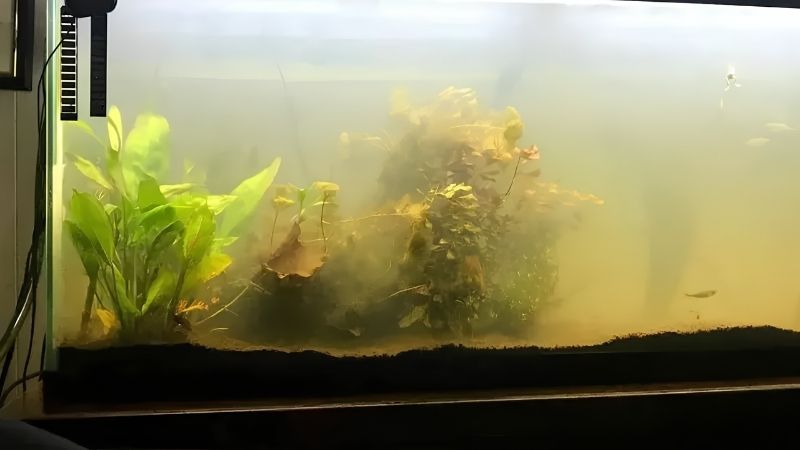
Cloudy fish tank after water change is one of the most common questions in the hobby, and the timing of it tells you very nearly everything. Cloudiness within minutes has a physical cause, cloudiness a day later has a biological one, and only one of those two actually needs you to do anything about it at all.
As an Amazon Associate we earn from qualifying purchases.
As an Amazon Associate we earn from qualifying purchases at no extra cost to you.







By David Nguyen
Timing Tells You Which of Four Causes You Have
A water change disturbs three things at once: dissolved gas, settled particles and the bacterial colony. A cloudy fish tank after water change is one of those three showing itself, and separating them takes a clock and four test readings rather than guesswork.
Time to Cloudiness Is the Deciding Number
Cloudiness appearing within minutes of refilling is almost always microbubbles or disturbed substrate. It resolves without intervention, typically within fifteen minutes for gas and a few hours for fine particles once the filter has circulated the volume several times.
Cloudiness appearing twelve to forty-eight hours later is biological. That gap is how long heterotrophic bacteria need to multiply on a sudden supply of dissolved organics, and it points to something done to the filter or substrate rather than to the water itself.
Alongside the clock, test ammonia, nitrite, nitrate and temperature. Ammonia or nitrite above 0 ppm after a change means the biological filter was disrupted, and that is the one version of this problem that carries real risk to fish rather than just looking wrong.
The Mechanisms Behind Each Type
Microbubbles form when cold tap water carrying dissolved gas warms in the tank and releases it, or when a filter intake sits above the waterline after a change and pulls air. The haze looks uniform and grey, and it rises rather than settles.
Substrate disturbance suspends fine sand, gravel dust and detritus that was sitting undisturbed. This variety settles when the filter is switched off, which is a quick diagnostic test worth running for a few minutes before assuming anything more complicated.
The bacterial version is a bloom of organics-feeding bacteria, not the nitrifying ones. It appears milky white and does not settle, and its fuel is dissolved organic matter released when substrate is disturbed heavily or when detritus is stirred out of a filter.
A fourth, less common mechanism is mineral precipitation. In hard water above roughly 8 dKH (143 ppm), a sharp temperature or pH difference between new and existing water can drop calcium carbonate out of solution as a fine white haze that clears over a day.
Normal Ranges Against Action Thresholds
The table separates what to ignore from what to act on. Read it with your four numbers in hand, because the appearance alone cannot distinguish a harmless bloom from one accompanying a disrupted nitrogen cycle.
| Timing and appearance | Readings | Cause | Action |
|---|---|---|---|
| Within minutes, uniform grey haze | All four normal | Microbubbles from dissolved gas | None, clears in 15-30 minutes |
| Within an hour, settles when filter off | All four normal | Substrate or sand dust | Add fine floss, wait a day |
| 12-48 hours later, milky, does not settle | Ammonia 0, nitrite 0 | Heterotrophic bacterial bloom | Feed less, wait 3-10 days |
| 12-48 hours later, milky | Ammonia above 0.25 ppm | Biological filter disrupted | Change 25-50%, do not clean media |
| Immediately, white and persistent | KH above 8 dKH (143 ppm) | Mineral precipitation from hard water | Match new water temperature first |
What This Means in a Real Tank
The same water change produces different results in different tanks. Volume, substrate type and how the filter is arranged all decide whether a routine maintenance session ends with clear water or a cloudy fish tank after water change that lasts a week.
Tank Size, Placement and Fit
Volume determines how much a disturbance matters. Replacing 30% of a 5 gallon (19 L) tank changes proportionally the same water as 30% of a 55 gallon (208 L) tank, but the smaller tank has far less established surface area to buffer the biological consequences.
Real capacity is lower than the label. A 20 gallon (76 L) tank holds roughly 17-18 gallons (64-68 L) after substrate and hardscape, so a bucket-measured 30% change is closer to 40% of the actual water and disturbs more than intended.
Equipment position matters more than people expect. A filter intake that ends up above the waterline during a change will draw air on restart, and a return outflow aimed straight at sand will suspend it every time. Measure before you order: 4-6 in (10-15 cm) behind the tank for a hang-on-back unit, and stand capacity against roughly 10 lb/gallon (about 1 kg/L).
How This Differs Across 10, 20 and 55 Gallon Tanks
A 10 gallon (38 L) tank clouds more readily and clears more slowly, because there is less water to dilute released organics and less colonised surface to consume them. Nano tanks are not simpler, they are just smaller versions of the same system with less margin.
Larger tanks hide small disturbances but punish large ones. A deep gravel vacuum in a neglected 55 gallon (208 L) tank can release months of accumulated organics at once, producing a bloom that a 10 gallon tank on a weekly schedule would never generate.
Turnover shapes recovery speed. A baseline of 4-6 times tank volume per hour for community stocking, or 8-10 times for goldfish and cichlids, determines how quickly suspended particles reach mechanical media. Printed GPH drops 30-50% once media and hoses load.
How Substrate and Stocking Change the Picture
Fine sand suspends easily and settles slowly, so sand tanks show the particulate version far more often than gravel tanks. Nutrient-rich planted substrates are worse again, since many release organics as well as particles when disturbed.
Stocking density decides the biological version. A heavily stocked tank carries more accumulated organics in the substrate, so the same vacuuming routine releases more fuel for a bloom than it would in a sparsely stocked tank of the same volume.
Season plays a part through source water. Tap water is colder in winter and carries more dissolved gas, so the microbubble version appears far more often in the cold months, and it is also when a temperature mismatch between bucket and tank is easiest to create.
Common Mistakes and Myths to Retire
Three assumptions turn a cloudy fish tank after water change from a cosmetic event into a real one. Each pushes people toward doing more when the correct response to most versions of this problem is to do considerably less.
Myth: Cloudiness Means the Water Change Was Too Big
Change size is rarely the cause. A 50% change with matched temperature and proper dechlorination produces no cloudiness in a stable tank, while a 20% change that involved deep substrate vacuuming and a filter rinse can produce a week of it.
The replacement rule: what you disturbed matters more than how much you replaced. Keep changes at a baseline of 20-30% weekly adjusted by measured nitrate, and treat substrate and filter work as separate jobs done on separate weeks.
There is one genuine limit worth naming. Changes above roughly 50% in a tank with hard tap water and a very different tank chemistry can swing pH and hardness enough to stress fish, which is a chemistry problem rather than a clarity one.
Myth: Adding a Clarifier Is the Standard Fix
Flocculants clump fine particles so mechanical media can catch them, which genuinely helps the substrate-dust version. On a bacterial bloom they change the appearance for a day while the dissolved organics continue feeding it, and the cloud returns.
They also add a variable at the worst moment. If ammonia is reading above 0 ppm you now have two things happening in the tank at once, and no way to tell which one is responsible for whatever happens next.
Myth: You Should Clean the Filter to Clear It Faster
This is the action that most reliably converts a harmless haze into a cloudy fish tank after water change lasting a fortnight. Cleaning filter media removes the nitrifying colony, ammonia rises, and a genuine bloom follows within a day or two.
Rinse media in a bucket of water siphoned from the tank, never under the tap, and clean only one part of the filter at a time. Chlorine and chloramine in tap water kill nitrifying bacteria on contact, which is precisely what you cannot afford here.
Preventing It Long Term
The preventable versions of a cloudy fish tank after water change come down to three habits: matching new water properly, splitting maintenance jobs across weeks, and keeping the filter intake submerged. None of them cost anything, and together they eliminate most recurrences.
What to Do on Every Water Change
Match new water to within 1-2 °F (about 1 °C) of the tank and dechlorinate before it goes in, not after. Where the supply carries chloramine rather than chlorine, check that the product label states it handles chloramine, because many do not.
Let cold tap water stand or mix warm and cold to temperature rather than filling straight from a cold tap, which reduces dissolved gas and largely eliminates the microbubble version. Refill slowly onto a plate or your hand rather than directly onto substrate.
Split the work across weeks. Vacuum a third of the substrate at each change rather than all of it, and rinse filter media on a different week entirely. Neither job is urgent enough to justify doing both in one session on a stocked tank.
Gear That Degrades and How It Shows Up
Filters lose flow as media loads and impellers wear, and less flow means slower clearing and less oxygen for the bacteria. A hang-on-back unit that loses prime after a power interruption may run dry unnoticed, and the first visible sign is often cloudiness.
Test reagents expire and read low as they age, which matters here because the ammonia result is what separates a harmless bloom from a filter failure. Strips drift quickly once opened in a humid room, so write the opening date on the box.
Heaters drift too, commonly ±2-4 °F (±1-2 °C) off the dial on budget units, which quietly widens the gap between bucket and tank on every change. Every powered device beside water belongs on a GFCI outlet with a drip loop and a UL or ETL mark.
The Twelve-Month Running Cost
Budget for dechlorinator, replacement mechanical media, test reagents and continuous power for filter and heater. A filter taking loose media lets you replace only the floss while keeping colonised biological media, which is the single choice that most reduces recurrence.
Proprietary cartridge filters work the other way. Discarding the whole cartridge monthly removes the colony on a schedule, so the cost of ownership and the frequency of blooms both rise together across a year of use.
Frequently Asked Questions
These five come up most often when a tank that was clear in the morning has become a cloudy fish tank after water change by the following evening.
How long should I wait before doing anything?
If ammonia and nitrite read 0 ppm, wait. Microbubbles clear in under an hour, particulate in a day, and a bacterial bloom in three to ten days. Intervening during that window usually restarts the clock rather than shortening it.
Is the cloudiness harmful to my fish?
The cloudiness itself is not. The accompanying ammonia reading can be, which is why the four numbers come first. A bloom with clean readings is a cosmetic event, while the same appearance with 0.5 ppm ammonia is a filter failure.
Why does it happen every single time I change water?
Something in your routine is disturbing organics or the filter each session. Common culprits are vacuuming the full substrate every week, rinsing media at the same time, or refilling directly onto sand. Separate those jobs and the pattern usually stops.
Can I prevent it by changing less water?
Smaller changes reduce disturbance but let nitrate climb, which trades one problem for a worse one. Keep the volume and change the technique instead: refill gently, vacuum a third of the substrate at a time, and leave the filter alone that week.
Does temperature mismatch cause cloudiness?
It can, in two ways. Cold water releases dissolved gas as it warms, producing microbubbles, and in hard water a sharp temperature change can precipitate minerals as a persistent white haze. Matching to within 1-2 °F (about 1 °C) avoids both.
The Bottom Line on Cloudiness After a Water Change
A cloudy fish tank after water change is usually harmless and usually self-correcting, and the clock is your best diagnostic. Minutes means gas or dust, a day or two means bacteria, and the only version needing action is the one accompanied by an ammonia or nitrite reading above zero. Match temperature, dechlorinate before filling, refill gently, and keep substrate vacuuming and filter cleaning on separate weeks. Then leave it alone, because most of what people do to clear a cloudy tank is what caused it to stay cloudy.
Koi Betta Fish: Colors, Genetics and Care
Cichlid Aquarium Filtration Guide: How It Works in Practice