Last Updated: October 4, 2026
- Top Pick: AQUATOP Xyclone PS-370 Protein Skimmer – 370 GPH Needle Wheel Pump Included – For Saltwater Aquariums Up to 100 Gallons – In-Sump or Hang-On Dual Outlet Design
- Best Value: Protein Skimmer for 50-100 Gallon Saltwater Aquarium
- Premium Choice: Reef Octopus Classic 110-INT Needle Wheel Protein Skimmer for Aquarium
Choosing the right protein skimmer for a 100-gallon aquarium is less about finding the biggest model and more about matching the skimmer’s rated capacity, physical footprint, water depth, and maintenance clearance. A skimmer rated for exactly 100 gallons may work in a lightly stocked fish-only system, but a heavily stocked reef tank usually benefits from a model rated for 125 to 200 gallons.
The Short Answer
For a true 100-gallon saltwater aquarium, choose a protein skimmer rated for at least 100 gallons and preferably 125 to 150 gallons for a reef setup. A practical target is a skimmer with a footprint of about 7 by 8 inches to 9 by 10 inches (18 by 20 cm to 23 by 25 cm) and a total height of 18 to 24 inches (46 to 61 cm).
As an Amazon Associate we earn from qualifying purchases at no extra cost to you.


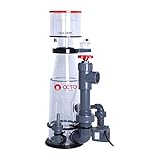

Look for a model that processes roughly 250 to 400 gallons per hour through its pump, uses a needle-wheel or pinwheel impeller, and operates in approximately 7 to 10 inches (18 to 25 cm) of sump water. The exact pump rating is not the same as air draw or skimming capacity, so use the manufacturer’s aquarium rating as the primary guide.
For a lightly stocked fish-only aquarium, a 50- to 100-gallon skimmer can be adequate. For a mixed reef with fish, corals, and regular feeding, choose a 100- to 150-gallon rating. If the tank is densely stocked or receives heavy feeding, a 150- to 200-gallon model gives you more reserve capacity without requiring a commercial-size unit.
Standard Sizes
The following dimensions represent common size classes for skimmers used on aquariums near 100 gallons. Actual measurements vary by brand, collection cup design, pump placement, and whether the model is in-sump or hang-on-back. Always compare the listed footprint with your available space before ordering.
| Skimmer class | Typical aquarium rating | Typical footprint | Typical height | Typical power draw | Best use |
|---|---|---|---|---|---|
| Compact or nano | 40–80 gallons | 5 × 6 in (13 × 15 cm) | 15–18 in (38–46 cm) | 8–18 watts | Lightly stocked tanks or tight sumps |
| Standard 100-gallon | 75–125 gallons | 7 × 8 in (18 × 20 cm) | 18–22 in (46–56 cm) | 15–30 watts | Typical 100-gallon reef or fish-only tank |
| Oversized reef | 100–200 gallons | 8 × 10 in (20 × 25 cm) | 20–24 in (51–61 cm) | 20–40 watts | Heavy bioload and frequent feeding |
| External or high-capacity | 150–250 gallons | 10 × 12 in (25 × 30 cm) | 22–28 in (56–71 cm) | 30–60 watts | Large sump rooms or very heavily stocked systems |
A 100-gallon aquarium does not hold exactly 100 gallons of water once you subtract rock, sand, equipment, and unused space. The operating water volume may be closer to 75 to 90 gallons. That is one reason a skimmer rated for 125 gallons is often a sensible match.
Current buyer options span a broad price range. Basic 50- to 100-gallon models commonly cost about $120 to $150, while more refined needle-wheel skimmers with better adjustment and quieter pumps often cost $250 to $350 or more. For example, entry-level units in the roughly $120 to $135 range may include a 370 gallons-per-hour pump or dual in-sump and hang-on installation. A midrange model such as a Reef Octopus Classic 110-INT-type skimmer may be closer to $325, depending on the retailer and current availability in 2026.
How to Measure Your Space
- Measure the sump chamber. Record the chamber’s inside length and width, not the outside dimensions of the sump. Leave at least 1 inch (2.5 cm) of extra width and depth around the skimmer for installation and removal.
- Check the vertical clearance. Measure from the normal waterline to the underside of the cabinet. Compare this with the skimmer’s total height, including the collection cup and adjustment outlet.
- Allow cup-removal space. A skimmer that fits under the cabinet may still be unusable if its collection cup cannot be lifted off. Ideally, leave 3 to 5 inches (8 to 13 cm) above the cup.
- Confirm operating water depth. Many in-sump skimmers perform best in 7 to 10 inches of water. If the sump is deeper, use an adjustable stand or skimmer platform rather than guessing at the water level.
- Measure plumbing and cable routes. Make sure the pump intake, outlet, power cord, and drain line are not pressed against the sump wall. A tight bend can increase vibration and make maintenance harder.
- Plan for maintenance. Keep enough room to remove the pump, clean the needle wheel, and access the air intake. A footprint that barely fits may become frustrating after several months of use.
By Room or Use Case
Under a Standard Aquarium Cabinet
For most 100-gallon reef systems, an in-sump skimmer around 7 by 8 inches and 18 to 22 inches tall is the safest starting point. Confirm that the sump chamber is wide enough for the body and pump, and check the cabinet opening rather than only the interior height. A skimmer cup often needs to be removed vertically, which can be difficult in a cabinet with a center brace or fixed shelf.
Compact Sump or Narrow Filtration Chamber
If the sump has a narrow equipment section, prioritize footprint over maximum rating. A compact model rated for 75 to 125 gallons can work well when the fish load is moderate. Choose a skimmer with an external pump or side-mounted pump only after confirming where the pump will sit. Some designs have a small body but require additional room for the pump and outlet.
Heavily Stocked Reef Tank
A heavily stocked 100-gallon reef tank benefits from a skimmer rated for 150 to 200 gallons. This does not mean the skimmer should be physically enormous. A model around 8 by 10 inches with a 20- to 24-inch height often provides useful reserve capacity. Adjustable water flow is especially helpful because you can reduce production if the skimmer removes too much too quickly.
Fish-Only Saltwater Aquarium
Fish-only systems can use a 75- to 125-gallon skimmer when stocking and feeding are moderate. Fish produce substantial waste, but the system may not need the same level of nutrient export as a coral-focused reef. A simple needle-wheel skimmer with a reliable pump and easy-to-clean cup is often a better value than a larger, highly adjustable model.
Hang-On-Back Installation
A hang-on-back skimmer is useful when there is no sump, but it needs clearance behind or beside the aquarium. Measure the tank rim, the distance to the wall, and the height above the waterline. Many hang-on units occupy about 6 to 10 inches of space behind the aquarium and may extend 18 to 24 inches above the floor or stand. Choose a dual-installation model only if its mounting brackets and outlet arrangement fit your tank.
Common Sizing Mistakes
- Buying by tank volume alone: A 100-gallon rating does not account for livestock, feeding, or the actual water volume after displacement.
- Ignoring water depth: Even a correctly rated skimmer can overflow or produce unstable foam if it sits in water deeper than recommended.
- Choosing the largest model available: An oversized skimmer may collect inconsistently in a lightly stocked tank. Moderate oversizing is useful; extreme oversizing is not always better.
- Forgetting the collection cup: Measure the removable cup and lid, not just the skimmer body.
- Confusing pump flow with skimmer capacity: A higher gallons-per-hour number does not automatically mean stronger nutrient removal.
- Leaving no service space: Pumps, air lines, and cups need regular cleaning. A cramped installation can shorten equipment life and discourage maintenance.
FAQ
Is a 100-gallon skimmer enough for a 100-gallon tank?
It can be enough for a lightly or moderately stocked aquarium. For a mixed reef, a model rated for 125 to 150 gallons is usually a more flexible choice. Heavy stocking and frequent feeding may justify a 150- to 200-gallon rating.
How tall should a protein skimmer be for a 100-gallon tank?
Most suitable models are about 18 to 24 inches tall, or 46 to 61 cm. The correct height depends on your cabinet and sump. Verify the manufacturer’s recommended operating water depth and leave room to remove the collection cup.
What sump size is needed for a 100-gallon skimmer?
There is no required overall sump volume, but the skimmer chamber should generally provide at least a 7 by 8-inch area for a standard model, with extra space around the pump and outlet. A wider 8 by 10-inch chamber is more comfortable for an oversized reef skimmer.
How much should a protein skimmer for 100 gallons cost?
Expect approximately $120 to $150 for a basic 50- to 100-gallon model and about $250 to $350 for a more established, adjustable needle-wheel skimmer. Quiet operation, DC pump controls, construction quality, and the manufacturer’s service support can explain much of the price difference.
Ready to decide? Our #1 pick for 2026 is the Compact or nano.
Live price & availability on Amazon.
Related Reviews & Guides

6 Best Real Plants For Betta Fish Tank 2026
Kuhli Loach Care Guide: A Peaceful Bottom-Dweller for Community Tanks