Last Updated: September 25, 2026
Best aquarium siphon choices are decided by how fast water has to leave and how far it has to travel. Gravity siphons need a height drop to work at all; pump-driven ones do not, which is the whole argument between the two approaches. Hose bore and priming method decide most of what is left of the choice between them.
As an Amazon Associate we earn from qualifying purchases.
As an Amazon Associate we earn from qualifying purchases at no extra cost to you. Prices and availability are accurate as of the date shown and are subject to change.
By David Nguyen
How Fast the Water Has to Leave
Picking the best aquarium siphon is a question of moving water rather than cleaning substrate, which is a separate consideration handled by whatever head is fitted. Four figures settle it, and the first is the one people rarely think about.
The Deciding Number: Flow Rate Against Tank Volume
Work out how much water actually leaves each week. A 40 gallon (151 L) tank on a 25% change moves 10 gallons (38 L), and a half-inch hose at a 3 ft (0.9 m) drop shifts that in roughly four or five minutes.
Hose bore drives the rate more than anything else. Going from 0.5 in (13 mm) to 0.75 in (19 mm) roughly doubles flow at the same height, which turns a fifteen-minute drain on a large tank into something closer to seven.
Two More Criteria With Numbers Attached
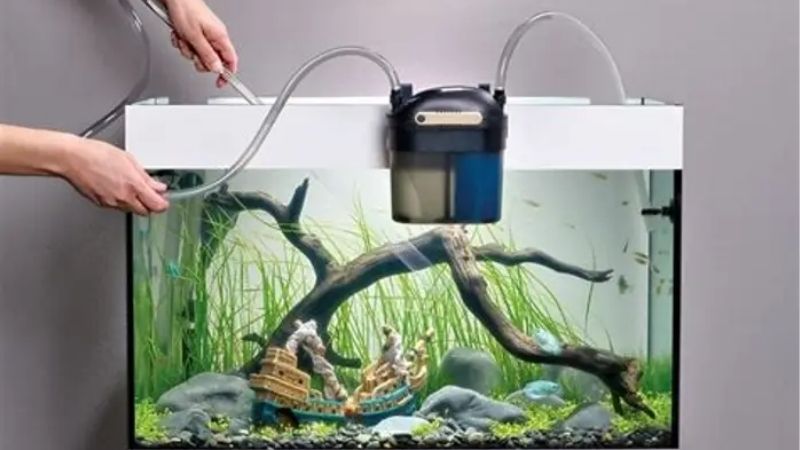
Height drop is what a gravity siphon runs on. The bucket has to sit meaningfully below the tank water line, and a siphon slows and stops as the two levels converge, which is why floor-standing tanks are awkward to drain by gravity.
That also caps how much can leave in one pass. A tank on a low stand may stop siphoning at 15% removed, so the change either happens in two stages or the water goes to a drain rather than into a bucket.
Priming method decides whether the tool is pleasant to use every week. A squeeze bulb or shake primer starts it in a few seconds, while a bare hose needs mouth siphoning or a pitcher of water, and neither belongs in a routine repeated for years.
Tank Size, Placement and Fit
Measure the distance from the tank to the drain and add 4-6 ft (1.2-1.8 m) of slack before ordering, since a hose stretched tight around furniture pulls the intake out of the water part way through a change.
Check the height relationship as well. A tank on a low stand with a bucket on the floor gives only a small drop, so the siphon runs slowly and stops early, which is usually the reason a change takes far longer than expected.
The Options by Tank Size and Layout
Four approaches cover essentially every tank. Each is matched below to a situation, because the best aquarium siphon depends on volume, on the distance to a drain and on whether gravity is available to you at all.
Self-Priming Gravity Siphon: The Default Up to 40 Gallons
Main numbers: a 0.5 in (13 mm) hose around 6 ft (1.8 m) long with a squeeze bulb or shake primer, moving roughly 2-3 gallons (7.6-11 L) a minute at a 3 ft (0.9 m) drop into a bucket.
It suits tanks from 10-40 gallons (38-151 L) where the change volume fits one or two buckets. It does not suit larger tanks, since carrying five or six loads is exactly the friction that causes weekly changes to be skipped.
Large-Bore Gravity Siphon: For Faster Draining
Main numbers: a 0.75-1 in (19-25 mm) hose, roughly doubling the flow of a half-inch line at the same height. Drains a 55 gallon (208 L) tank’s weekly change in a fraction of the time.
It suits tanks from 55 gallons (208 L) upward with a drain within hose reach. It does not suit small tanks, where the flow empties the tank faster than you can react, and the larger hose is stiffer and harder to store.
Tap-Driven Venturi Siphon: For Tanks Far From a Drain
Main numbers: a 25-50 ft (7.6-15 m) hose driven by a venturi fitting at the faucet, which both creates suction and refills afterwards. No height drop is needed and no buckets are carried at any point.
It suits tanks in a different room from the sink, and anything above 55 gallons (208 L). It does not suit low mains pressure or taps without a removable aerator, and it discards tap water to drain while generating suction.
Submersible Utility Pump: The Fastest Option
Main numbers: 300-800 GPH (1136-3028 LPH) pushed through a hose to a drain, working uphill and needing no height difference at all. A 20 gallon (76 L) change empties in two or three minutes.
It suits large tanks, basements and anywhere gravity does not help. It does not suit unattended use, since a pump left running empties far more than intended, and it needs somewhere safe to store a wet pump between changes.
| Option | Typical flow | Needs height drop | Priming | Best for |
|---|---|---|---|---|
| Self-priming gravity siphon | 2-3 gal/min (7.6-11 L) | Yes | Bulb or shake | 10-40 gallon tanks, bucket changes |
| Large-bore gravity siphon | 4-6 gal/min (15-23 L) | Yes | Bulb or shake | 55 gallons and up, drain in reach |
| Tap-driven venturi | Depends on mains pressure | No | Automatic at the tap | Tanks far from a sink |
| Submersible utility pump | 300-800 GPH (1136-3028 LPH) | No | Switch on | Large tanks, basements, speed |
| Bare hose, no primer | Same as bore allows | Yes | Mouth or pitcher | Emergency use only |
Head to Head, and When Not to Buy
Two approaches get compared constantly, and there is a case where the siphon itself is not the limiting factor at all. The best aquarium siphon is frequently the one already owned, used with the bucket in a better position.
Gravity Versus Pump
Gravity wins on cost, on having nothing to fail and on stopping by itself when levels equalise, which is a genuine safety feature. For tanks up to 40 gallons (151 L) it is entirely adequate and nothing is gained by upgrading.
A pump wins decisively above 75 gallons (284 L) or wherever the drain is above the tank. It loses on needing supervision, since nothing stops it, and on being one more piece of electrical equipment stored damp between uses.
When a New Siphon Is the Wrong Fix
A slow siphon is usually a height problem rather than a tool problem. Lowering the bucket, or standing it on the floor rather than a chair, restores flow immediately and costs nothing at all to try first.
A siphon that keeps breaking is usually air entering at the intake because the tube has drifted toward the surface. Weight it or hold it lower in the tank before assuming the tool itself has failed in some way.
The Cheaper Route That Works
A longer hose on an existing siphon is the cheapest meaningful upgrade, since it lets you reach a drain rather than a bucket. Hose is sold by the metre and costs a fraction of a complete new tool.
Two buckets rather than one halves the standing around on a mid-size tank. One fills while the other is emptied, which is a change of habit rather than a purchase and removes most of the tedium from the job.
Using It and the 12-Month Cost
The best aquarium siphon is simple, cheap and used every week, which makes its failure modes dull but persistent. This section covers technique, what wears out and the hygiene points around anything carrying tank water through the house.
Technique That Makes It Faster
Start the siphon before positioning it, then place the intake where the water should actually come from. Fighting a running siphon into position wastes the height advantage and is the usual reason a water change starts badly.
Mark the hose at your usual change volume, or use a marked bucket. Guessing at 25% of a tank leads to changes that drift smaller over months, which shows up as nitrate climbing on an otherwise unchanged routine.
Keep the intake off the substrate unless a gravel head is fitted. A bare hose pushed into gravel lifts substrate into the bucket, and it also blocks repeatedly, which is the usual reason a change stalls part way through.
What Wears Out
Hoses stiffen and crack at the ends where they flex most, usually within two or three years. Cutting an inch from the perished end restores the seal, which is worth trying before replacing anything.
Squeeze bulbs and one-way valves are the parts that fail on self-priming models, and they are rarely sold separately. Plain siphons have nothing to fail, which is a real argument for simplicity in a weekly tool.
Hygiene, Storage and Timing
Keep the siphon and bucket for aquarium use only, and never wash either with soap, since residue rinses out poorly and carries into the tank. Label the bucket, since an unmarked one gets borrowed for cleaning.
Drain and hang the hose after use rather than coiling it wet, because standing water grows biofilm within days. On timing, maintenance tools discount most deeply in late June and late November, and prices move constantly.
Best Aquarium Siphon Questions
These arrive when a weekly change starts taking longer than it should. Every answer about the best aquarium siphon stays with flow, height and priming, since those three explain nearly every complaint about the job.
Why does my siphon keep stopping?
Almost always because the bucket has filled to near the tank water line, removing the height difference that drives it. Lower the bucket, empty it sooner, or move to a hose that reaches a drain instead.
How fast should a water change be?
A 25% change on a 40 gallon (151 L) tank should take four or five minutes to drain with a half-inch hose. Considerably longer than that points at height, hose bore or a partially blocked intake.
Is a pump safe to use in the tank?
Yes, provided it is aquarium-safe, has never been used with detergents and sits on a GFCI outlet with a drip loop. Never leave it running unattended, since nothing stops it when the intended volume has left.
Can I refill through the same hose?
With a tap-driven system, yes, that is how it is designed. With a bucket siphon, refill separately with treated water matched to within 1-2 °F (about 1 °C), pouring onto a plate or your hand to avoid disturbing substrate.
See More:
Conclusion
The best aquarium siphon for tanks up to 40 gallons (151 L) is a self-priming gravity model on a 0.5 in (13 mm) hose, moving 2-3 gallons (7.6-11 L) a minute at a 3 ft (0.9 m) drop into a bucket.
Above 55 gallons (208 L), move to a larger bore, a tap-driven system where the drain is distant, or a submersible pump where gravity does not help. Buy enough hose to reach a drain, and never leave a pump running unattended.

Aquarium Water Conditioners: Comparison and Buying Guide (2026)
8 Best Aquarium Pumps for Water Changes (Portable & Powerful)